Author: Sheila Marler

  • The Law of the Baseline: Single-Minded Wisdom and the Free Gift

    Reading Time: 7 minutes

    James 1:5-8 as translated by James B. Adamson, p. 55:

    But if any of you is lacking knowledge (of God’s way and will), let him ask of God, who gives it to all as a simple (unconditional) gift and chides not (the petitioner for previous ignorance).

    But let him ask in faith, with no halting between two opinions: for the man who halts between two opinions is like a sea of waves, the way it is blown and beaten under the winds. 

    Let not that (sort of) man imagine that he will get anything from the Lord.

    A man who is of two minds is unsteady in all his ways.

    Verse 5: The Problem of Knowledge

    Adamson begins this section with a reference to Genesis 2: 17 and 3: 22, which he says may have a doubtful meaning. Below are the two verses in question taken from the Catholic Bible NABRE:

    Gen. 2:17

    [The Lord God gave the man this order: You are free to eat from any of the trees of the garden] except the tree of knowledge of good and evil. From that tree you shall not eat; when you eat from it you shall die.

    Gen. 3:22

    Then the Lord God said: See! The man has become like one of us, knowing good and evil! Now what if he also reaches out his hand to take fruit from the tree of life, and eats of it and lives forever?

    What is Clear in These Verses: Knowledge is an Attribute of Yahweh and He Monopolizes It

    Adamson argues that one thing is clear regardless of whatever doubts one might have. In the early Hebrew cult of Yahweh knowledge is an attribute that is jealously monopolized by the divinity. The later Hebrew religion, however, is similar to Christian faith in the bond of wisdom between God and his believers. An old commentary on Psalms 99:4 says that sometimes Wisdom means Law (Midr. Ps. on 99:4). The rabbis taught that this Wisdom/Law was needed to defeat the Evil Spirit in man. They also taught that it is a gift that can’t be bought by man; its source is God and it is freely given.

    The Later Hebrew Religion to Christian Faith

    Adamson tells us that in all Christian temptation wisdom is to be had ‘just for the asking’. Then, in the next paragraph he demonstrates that there are no suitable adverbs to describe the mind of such a giver. He gives a few examples of adverbs that are not quite adequate: kind; generous; wholehearted. James uses an adverb meaning ‘simply’. This word is often used in Greek to contrast with another Greek word meaning complex variety in nature or art (Please see the Greek words in the notes, p. 56). The King James Version uses ‘liberally’, but Adamson thinks ‘liberally’ is too much like ‘profusely’. In his opinion, ‘freely’ has the fewest and least defects.

    God gives his wisdom to men not only just for the asking but also without chiding a man for his previous sins. Apparently, James had in mind the tendency of humans to remind others of any favors they might have done for them. Adamson cites Bunyan: “It appeareth that He (Christ) is free, because he giveth without twitting.” Twitting, according to Adamson means ‘rebuking’ or ‘taunting’.

    A Typical Hebrew Prayer for Wisdom in Righteousness

    Adamson concludes that James 1:5 has the characteristic Jewish faith in God as its source. He compares Psalms 19:12 as an illustration of a typical Hebrew prayer for wisdom in righteousness. The psalmist has praised the law of the Lord in 7-11. Then in Psalms 7:12 he proceeds to ask pardon for any offenses he may have committed against that law, unconsciously or knowingly.

    Who can be aware each time he offends? O cleanse thou me of my unconscious sins.

    Verse 6: Faith

    Luther called verse 6 one of the best verses of the Epistle. James teaches faith is the essential condition of prayer. The best light on this verse is Hebrews 11:6 according to Adamson:

    Anyone who comes to God must believe that he exists and that he rewards those who search for him.

    Faith in What?

    In James 1:6, ‘faith’ does not refer to faith in the Christian religion. It means confidence in prayer. It means the petitioner’s belief and trust that God will hear his prayer and grant it. And if it is denied, this denial will be according to God’s superior wisdom. Jesus prayed with this faith in Matthew 26:39 and in Mark and Luke. Therefore, this teaching of James is identical with that of Jesus. Adamson quotes C. L. Mitton((The Epistle of James (1966).)):

    Here and in the Synoptic Gospels it means primarily the simple act of coming to Jesus with some need in complete confidence that He can and will deal with it. It was this attitude of faith that seemed to release powers in Jesus that made all things possible. Often when Jesus had healed an ailing man or woman, his explanation of the healing was: ‘Thy faith hath saved thee’ (p. 30).

    Adamson adds that these links of faith reveal the relation of God and men as partners in human life.

    Doubt

    The doubter is incapable of making a choice between the alternatives before him, whether or not to believe that God will grant his prayer (Please see the Greek words in the notes, p. 58). He probably believes in God but is not confident that he will get what he wants.

    The rendering ‘uncertainty and indecision’ is an unprecedented New Testament meaning. It seems to have developed from the verb meaning in the present, “I am making up my mind between two alternatives.” Adamson compares this to the classical use, akin also to the idea of self-debate contained in the middle. Some have disputed the translation, but the meaning is not disputed.

    The Analogy Between Doubt and a Sea of Waves

    the crucible of patience
    Doubt: A Sea of Waves

    This verse contains a marine analogy, ‘like a sea of waves, the way it is blown and beaten under the winds’. The translation is simple for the most part, although Adamson provides a long paragraph about possible allusions on pages 58-59. We get the sense of the doubter inclining toward one alternative (say, to believe in prayer) and then toward the opposite alternative. He is never able to settle upon either one so he is in constant agitation without making any progress to a result. Adamson likens him to the Lake of Galilee, a sea of waves. Although readers of this verse might know there could be a storm on the Lake, they assume the winds and their effects on the waters are no more than normal. Waves on the Mediterranean however might be driven by a tempestuous wind. For this see Acts 27:4, 7, 9 and 14.

    The Mediterranean Sea

    What is necessary is a real, vigorous wind, not any slight rufflement: it can come in a tempest, as in that which wrecked Odysseus’ ship– “the surge loosed the sides from the keel”. But Adamson thinks what James has in mind is the more normal, but quite vigorous action of the winds exemplified in Thucydides ii.84, in the naval battle off Naupactus.

    The point of comparison in James is the unsettled behavior of the waves to and fro, like the doubter’s mind. It’s as if the winds drive them in one direction today and perhaps in another direction tomorrow.

    Verse 7

    For his commentary on verse 7, Adamson refers the reader to Excursus B (pp. 92ff.) which begins on page 90.

    Verse 8: The Divided Mind

    The adjective ‘of divided mind’ (see the Greek in the notes p. 59) is only found here and at 4:8. Adamson goes into some depth on the idea of the divided mind. He says this concept is not in LXX (the Septuagint) or in Greek literature before James, but it soon became current in post-apostolic writings:

    In the Church Fathers

    [It was] especially found in Hermas, sometimes linked with “prayer” and “simplicity” (40 times), Clement of Rome, Epistle of Barnabas, Didache, and the Apostolic Constitutions. We are aware of scholars who have judged that the Epistle of James has neither structure nor pedigree, but if James was the author of this Epistle, it is not surprising but rather inevitabe that the occurrence (and perhaps invention) of this word here set Clement (c. A.D. 96) and the others to using it profusely: Lightfoot, Westcott, and Zahn, among others, believed that Cement knew and used the Epistle of James. The hypothesis that James here is quoting from a lost book like Eldad and Modad appears unnecessary. (Adamson p. 60)

    What Does it Mean?

    Divided mind literally means of two minds. Here and in 4:8 the point is doubt, not duplicity. In James the word describes a mind distracted by lusts and temptations. This idea is from John Bunyan’s “Mr. Facing-Both-Ways.” It was epitomized in real life by Augustine’s prayer: “O Lord, grant me purity, but not yet.”((Confessions vii. 17.)). Kierkegaard saw that doubt and indecision can degenerate into despair:

    Is not despair simply double-mindedness? For what is despairing other than to have two wills? For whether the weakling despairs over not being able to wrench himself away from the bad, or whether the brazen one despairs over not being able to tear himself completely away from the good: they are both double-minded, they both have two wills.((S. Kierkegaard, Purity of Heart Is To Will One Thing (E. T. 1938), p. 61.))

    The Greeks

    The idea of a man divided in doubt or hesitation is common enough in Greek. Homer says Achilles’ heart within his breast “was divided in counsel” (as quoted by Adamson, p. 60).

    The Old Testament

    The Old Testament notion of the double heart, is literally ‘with heart and heart’. Adamson says this is the root of Jame’s locution (see Ps. 12:2; 1 Chr. 12:23; Sir. (Ecclesiastes) 2:12-14). This is close to the rabbinic doctrine of man’s spirit as originally pure and so to be returned to God. It is similar also to the doctrine of the two Yetsers, good and bad, though essentially one, seated in the heart. He gives the example of prayer being offered with a divided heart, part for God and part for the world.

    The Essenes

    There is recent evidence from Qumran of a similar type of dualism. For example, “Relationship of the Shepherd of Hermas to the Epistle of James.” See notes, p. 61 for more sources.


    The caves at Qumran


  • The Scholastic Examination: Approbation and the Two-Fold Law of Testing

    Reading Time: 4 minutes

    It is necessary to discuss some terms before we begin Adamson’s commentary on James 1:3-4. As in any scholastic examination, the terms matter. In this article James B. Adamson discusses the importance of approbation and the two-fold law of testing.

    Approbation

    Approbation is a formal noun meaning approval or praise. Adamson compares approbation in Christianity to a scholastic examination course. It requires endurance under trial and temptation.

    Peirasmos

    According to an online source: “The matter of significance about peirazo (the verb form) is that it is used in both a good sense and a bad sense. It can have the idea of testing with the purpose of bringing out that which is good, or it can have the idea of testing with the purpose of bringing out that which is bad.”

    Translations By Adamson and the Catholic Bible

    Peirasmos doesn’t actually appear in Adamson’s translation of James 1:3-4, at least not in that form. This is Adamson’s translation:

    You must realize that your approbation is accomplished by constancy in endurance. But let that constancy perfect its work, so that you may be perfect, and complete in everything part, lacking in nothing (but able to withstand any kind of assault of evil by which you may be tried. (James 1:3-4)

    Nor does the word peirasmos appear in the Catholic Bible’s translation.

    For you know that the testing of your faith produces perseverance. And let perseverance be perfect and complete, lacking in nothing.

    So, why bring the word up? In both translations ‘peirasmos’ is present in a different form. According to the website cited above, the same Greek word is used for ‘trial’ and ‘tempted’. In the translations of Adamson and the Catholic Bible, ‘assault’ and ‘testing’ are used in the place of peirasmos. Adamson’s next statement makes sense in that light.

    The Probationary Function of Peirasmos

    Experience itself shows the probationary function of peirasmos: the wind of tribulation blows away the chaff of error, hypocrisy, and doubt, leaving that which survives the test, viz., the genuine element of true character (Adamson p. 54).

    Adamson argues that Judaism has a similar understanding of peirasmos. Both Judaism and Christianity regard peirasmos as training and testing the seeker after righteousness in his battles with adversity and with his own evil inclinations.

    The Yetser Ha-Ra

    Judaism speaks specifically of the internal testing by the yetser ha-ra. This is the name for the willful animal impulses that are indispensable to the survival of the human species. The main Jewish idea emphasized here by Adamson is that God purifies the righteous each one according to his rank and his deeds. He cites b. Pes. 118a. I didn’t find this source in the bibliography, but I believe he is referring to Pesachim 118a.

    Rav Ḥisda said: What is the meaning of that which is written: “Give thanks to the Lord for He is good” (Psalms 136:1)? It means give thanks to the Lord who exacts one’s debt, the punishment for a person’s sins and wickedness, in accordance with the goodness of each individual. God punishes each person based on his means. He punishes a wealthy person by taking his ox, and He punishes a poor person by means of his sheep. He punishes the orphan by taking away his egg, and He punishes the widow by means of her chicken. God punishes each person based on his ability to endure deprivation, and He does not punish people with more than they can handle.

    Adamson says the concept of the evil inclination is important in James’s doctrine of peirasmos. James describes its activity in 1:13 as well as the verse under discussion, James 1:2.

    No one experiencing temptation should say, ‘I am being tempted by God’, for God is not subject to temptation to evil, and he himself tempts no one. (James 1:13)

    Did Temptation Have This Double Meaning in the First Century?

    Some have questioned if ‘temptation’ had this meaning in the first century. But because James used ‘peirasmos’ it’s generally agreed that it did.

    Adamson’s ‘Constancy in Endurance’

    Before I end this article, I have to mention a possible source of confusion in this section of Adamson’s commentary. It’s his discussion of ‘endurance’ and ‘perfection’ on page 55. He explains that in verse 3 he used the phrase ‘constancy in endurance’ instead of ‘endurance’.

    In the usual text “endurance” is the result achieved; in our emended text, in endurance, it is the means and method by which we strive for (and, we hope, win) approbation.

    He believes Christian constancy is ‘that permanent and underlying active trait of the soul from which endurance springs’. It means ‘steadfastness’, or ‘staying power’, and not patience. Here he cites Romans 5:3:

    Not only that, but we even boast of our afflictions, knowing that affliction produces endurance…

    And 2 Peter 1:6:

    …knowledge with self-control, self-control with endurance, endurance with devotion…

    Adamson argues that in Romans 5:4 the present tense of ‘works’ signifies progress, not completion. So, it is not a question of more of our fruits which will give completeness of Christian character but of continued striving by God’s grace to see that our endurance be unremittingly carried on till our death. Therefore, ‘Perfect’ and ‘complete’ and ‘lacking in nothing’ have a different meaning than we normally give them. In his view, they are the essence of the doctrine.

    A Request for Correction or Clarification

    Sadly, I missed some of Adamson’s tonal qualities when I read this the first time. At the moment I’m surprised that these simple verses sound so demanding and joyless and that it isn’t apparent until one tries to share them. The most relevant concern that comes to mind is that perhaps some won’t be able to apply them to our present conversation.

    On the other hand, my concern might say something about our secular times. I appreciated the commentary when I read it myself, but I lose confidence in it when I share it. In one sense, to be concerned about strenuous admonitions ignores the fact that we witness demanding and joyless policies and practices every day with no accompanying encouragement. Life is not a trivial thing even in the best of times.

    The Concluding Paragraph of This Section

    The Scholastic Examination: Approbation and the Two-Fold Law of Testing
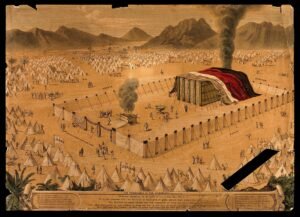
    Ancient Tent Camp

    Perfection, at first conceived in terms of OT cultic requirements (e.g., Exod. 12:5), later came to mean completeness in wholehearted dedication to Israel (Deut. 18:13), as in Noah and others (e.g., Gen. 6:9); here James continues the OT idea of perfection as a right relationship to God expressed in undivided obedience and unblemished life. Balance pervades the Epistle of James: here–characteristically–James has sounded the prelude (1:3) to the theme to be developed in 1:16-21.

  • The Crucible of Patience: Peirasmos and the Defiance of Joy

    Reading Time: 4 minutes

    James’s Capacity for Joy Even in the Trials of Life

    It is fitting to call this verse the crucible of patience. But joy is an important part of it. In Adamson’s view, when James exhorts his audience to see joy even in the trials of life, he is in tune with the capacity for joy found in Greek art and literature. This article will explain the meaning of peirasmos and the defiance of joy in the Christian context.

    Adamson argues that James writes and thinks in Greek better than any other New Testament author. Perhaps that’s why he objects to the inclusion of the ne nos inducas (“Lead us not…”) in the Lord’s prayer. He believed this had a different spirit than the opening words of James. 

    Deem it nothing but an occasion for joy, my brothers, whenever (on each occasion when) you encounter trying assaults of evil in their various forms. (James 1:2)

    Sympathy for the Poor

    In Adamson’s opinion, no New Testament author expresses more sympathy for the poor or more indignation at their sufferings. But it was the joy James saw in their sufferings that makes him stand out among the Christians of that period. 

    Mastery of the Greek Language

    Adamson continues his praise for James arguing that James is close to the Greeks in his mastery of their language. He thinks this puts him in the company of ‘the unidentified author of the Epistle to the Hebrews’ or, for that matter, in the company of Aeschylus.

    This is Agamemnon, my
    Lord husband, slain, the deed of this right hand
    Fulfilling justice; thus this matter stands.
    (Aeschylus Agamemnon 1403-1405, as translated by Adamson)

    Peirasmos

    According to Adamson, the dominant ideas of the Epistle are the duty and the reward of endurance under peirasmos, a ‘certain and not distant victory’. The words and example of Jesus inspire this approach. He cites Luke 6:22.

    Peirasmos roughly means temptation or temptations. (The KJV translation, Strong’s translation, and an outline of Biblical usage can be seen here.)

    The Concept of Christian Joy

    In the following paragraph, Adamson discusses the concept of joy. Christian joy is a kind of activity. He compares it to Aristotle’s notion of happiness. However, the word ‘happiness’ falls short of Aristotle’s thought in Greek, and ‘joy’ in English falls short of the Christian’s thought.

    Christian joy is a man’s pleasure in his (and his brothers’) progress toward Christian salvation; and it is not undiluted pleasure. Judaism also ‘baptized moral joy into religion’ (Adamson p. 53).

    Adamson cites the rabbis (b. San. 101a and Exod R. i.1); and R. Joshua B. Levi (Ta’an. 8a), who declared that ‘He who gladly accepts the sufferings of this world brings salvation to the world’.

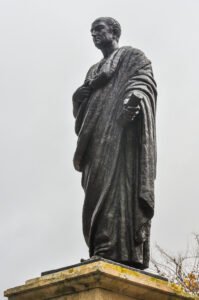
    Pagan philosophy understood this concept in much the same way: ‘True joy is an exacting business’ (the Stoic Seneca, p. 53).

    The Crucible of Patience: Peirasmos and the Defiance of Joy
    Lucio Anneo Seneca

    Internal and External Temptations

    Some commentators have argued that James distinguishes between internal and external temptations. But Adamson tells us that in the Christian life, there is no effective difference. Both external and internal stimuli can goad a man into sin. This is due to the defects inherent in human nature.

    When it comes to sexual lust, for example, the temptation of straying thought is no less real or potent than a provocative woman. (Adamson’s term was ‘ provocative temptress’. I am aware of the importance of words and meanings when it comes to Bible verses and commentary, so I’m making you aware of this change. I changed it because I believe Adamson’s commentary on the Epistle of James is worthwhile and I prefer not to lose readers in the first chapter. This particular word choice is not representative of Adamson’s work.)

    The Greek Version Regarding Internal and External Temptations

    I’m afraid I don’t understand Adamson’s point here well enough to summarize the rest of the paragraph. It was obviously important to him because he provided his argument in careful detail so, I’ve included the direct quote. Don’t be discouraged. Most of the book is enjoyable to read.

    In the Greek of this verse, the picturesque adjective ‘various’, or ‘varied’, (Ī€ÎŋΚÎēίÎģÎŋĪ‚) is in an emphatic position; and it would not have been wasted here by a master of the language on a tepid armchair dichotomy to signify or emphasize such difference as may exist between ‘external’ and ‘internal’ temptations. There are no otiose adjectives in James’s style; in 1:2 (against Ropes, one of the sources listed in his bibliography) ‘varied’, as the order shows to the discerning, is as emphatic as the noun ‘endurance’ in the next verse and the adjectives and participial phrase in v. 4, and the noun’ wisdom’ and the adverb ‘simply’ in v. 5. If James had wanted to use peirasmos in a selective sense he would scarcely have given it the expansive and emphatic ‘varied’ in hyperbaton without any indication that the sense of the noun was restricted. It is only in a clear context that peirasmoi has the narrower meaning. The Greek verb, encounter, note #18 on page 54, is apt for both kinds of temptation (Hort, against Mayor). Like the Latin incido it can have a deliberate meaning, as in a memorable passage in Xenophon, but it often indicates an unplanned and frequently, as here, an undesired incident. Much of the strength of temptation lies in our never knowing what it is going to do next.


  • The Diaspora Remnant: The Scattered Twelve Tribes and the Un-Enclosed Frontier

    The Diaspora Remnant: The Scattered Twelve Tribes and the Un-Enclosed Frontier

    Reading Time: 4 minutes

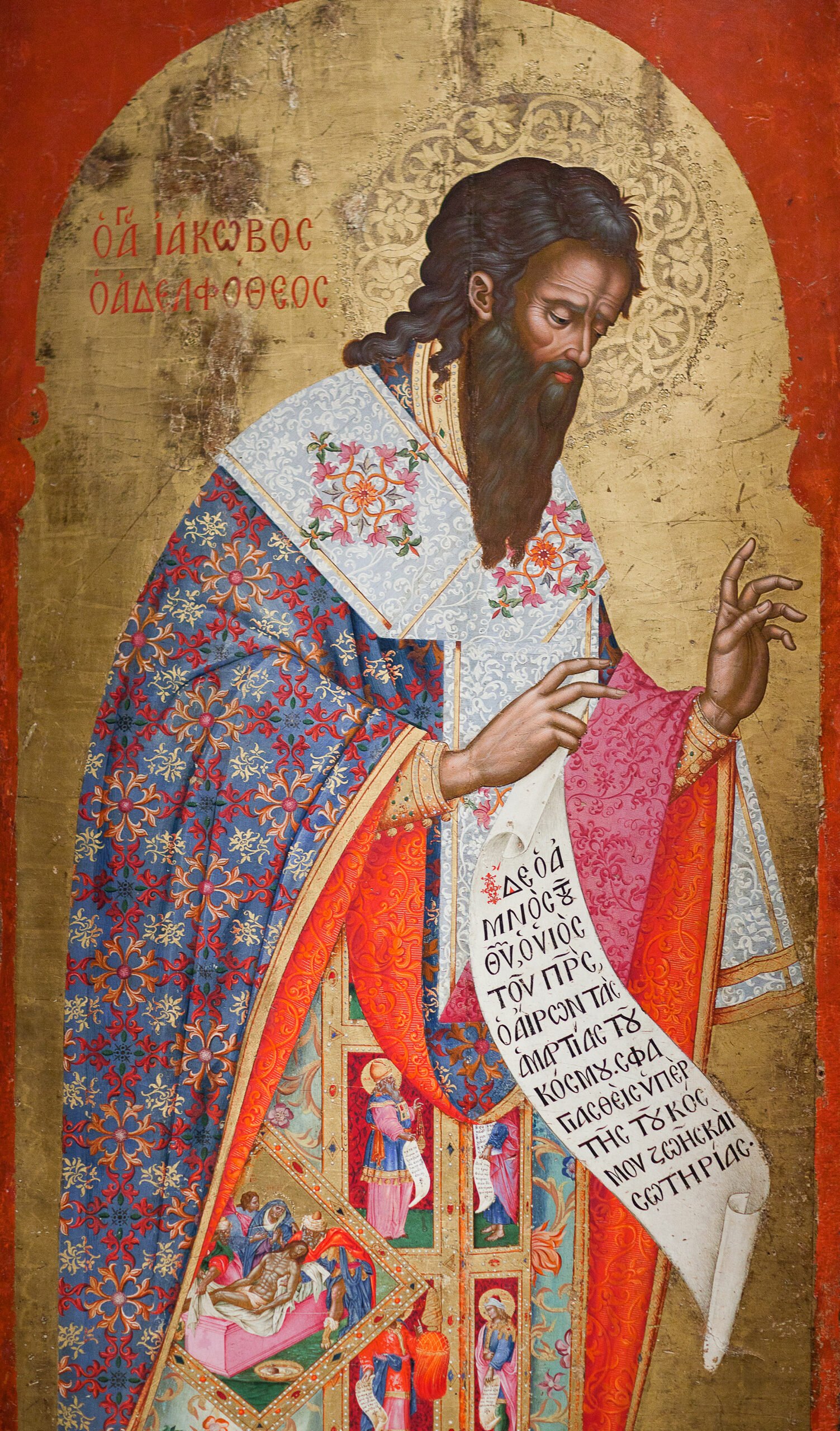
    James, the Brother of Jesus

    James B. Adamson begins his commentary with the assumption that James is the brother of Jesus. He argues this point in detail in his introduction. I have chosen not to include that detail because I prefer to start right away with the text of the Epistle and Adamson’s related commentary. However, if anyone is interested in the arguments presented in the introduction, please let me know and I will write about them. Alternatively, readers can order the commentary.

    James, a bond slave of God and the Lord Jesus Christ, to the Twelve Tribes of  the Dispersion, salutation. (James 1:1)

    The Prologue to the Diaspora

    Considering the Term ‘The Twelve Tribes of the Dispersion

    Adamson begins by highlighting meaning of the term ‘the twelve tribes of the dispersion’ as it would have been used by ‘James the Lord’s brother’. He argues that this term could not refer figuratively to the whole multiracial Christian Church because the Epistle reflects the earliest stage of the teaching of the gospel. That would imply the most Jewish milieu. Therefore, it seems clear that James was not addressing Christianity’s ‘spiritual catholicity’. His theology and eschatology is that of a Jew who, like Jesus, focused on his own people.

    To continue the argument, if James was implying a new spiritual meaning for the twelve tribes, he would not have added ‘of the Dispersion’, which gives it the historical application. ‘Of the Dispersion’ implies ‘the ancient, restricted, physical and national privileges of the Jews under the Covenant. Nor did James refer only to non-Palestinian Jewish Christians. The rabbis believed the Palestinian Jews represented all the twelve tribes of Israel.

    The Bond Slave of God and Jesus

    As far as I can tell, this identification of James as Jesus’s brother is not a controversial position even though Adamson’s approach is unique. That said, it seems to me that it has at least one controversial implication as Adamson explains below. It has to do with James identifying himself as the bond slave of God and Jesus. Adamson argues that James uses this term in a spirit of loyalty and devoted service to both God and Jesus. He explains that Paul also uses this term in an opening, in his Epistle to Titus. The concept is Hebrew (‘ebed) rather than Greek.

    It is used in loyalty and respect toward prophets and rabbis, e.g. Gamaliel, Johanan b. Zakkai, and here toward God and our Lord Jesus Christ, as in the (non-Pauline) Epistle to the Hebrews…

    Since proverbially no man can be the servant of two masters, it may be that James, in order to obviate any possible offense to the cherished monotheism of orthodox Jewry, is here emphasizing that service to Christ is also service to God, since they are both One (John 5:17; 9:4; 17:4), but we doubt whether such subtlety in the opening is truly in keeping with the character of this Epistle.

    We hold that James, the Lord’s brother, is here writing as a Jew–not ‘a Jewish Christian’…, but a Christian Jew–to Jews, and that he was writing with full hope that the Jews as a whole would turn to Christ… (Adamson, pp. 50, 51)

    Adamson looks ahead in the Epistle to the verses in which James will preach both aspects of the Christian religion, faith and works. He tells us that James will stress both aspects to the Jews as descendants and heirs of Abraham. However James is not teaching the same concept as Paul in Gal. 3:7:

    Realize then that it is those who have faith who are children of Abraham.

    Paul is concentrating on one aspect of Christian duty and the same aspect of God’s Fatherhood, the spiritual aspect. In this sense, Abraham’s fatherhood of the Jews is only symbolic. In James, however, prominence is given to God without prejudice to Christ. James understands that Jesus did not come to supplant but to supplement the Father. He did not come to supersede God’s Old Testament lessons to the Jews, but to reinforce them and extend them to the Gentiles.

    To James, therefore, Christianity is not a new religion but the consummation of the old; and we shall never see Old Testament and New Testament as an intrinsic unity unless we grasp this fundamental truth enshrined in our Epistle.

    In some verses, Prominence is Given to ‘God‘

    Adamson lists the following verses in which James gives prominence to God without prejudice to Christ: 1:1, 5-8, 12-15, 16-21, 26, 27.

    In Others, James Gives Prominence to Christ

    Christ is the focus in 2:1:

    Do not try to combine faith in the Lord Jesus Christ, our Glory, 
    with worship of men's social status.

    And Finally, James Speaks of God

    James speaks of God again in 2:19-25; 5:1-6 (esp. v. 5), in the prophetic tone of the whole passage 5:7-8, 9-11, 14-15, and in the example of Elijah in 5:16-18.

    Adamson’s View of Who James Was Addressing

    In the view of Adamson, James addresses his Epistle both to Christian and non-Christian Jews, outside and within Palestine:

    see Paul’s practice in Acts 17:1-4 (esp. v. 2, ‘as his manner was’); also Gamaliel’s attitude (Acts 5:34-40). To Christian Jews Jesus is peculiarly the fulfillment of their eternal hope of ultimate restoration from the Dispersion (see 2 Esdras 13:40; Tobit 13:3-5, 15-18; Rev. 21:10-17 and Rev. 18-21. On that note James opens his Epistle, the note of suffering but hopeful brotherhood.

    The Word Salutation

    According to Adamson, the word salutation is the usual greeting with which Greek letters of all periods opened. (He cites Acts 15:23 and 23:26.) In Hebrew (and ancient Syriac and modern Arabic) the regular greeting is “Peace!” In Latin it is “Health!” (Salve or Salvete, in Letters Salutem, i.e., salutem dicit). In Greek it is “Joy be to you.” 

  • The Sincere Sovereign: Why James B. Adamson’s Commentary Explodes the Corporate Narrative

    The Sincere Sovereign: Why James B. Adamson’s Commentary Explodes the Corporate Narrative

    Reading Time: 3 minutes

    This first article in the series will introduce James B. Adamson and explain why the sincere sovereign is a fitting description; his commentary explodes the corporate narrative. At the time of publication, James B. Adamson, M.A., Ph.D. was a Presbyterian minister in Santa Rosa, CA.

    The Sayings of Jesus, the Tradition of Elijah and Moses, and the Style of the Psalms and the Prophets

    James B. Adamson was convinced that James was a master writer whose knowledge and choice of Greek bestow on his epistle a sustained unity of style and content that bears a close affinity with the Synoptic Gospels and the sayings of Jesus. The substance and authoritative tone of this epistle follow in the tradition of Elijah and Moses, and the style and diction resemble some of the outstanding qualities of the Psalms and the prophets. (W. Ward Gasque, Eastern College)

    Adamson’s view of James was unique among scholars at the time he was writing this commentary. However, there is general agreement with his view that James was committed to Jewish Christianity. His epistle has been called ‘the Amos of the new Covenant’.

    The Prophet Amos

    Adamson Wanted to Address an Error Made by Luther and Subsequent Commentaries

    Adamson wrote in his preface that one of his most important aims was to combat what he considered a fatal error made by Luther. And unfortunately, subsequent commentaries repeated this error. These sources argue that James’s epistle lacks cohesion of thought or design. Adamson disagrees and uses the structure of the epistle to identify its date and authorship. For example, he argues that James 5: 1-8 has a strong Old Testament and Jewish element. This is especially evident in the verb ‘howl,’ in 5:1. This verb occurs here alone in the New Testament, and in a passage of prophetic character, Isaiah 34:1.

    Come now, you rich, weep and howl over your coming miseries. Your wealth has rotted, your clothes are moth-eaten: Your gold and silver is corroded, and the corrosion shall be for evidence against you, and shall devour your flesh like fire; you have laid up treasure in days that are coming to an end. See, the wages of the workers that have mowed your fields, which you have withheld from them, cry aloud; and the outcry of the reapers has reached the ears of the Lord of Hosts. You have lived on the earth in luxury and wantonness; you have fattened your hearts for the slaughtering day. You have condemned and murdered the just man; he does not resist you.

    Hold out then, brothers, in patience till the coming of the Lord. See the farmer waits for the precious fruit of the earth, with persevering patience over it, until it shall have had the winder and spring rains; You too must persevere with patience, and fortify your hearts; for the coming of the Lord is near.


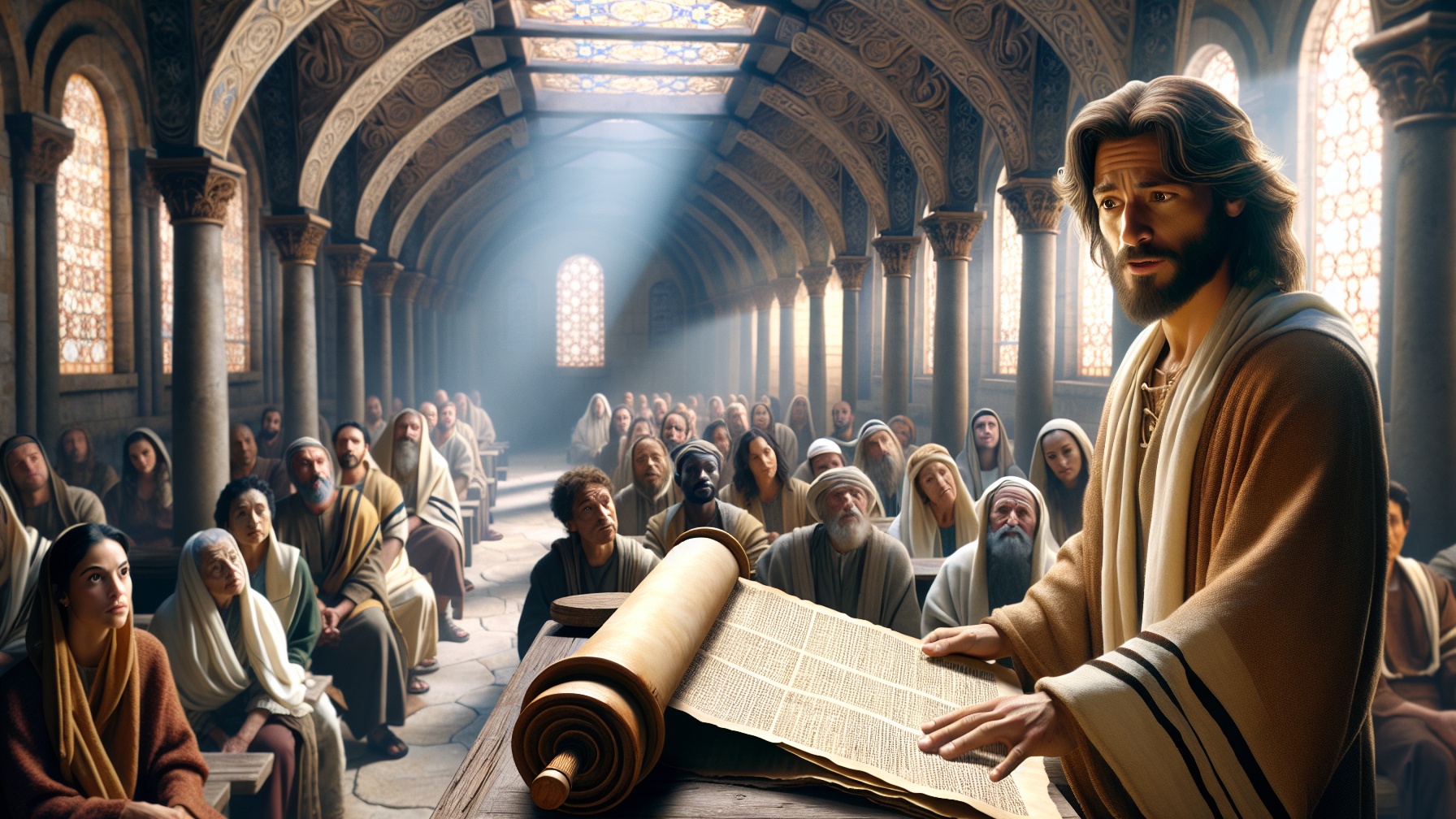
    Jesus Reading the the Synogogue

    James thus takes us back to the techniques of the Old Testament and the synagogue, comforting the afflicted in the Hebrew manner with a prediction of the fall of their enemies and oppressors, in the same way as, for example, the comprehensive curse of Isa. 34 upon the evil is immediately followed by the next chapter’s sublime comfort for their victims (Adamson, p. 12).

  • The Epistle of James Chapter 3

    Reading Time: 4 minutes

    In the Epistle of James, Chapter 3, James continues his teachings on wisdom. The first half of the Epistle instructs the Christian on the duty to guard his tongue. Adamson refers to James 1:26 for example.

    If anyone thinks he is religious and does not bridle his tongue but deceives his heart, his religion is vain. (Bible quotations are taken from the Catholic Bible NABRE unless otherwise stated).

    James B. Adamson tells us that this is not just a lament over the constant weakness of man. He warns Christians that becoming a teacher carries an ominous responsibility.

    Seek not many of you to be rabbis, my brothers, knowing that we shall be adjudged more severe punishment (James 3:1, Translation by Adamson, p. 139).

    In verses 5-12, James deliberately builds up to the condemnation of contentious heresy found in 3:14-16. Adamson’s emphasis is on verse 15:

    This wisdom is not one descending from above, but is of the earth, of this life, of the devil.

    The Importance and Responsibility of Wisdom

    James is focused on wisdom in Chapter 3. At this time, the Christianity of the converts is itself being threatened by the teachers’ failure to guard their tongues. However, his caution to sincere Christians is sympathetic. He warns them about the higher standards expected of the leaders in wisdom and therefore, the greater risks involved for teachers. In speech, it is even harder than in bodily action to avoid the sin of error, willful or involuntarily.

    The following is Adamson’s translation of 3:2-12:

    For we are all guilty of many sins. Only if such a man there be as never sins in what he says, only there would be a perfect man, able as with a bridle to control his whole body also.

    See, we put bits in horses' mouths to make them obey us, and so we are able to turn their whole body this way and that.

    See also how ships, so great as they are, and driven by fierce winds, are turned this way and that by a very small rudder in whatever direction the steersman's desire may choose.

    So too the tongue is a little member of the body vaunting great powers. See how much brushwood a little fire sets alight?

    The tongue also is fire; the sinful world (is) wood. Thus the tongue stands among our members, defiling the whole body and setting fire to the circling course of creation, and being set on fire by hell.

    For every genus of beasts and birds, reptiles and sea creatures, is subdued and stands subdued to mankind.

    But the tongue no man can subdue; it is an evil irreducible to order, full of deadly venom.

    With it we bless our God and Father, and with it we curse men who have been created in the likeness of God.

    Out of the same mouth come forth blessings and cursing: it is wrong, my brothers, that this be so.

    Does a fountain from the same outlet spout forth both sweet and bitter?

    Can a fig tree, my brothers, produce olives, or a vine figs? So no fountain can produce salt water and fresh.

    James is Thinking First and Always of Sincerity

    So, James warns sincere Christians that they should hesitate before taking on the responsibility, risk and punishment associated with becoming teachers. Adamson notes the words used in 3:8. ‘Unstable’ and ‘doubeminded’ occur together in 1:8; ‘Unstable’ or ‘treacherous’ occur in 3:8; and ‘doubleminded’ (plural) in 4:8.

    The Unity of Chapters 3 and 4

    “Chapters 3 and 4 both develop the thought of 1:5-8, the sincere seeking for God (literally, god’s wisdom). He starts, as in 2:1 where he deals with sincere faith, with a preliminary warning which is developed on somewhat divergent lines, for he deals with one aspect only of the matter. The tongue is represented as the acme of insincerity, a lie against that consistency and constancy of nature which should sound in the nature of everything that is uninfected (as, alas, “the world in iniquity” and unregenerate man, including the tongue, are infected) with sin.

    [These two chapters]”… form almost a unity. It is one mark of James’s style, as of much other oratory, to round off a paragraph by coming in full circle to the point with which it began: 3:13-18 is an obvious example, beginning and ending with the duty of good works in meekness and peace as part of true wisdom. So here James begins Chapter 3 and ends Chapter 4 of these two allied chapters with the same warning, namely, the responsibilities of advancement in knowledge (3:1 and 4:17).

    “James 3:1, 2, is an application of 1:19, “slow to speak”, 3:13-18, of the same verse, “slow to wrath”; and 3:3-12 is related to 1:26 on the duty of bridling the tongue. 3:13, 15, 16, indicate the special application to teachers of the directions against wrath (in 1:19, as already mentioned) and to humility and good works, as in 1:21…

    In 3:17, on pure see 1:21; on peaceable, gentle, easy to be intreated see 1:19; on mercy see 1:27 and 2:13; on good fruits see 1:22; on unwavering see 1:6; and without hypocrisy is close to 1:22, 26.

    “This third chapter drives home the lesson of 1:5. Even with faith in God and in righteousness, I still constantly need his guidance in the daily problems of life” (Adamson p. 139).

  • I Wish This Was Just Paranoia

    Reading Time: 2 minutes
    I Wish This Was Paranoia

    I wish this was just paranoia, but it’s real. It seems to me the current political environment is calculated to stomp all over everything we stand for. It is eery how well-aimed certain activities appear to be in this regard. But the most disorienting thing about it is that Trump has no legal authority and yet, like a bad penny, he remains at the head of our country.

    The Problem With Donald Trump and His Crowd

    Trump’s so-called authority is based on acting like he has a right to it. We all know this is wrong, but strangely we don’t quite know how to process it. I propose that we begin by reminding ourselves every day that Donald Trump is a felon and he rules at the whim of wealthy idiots, who also have no authority.

    Trump’s election in 2024 was not legal. He was only allowed to appear on the ballot thanks to ‘conservative’ manipulation of the Supreme Court. Therefore, his presence in the White House is nothing more than insubstantial hocus pocus. We betray the Constitution every time we talk about him as though he belongs there.

    However, there is a more horrifying part of this–the shadowy cabal in the background with plans to duplicate Trump when he’s gone. The cabal is helped along by the silence of our news media, which is supposed to be helping us. Meanwhile, the media’s pundits harangue us for not doing anything to stop the bad guys. What exactly are they suggesting I wonder? I assume they mean we should protest even though protests are ongoing.

    Counting Our Blessings?

    If this was the wild west we would form a posse and hang the bastards–anything less would be futile. But I don’t think that’s what the pundits have in mind. If they dared to suggest such a thing, they wouldn’t remain in their cushy jobs for long.

    Then there’s the famous progressive tactic of fighting the bastards through the electoral system. Sadly, the only positive effect I can see from our participation the 2016 and 2020 elections is that we forced them to show their hand before they were ready. They have actually been here for decades betraying us in small increments in hopes that we wouldn’t notice what they were doing. Now we see them.

  • Project 2025, Opus Dei & the Mormons?

    Reading Time: 6 minutes

    I’ve been re-reading an article from my files about the Mormon Mafia and the JFK assassination by John F. Sweeney. I haven’t written about Sweeney’s paper and I don’t intend to write about it today. It is quite damning and I don’t want more trouble in my life than I’ve already had. Another reason I haven’t written about it is the hundreds of JFK assassination theories that already exist. No, instead this article is about a book cited by Sweeney, The Cleansing of America1 by Willard Cleon Skousen. My question: Is it true what some are saying that we should be connecting Project 2025, Opus Dei & and Mormons?

    Project 2025, Opus Dei & the Mormons
    Conspiracies

    If you like to research the books you read, as I do, I should warn you that Cleon Skousen’s book is on another level of believability. It does not depend on sources. In fact, it doesn’t depend on reality at all. Skousen claims to know God’s plan for the United States and the World. And as we all know too well, such beliefs are the political currency of our time.

    Cleon Skousen Left Instructions For Future Publication of His Book

    According to the preface, this book represents years of writing and speaking about prophecy and the latter days relative to the United States. Skousen told his family that he wrote it for them, but he didn’t feel comfortable going public with it until the time was right. He left instructions for future publication and assured his family that they would know when the time was right. It would be a chaotic time with many horrors. For example, people would abandon the constitution. (Apparently the time was right in 2010.)

    Skousen: “The Restoration of the Gospel is What Peter Had in Mind When He Talked About ‘The Restitution of All Things”

    According to the Introduction, this book is a sequel to The Majesty of God’s Law. Skousen relied ‘almost entirely on the Bible and standard secular sources’ for that first book. However, for this prophecy concerning the last days in America he had to use the marvelous works of the Restoration (The Book of Mormon). Skousen believed the restoration of the Mormon Church fulfilled the Apostle Peter’s vision of the ‘restitution of all things’.

    Summary of the Introduction

    The central theme of The Cleansing of America is the preparation of America for six major purposes:

    • The restoration of the Constitution
    • The adoption of God’s law
    • The introduction of a Zion society under the Law of Consecration with individual stewardships.
    • The great last gathering of Israel
    • The coming of the ten tribes
    • The building of the New Jerusalem
    Chapter 1: The Divine Destiny of America

    In chapter one we learn that the end goal is the ‘divine destiny of America’. But first, nine things must happen:

    America Must Be Cleansed so that the Restored Gospel can Flood the Earth and Prepare Israel for the Last Gathering

    • The message of the restored gospel must flood the earth in order to search out the remnants of Israel and prepare them for the great last gathering. This has increased since 1989 because the world has opened up.
    • But first we must cleanse America. The near future will see the fulfillment of the time of the gentiles in America. At that time, the wickedness of the gentiles will have so thoroughly sinned against the gospel and desecrated the land that it will go beyond the further endurance of God.

    The Earth Will be Cleansed by a Scourge. The scourge Will Eliminate Wickedness among the Gentiles and Church Members.

    • The Lord says the means of this cleansing will be a desolating scourge, which will eliminate the elements of wickedness among the gentiles as well as the members of the church.

    Church Members Will Be Called to Flee to America Before it is Sealed Off

    • After America is cleansed, the members of the church worldwide will be called to flee to America before it is too late. Also, those who do not want to be drafted into the military world dictatorship will be called to flee to America before it is sealed off.
    • The Western hemisphere will then be sealed off so that it cannot be attacked. The roaring seas will prevent anyone from reaching America either by sea or by air.

    America Will Be the Only Peaceful Place on Earth, Allowing the People to be Organized According to God’s Law.

    • The scripture says at that time America will be the only place on the face of the earth where there will be peace. This will allow the people to be organized according to God’s law. Zion’s cities will be built up to provide freedom, peace and prosperity for the inhabitants of all faiths and the new Jerusalem will be set up as the capitol to govern the entire land.

    Jesus Will Appear to the Jews and Leaders of the Military Dictatorship After the Battle of Armageddon

    • After the Battle of Armageddon, Jesus will appear to the Jews and the leaders of the military dictatorship will be wiped out. With only a sixth of the army surviving, the battered remnants will flee back to their homes. America will no longer need to be sealed off. Thereafter, the New Jerusalem in America will be the Zion from which shall go forth the law with the word of the Lord from Jerusalem.

    After the Fall of Gog and Magog, the Remaining Nations Will Fight Among Themselves. The Ten Tribes Will Journey To America and Then Go Out Again to Warn the Nations.

    • After the fall of Gog and Magog, following the Battle of Armageddon, the remnants of the remaining nations will be fighting and quarreling among themselves. Meanwhile, the ten tribes will make their miraculous journey to the temples in America. Twelve thousand will be chosen from each of the tribes. These 144,000 will go out among the nations to warn them for the last time. Those who reject their message will be sealed up to destruction at the time of Christ’s second coming.

    Before the Second Coming Gigantic Changes Will Take Place on the Surface of the Earth.

    • And just before the second coming there will be many gigantic changes on the surface of the earth. The continents and island will become one land. The mountains will be lowered, the seas will be forced back to the poles, and the earth will be restored to its paradisiacle glory just as it was before the Fall.

    According to Skousen, the Lord has said that all of these things must occur before the ushering in of the millennium. If that’s the agenda, where we are now on this continuum?

    The Signs of the Times (According to Skousen)

    “The hedonistic disintegration of the culture in recent years is virtually unbelievable. All the elements of rot and corruption which have destroyed three previous civilizations on this continent are now spreading the same poisonous decadence on every level of American society.

    Who would ever have guessed that America would outlaw Bible reading, prayer, or the ten commandments in public schools? Or legalize the abortion of 40 million American babies in a single generation…or tolerate a flood of murders, robberies, violent assaults and rapes exceeding that of any other nation in the world? …[W]ho would have thought that with the hundreds of millions spent to build prisons, the most dangerous types of criminals would be turned loose on the streets because officials claimed they had no room to hold them? Or… the filth pouring out in books, magazines, television and motion pictures? [Who woud have believed] the thousands of children being sexually abused, even by their own parents? Or the legalizing of sodomy as an optionally judicially protected lifestyle and calling it part of the new morality?” (Skousen, Chapter 1)

    Skousen then informs the reader that many prophets have predicted doom for this nation. They have said the only way to avoid destruction is for the entire people to repent. However, not one of the prophets believed repentance would take place. Not even Maroni, the last prophet of the Nephites.

    The Importance of Civilizational Decline in Right-Wing Scenarios

    I explained in a previous article the importance of civilizational decline in right-wing scenarios. In this book, Skousen spins his own version of certain doom for the United States. His warns the gentiles who are strangers to the law of God that the sword of the justice of God will come upon them if they fail to repent.

    Don’t Give Goodness a Bad Name

    It’s a terrible thing to hold someone’s religious beliefs up to ridicule. But if those beliefs result in judging and physically destroying entire nations, they mock the patience and good will given to the Mormons by the American people.

    No doubt as members of the human race we all have much to repent for, the Mormons Church included. I’m not thinking so much of church members who have strayed. I’m thinking of the church’s leadership.

    Was Skousen’s prophecy of a scourge behind Donald Trump’s failure to act during the Covid crisis? Are South African refugees members of the church fleeing to America before it is sealed off. Could the imprisoning of immigrants have something to do with building a Zion society?

    This may sound farfetched, but what else can explain the unflinching cruelty of the current administration?

    1. The Cleansing of America, W. Cleon Skousen, Valor Publishing Group, April 2, 2010. â†Šī¸Ž
  • A Problem With the Progressive Conversation

    Reading Time: 3 minutes

    There is a problem with the progressive conversation. Progressives have apparently forgotten everything that has happened since the 2016 election. Maybe that’s why they keep trying to help the Democratic Party. They started doing this while the Biden administration was still in control and they continued through the Harris campaign. Now they’re scratching their heads over what they see as Democratic incompetence in dealing with Trump. This is very frustrating.

    Progressives are ignoring certain facts, which I list below. Those with knowledge of American politics will have to decide if the following facts are helpful. It’s important to mention that improving the conversation may not improve the political situation. But if the alternative media channels insist on talking about politics they should consider all the facts. Otherwise they will just add to the chaos.

    The 2016 Election

    1. Progressives’ ability to remember certain important facts would improve the conversation.
      • The Democratic Party demonstrated its ability to keep a candidate out of the White House. Yet Trump is the President.
      • Some Democrats openly admitted during Bernie’s campaign that they preferred Trump to someone like Bernie.
      • The DNC’s frantic and obvious effort to destroy Bernie’s candidacy–twice– was suspicious. In my opinion the Democrats chose suspicious behavior over decorum, even though the best competitors they could offer clung to an establishment worldview rejected by progressives.
      • In the 2016 campaign, the DNC styled Hilary Clinton as the Democratic version of an emperor. Think white pantsuit, golden lighting, arms raised like a prizefighter. Maybe that’s why she couldn’t communicate to the voters why she wanted to be president.
      • Donald Trump announced his candidacy after a meeting with Bill Clinton.
      • Hilary received enough cash after her loss to Donald Trump to purchase the estate next to her New York residence.

    The 2024 Election

    1. Since Trump’s second inauguration, the Democratic Establishment has continued to act as though they are watching a play. It took Elon Musk’s outrageous behavior to jolt Congressional Democrats out of their stupor.
      • During Bernie’s campaign, Members of Congress didn’t need an unelected billionaire to wake them up. They were united in their contempt for Bernie. This attitude filtered down to state Democratic parties. I believe the Maricopa County Democratic Party is a good example of the DNC’s thorough organizing effort.
      • We shouldn’t forget that the DNC did not stand behind Joe Biden in 2024. In addition, they failed to inform the electorate of the Biden/Harris administration’s strengths.
      • Why did it take so long for Congress to become ‘aroused’, as Chuck Schumer put it? Were they waiting for their cue from the DNC?
      • At least one Democratic Representative may have received a cue. This is Hakeem Jeffries, Minority Leader of the US House of Representatives. He claims the Republicans are in control and the Democrats can’t do anything about it. Jeffries almost sounds like he’s calling for someone else to step in. But maybe it only seems that way to me because of my own background.

    The Enemy From Within

    1. Donald Trump has told us that the problem in America is ‘the enemy from within’.
      • The Mormon Church has been warning its membership about the enemy from within for decades. There will come a time, the Church claims, when the Constitution will be hanging by a thread. At that time Mormon leaders will be called upon to step in and rescue us.
      • The Church also predicts that it will be put in charge of ‘poor relief’. This is the exact term used for the Catholic Church when it was still a European institution. At its height, the Catholic Church owned a third of the land of Europe. We don’t know how much land the Mormon Church now owns worldwide because it is often bought furtively. But we know it’s a lot.
      • The Church in Utah uses the US welfare program to pressure recipients to be active in the Church. This aspect of the current crisis makes me believe these actors are no joke. There is a takeover in progress and its exact characteristics, while not known to us, have already been worked out.
      • Jonathan Rauch has been making the rounds of certain alternative media channels to promote the Mormon Church as an authority on civic religion.

    See also: The Foundation of American Civil Religion

  • The Most Important Skill for 2025 is Ignoring Trump

    Reading Time: 2 minutes

    Since 2015, we’ve had good reasons for our continued participation in this one-sided conversation. I say one-sided because progressives have been the only ones actually carrying on a conversation. I believe Trump and his cronies, among others, function as a distraction and an elaborate insult to voters. Therefore, I argue that the most important skill of 2025 is ignoring Trump.

    The reason we put our hope in a conversation in the first place was the belief that America’s foreign policy had proven to be a failure and that our leaders would see the error of their ways. In addition, the climate crisis and agricultural policies were looming threats, which no one was addressing. It was obvious that we needed a course change. In other words, this was supposed to be a conversation with our leaders–at least with the leaders of the Democratic Party. But their willingness to change direction was a false hope.

    We remained in the conversation at that point because of a lasting threat from the radical right. For three election cycles, we supported the Democratic candidate for president in an effort to deny Trump the presidency. However, a funny thing happened on our way to shore up the conversation. First, Donald Trump ran for office. Then he won, twice. This made a joke of our conversation.

    Of course, it’s not only Trump and his cohorts who made a joke of the conversation. America’s determination to obliterate Gaza made a joke of it too. On October 7, 2023, a certain YouTube channel was drumming up indignation against the Palestinians. They went so far as allowing their guests to call the Palestinians sub-human animals. This was the Bulwark channel. (This is a link to the channel. The video may be hidden.) To be fair, the speakers were not the regular hosts of the channel, but in my opinion this segment left a lasting stain on the channel’s image.

    It also inspired fear, both for the Palestinians and for our progressive agenda. Pundits have drummed up indignation in the past and we know they want to lead us into another conflict. So, we continued to talk in hopes of a peaceful resolution. But that didn’t happen either. It’s almost as if American and Israeli leaders relish our dismay.

    Now, with a second Trump presidency looming, I feel I have no choice but to disconnect from American politics. Not a single thing I’ve been talking about for more than a decade remains on the table. Instead, we see an elaborate display of sheer patriarchal force. The he-men among us have drowned the conversation in testosterone. Their answer to our concerns is the caveman’s club.

    The only clue we have that they were listening at all is the realization that they have closed down everything that’s important to us. In retrospect, I have to admit that the political conversation may have been dead when we started, but Trump has finally relieved us of trying to revive it. His second presidency is the final joke. Boorishness has triumphed.

    For a more positive analysis on the political situation watch Yanis Varoufakis’s approach on DiEM25