Progressives reject the use of violence, political or otherwise. This is especially true in this electoral cycle and in this political atmosphere. The use of violence toward Donald Trump or anyone else is not only deplorable, it is inflammatory. There are two possibilities. If this was a real assassination attempt, it may be directly attributable to the actions of the Supreme Court. The Court’s actions have now been compounded by threats by the head of Project 2025. On July 2, 2024, Kevin Roberts, the president of The Heritage Foundation, announced that his group is already in the process of taking the country back. But, was this shooting really an attempt at Trump’s life, or another provocation? This article aims to examine the alleged attempted assassination of Donald Trump in the light of Project 2025 and fear in America.
Previous Deliberate Provocations
In the above interview, Roberts stated that he thinks the Supreme Court’s presidential immunity ruling is encouraging and that the group, known for Project 2025, is already in the process of “taking the country back.”
“We are in the process of the second American Revolution, which will remain bloodless if the left allows it to be.”
This is indeed threatening. On the other hand, the whole episode seems rather over done. This is especially true if we take into account the numerous calls for civil war from Republican members of Congress in the last decade. Added to this dangerous rhetoric is the fact that Roberts’s admission of malevolent intentions was made before Donald Trump has secured the White House. If we compare this situation to the Nazi takeover of Germany, it becomes almost cartoonish.
The Nazis at least were mindful of appearances. They were careful to gain control through democratic means, at least on the surface. It was only after Hitler became chancellor of Germany that the true nature of his rule was revealed.
Therefore, the suspicion arises that the so-called plan of Project 2025 was not so much a statement of intent as a provocation to violence. And now, the very same people who have issued these threats to the American system of government are able to point to a situation similar to the burning of the German parliament (Reichstag) building. All things considered, it is important to look at this event very carefully.
The Facts Don’t Add Up
I think is is worth mentioning the logistics of the alleged assassination attempt. There was at least one witness. A man named Joseph heard the gunshots ring out and saw a man fall to the bottom of the bleachers.
It was “rather chaotic at that point” as he was trying to figure out where the gunshots were coming from. He said that it seemed the shots were coming from behind the bleachers and that the man was hit from behind, in the back of the head.
Dasha Burns and Rebecca Cohen, NBC News
However, according to this video Trump was looking to the side when his ear was shot. If the shots were coming from behind the bleachers, as Joseph said, how could a bullet graze Trump’s ear without killing him?
Where did Christian nationalism come from? What’s so special about Carthage? Both of these concepts have echoes in the European Right. In other words, European and American Fascism are Connected.
The Christian Nationalist Party
Francis Parker Yockey and two associates launched the European Liberation Front (ELF) sometime in late 1948 or early spring 1949. His associates were John Anthony Gannon and Guy Chesham. ELF’s manifesto was The Proclamation of London. ‘Even at its height, the ELF only had about 150 supporters. Its main task seems to have been the production of anti-American neutralist propaganda.’1 (p. 175)
In either late 1949 or early 1950 Yockey returned to America hoping to find poitical and financial supprt for the ELF from the Christian Nationalist Crusade (CNC), the largest American far-right group in the immediate postwar period. The group’s founder, the Reverend Gerald L. K. Smith, was a flamboyant demogogue and fanatical anti-Semite who began his career as an advisor to Louisiana Govrnor Huey Long, After Long’s assassintation, Smith helped co-found the Union Party with Father Coughlin and Doctor Francis Townsend. Smith lived in Detroit during World War II and enjoyed the patronage of Henry Ford. In 1947 he created the Christian Nationalist Crusade/Christian Nationalist Party as the postwar continuation of his America First Party.
Kevin Coogan p. 220
The St. Louis Police Department gave the FBI a memorandum about this meeting. Yockey gave a speech under his pen name of Ulick Varange. The subject was the underground working of the party in France, Germany, England, and Belgium.
All remarks at meeting were directed against the Communitst, Jews, Negroes, and Republican and Democratic Parties…VARANGE stated that he attended the trials at Nuremberg and other places and spoke of the unfairness of the trials and the importance of the testimony of the Jews. He also stated that we will have a Nuremberg trial in this country some day…
St Louis Police Department memorandum, as reported by Coogan, p. 221
Beyond Right and Left
In the last article, Marco Tarchi said Tolkien, the fantastic, the saga, had made a ‘group-mind’ possible. This quote is from his programmatic Beyond Right and Left. (By beyond, he means the conventional definitions of these two positions.)
There is a recent American book arguing the same thing. It’s author, Verlan Lewis is currently making the rounds in the United States. Several YouTube channels have interviewed him. In this one, the hosts seem a little uncomfortable with Verlan’s arguments. They may not have been aware of its echo in the European Ultra Right.
Richard Mellon Scaife and The League to Save Carthage
In the foyer of Richard Mellon Scaife’s Pittsburg mansion stood a brass elephant on a mahogany stand. Visitors might have thought it was the mascot of the Republican Party. This would have made sense because Mellon’s forbearers had been a financial mainstay of the Republican Party for a century. They were founders of Mellon banking, Alcoa Aluminum and the Gulf Oil Empire. But this elephant was actually paying homage to Hannibal, the fabled military strategist. Hannibal had scaled the Alps on elephant back to launch a surprise attack on the Roman Empire. This homage to Hannibal served as inspiration for a private organization that Scaife founded in 1964.
In his 2009 unpublished memoire, Scaife claimed to describe a ‘richly conservative life’. He likened his secret organization of wealthy men to the Romans who failed to prevent the fall of Carthage. He called them the League to Save Carthage. They waged a strategic war of ideas aimed at sacking American politics. According to Jane Mayer, Scaife’s memoire serves as a secret tell-all about the building of the modern conservative movement.2
In his memoire, Scaife estimated that in a period of fifty years he had spent a billion dollars on philanthropy. Over $600 million of that had gone into influencing American public affairs.
Bachofen Claimed Rome’s Destruction of Dido’s Carthage was a Spiritual Struggle
Chapter 32 of Coogan’s book covers Evola’s Revolt Against the Modern World. In this chapter, Evola describes a strong emphasis on the masculine, as opposed to the feminine. Coogan cites Evola’s use of Johann Jakob Bachofen’s justification for this view in The Myth of Tanaquil (Die Sage von Tanaquil).
Rome’s central idea…the idea underlying its historical state and its law, is wholly independent of matter, it is an eminently ethical achievement, the most spiritual of antiquity’s bequests to the ensuing age. And here again it is clear that our Western life truly begins with Rome. Rome is the idea through which European mankind prepared to set its own imprint on the entire globe, namely the idea that no material law but only the free activity of the spirit determines the destinies of peoples.
Campbell, introduction to Myth, Religion and Mother Right p. 1, (as quoted by Coogan p. 307)
Bachofen has had a covert influence on both the Left and the Right. He was a great influence on Julius Evola. Thanks to Bachofen, Carthage has become a central idea for the Ultra Right.
‘Marx and Engels praised Bachofen’s concept of primitive communism in early societies. Evola, however, emphasized the Bachofen who believed that the transition of human society from matriarchy to patriarchy was the crucial moment in the evolution of human freedom.’3
‘Bachofen believed that Rome’s destruction of Dido’s Carthage was a spiritual struggle. It was a clash primarily of Grundanschauungen, spiritual ideals, and not of merely economic and political interests’ (Coogan p. 308). Integral to this argument was Bachofen’s claim about Christianity and other Oriental cults of late Imperial Rome. He claimed they were not merely foreign incursions:
‘On the contrary, [they] marked the re-emergence of an attitude to nature, history, and the state that had always been there but that Rome had tried to suppress’– namely its underlying matriarchy.
Grossman, Basle and Bachofen, p. 175 (As quoted by Coogan, p. 308)
Along the same lines, Evola argued that Heracles was the West’s first great mythic hero. Heracles dominated the Tree/Female life force principle by obtaining ‘Hebe, everlasting youth. By contrast, Dionysus stood for a ‘Chthonic-Poseidon from of manhood (Coogan, p. 306).
Ultra Right Influence All Over the World
In 1951, Francis Parker Yockey attended the MIF’s Naples meeting. (MIF, was the MSI’s women’s division, the Movimento Italiano Femminile. MSI was the largest and best-organized fascist movement in postwar Europe.) Yockey joined the MSI hardliners. This faction was opposed to turning the group into a purely parliamentary organization. This was part of the war between the ‘left’ and ‘right’ wings of Italian fascism.
During this time, an anti-Semitic group published a weekly called Asso di Bastoni (The Ace of Spades) (Coogan p.211). According to Coogan, Asso Di Bastoni was an excellent example of Italian ‘universal fascism’. On June 1, 1951 it boasted of Ultra Right Influence all over the world:
‘There is no place in the world where a fascist movement has not developed..From the ices of the island of Olafur Thors, head of the ‘National Front’, to the Tierra del Fuego, where Peron commanded, to the islands of the Persian Gulf where a section of the MSI exists…to the rice plantations of nationalist Thailand of the ex-collaborationist Luang Pibul Songgram, from the land of the Pharaohs and of the Pyramids where the dictator Nasser is developing his doctrine of the nationalist and authoritarian corporatism to the state of Azerbaijan where the memory of the deeds of Fatalibayli Dudanginsky are still remembered, to the Balkans with the Ustaches and the Iron Guards, and to the Mountains of the Phalange, from the English castles of Sir Oswald Mosley to the Russian steppes of Vlassov and to the Black Forest of the steel Helmets’ and of the Werewolves, from Budapest on the Danube with the ‘Croci Frecciate’ to the islands of Indonesia of the ex-collaborationist Sockharno, from the slopes of Fujiama, the sacred mountain of the Japanese, where the nationalist sect of the Black Dragon of Ichiro Midori is working, to the Indies where the faithful followers of Chandra Bose meet, from the Ireland of the Blue Shirts to Tunis of ex-collaborationists Habib Burghiba, from the Parisian Montmartre with the young cohorts of Doriot and the journalists of Rivarol to the fertile plains of Wang-Ching-Wei’s China, from the deserts of the Middle East of Daoud Monchi Zadegh and of the grand Mufti to the quiet and limpid waters of the Swiss lakes of Amaudruz, from the Norwegian fjords of Hamsun and Per Enghdal and Sven Hedin’s Stockholm to the Lisbon of the ‘Portuguese Legion’ the Slovakia of Tiso and Cernak and the Bolivia of Paz Estenssoro, from Mannerheim’s Finland to the islands of the West Indies where nationalist and phalangist movements are active in black shirts to Israel and the extreme rightist party ‘Herut’, everywhere, in every place and country of the world, the fascist approach has found and finds fanatic supporters.
Coogan p. 217
Kevin Coogan, Dreamer of the Day: Francis Parker Yockey and the Postwar Fascist International, Autonomedia, Brooklyn, NY 1999 ↩︎
Jane Mayer. Dark Money: The Hidden History of the Billionaires behind the Rise of the Radical Right. Narrated by Laurel Lefkow, Audible, Chapter 2. ↩︎
Roger Griffin argues that nostalgia for a holistic cosmology is important to the Italian sacred Right’.1 This explains why fascists like literary and historical fantasy. According to Griffin, they are motivated by a mode of aesthetic politics. They have this in common with the Left, with some important differences.
An old church door, Stow-on-the-Wold, England. Credit: RichVintage
Griffin’s Argument
Roger Griffin came to the field of history by way of literature. Along the way he learned that
“all disciplines develop colonial or neo-colonial attitudes if they do not accept as an implicit premise of their ractivity that there are areas of human reality they are less well-equipped than others to document or explore.”
Griffin p, 102
Unfortunately, the boundaries between literary and historical phenomena are not clear in the case of fascist ideology. This becomes obvious to Griffin in the context of J. R. R. Tolkien.
A group of articles appeared in 1983 to mark the publication of Tolkien’s biography. One of them was written by the president of the Tolkien Society in Italy. It was entitled Why He Became a Cult for Us. The author was Gianfranco de Turris, a prominent propagandist of the neo-fascist Right. De Turris was ‘one of Italy’s major publishers and cognoscenti of literature of the fantastic.’ And he wasn’t the only fascist to appreciate Tokien.
Marco Tarchi wrote in his programmatic, Beyond Right and Left, ‘we had an example of what it means to belong spontaneously to a cohesive group-mind without any leadership in the years in which many of us discovered Tolkien, the fantastic, the saga‘.
Probably the most meaningful indication that the Italian neo-Right had adopted Tolkien as one of its official sources is the name the neo-fascist Movemento Sociale Italiane (MSI) chose for its youth training base in the Abruzzi, ‘Camp Hobbit’.
Tolkien and the Left
The Left has Tolkien and the love of fantasy in common with the Right. Griffin cites William Irwin Thompson’s book, At the Edge of History. This book discusses the new idols of the Aquarian Age. Thompson’s book includes everyone from Blake to Edgar Cayce, the I Ching to Velikovsky, and the Mayas to Arthur C. Clarke.
A hitchhiker introduced him to The Lord of the Rings, presenting it as the real history of this planet. This description led Thompson to formulate a theory. Maybe the history of the world is a myth, and myth is the remains of the real history of earth.
Escaping the Ringwraiths. Credit: Sergei Dubrovskii
Griffin expands on this idea.
To ignore the cults the metaphysics growing up outside academia, to put one’s faith in them as the dawning of a new phase of industrial society or to indulge in breast-beating about the threat they pose to high culture may throw considerable light on the psychological make-up of the historian but little on history. What the historian is surely called upon to do is identify causal structural factors shaping events, and what is being argued in this article is that the Italian ‘sacred Right’ demonstrates how important the nostalgia for a holistic cosmology can be as a component of the ideological forces at work in contemporary history.
Evola and A Kinder Gentler Fascism?
At the time Griffin’s article was published, (2005) right-wing authors claimed Euro-fascism was no longer just a revival of the fascist creeds of the thirties. Unfortunately, there doesn’t seem to be one fascist program or ideology. That said, Griffin was able to place de Turris, Tarchi, and Rauti within the ‘sacred’, ‘metaphysical’ Right.
Julius Evola influenced all three of them. Evola is important first as inspiration to their youngest recruits; second, as one of the most qualified representatives of Right Wing culture; and third, he has supplied the theoretical basis for neo-fascist violence.
Evola’s Two Forms of Society, the Modern, Unsubstantial Form, and the Superior, Traditional Form
Griffin says the best introduction to the principles at the heart of Evola’s writing is The Revolt Against the Modern World, published in 1933. In this book, Evola identifies two fundamentally opposed forms of society: the ‘modern’ is essentially secular and based on the ‘inferior realm of becoming’. It represents an onslaught on the other form of society. That would be the original type based on the ‘superior invisible realm of being’, the only one with any substantial reality. ‘Traditional is the term for the ‘superior’ type. It is a key term for understanding contemporary neo-fascist thought.
A Traditional society is one in which the individual is an organic part of a hierarchical state governed by a caste of warrior-priests, custodians of supratemporal metaphysical truths, and headed in their turn by a monarch.
Griffin p, 104
Myth and civilizations of the distant past are evidence that Traditional states existed. For them, life was an initiatic experience. Ritual, the rule of law and caste protected them against the degenerative forces of secularism, egalitarianism and individualism.
The Forces of Degeneration
In this view, Western society is in an advanced stage of decline. This process is said to be irreversible. (Remember Oswald Spengler and his saga of decline?) Yet the fascists remain, glowering and threatening.
In the 1934 and 1951 editions of Evola’s book, he wrote that international fascism would bring a cultural rebirth and a new Golden Age of Traditional values. In the postwar edition of his book, he advocated a stoic response to the decay. He believed ‘Bolshevism’ and ‘Americanism’ would eclipse the true ‘immortal principles’ for the foreseeable future. The only suitable political response was a refusal to dedicate one’s self to any political cause. This is the Traditionalist worldview.
Is the Answer a New Approach to History?
Griffin speculates that if there are ‘two cultures’, maybe the division has to do with they way the two sides deal with modernity. Some learn to live with partial knowledge. Others only feel at home in a total explanatory system. This second category needs a vision of the world.’ Or is that naive?
The Ring cycle is based on Christian experience; Tolkien hated apartheid and rejected racist policies in his native South Africa. Maybe this is not a both-sides kind of issue. The differences are crucial here and now.
Conclusion: the Historical Implications of Radical anti-Modernism Have Not Gone Away
Perhaps these differences were overlooked and that’s why the world got German Romanticism, idealism, neo-paganism, and the rise of Nazism. And we can’t forget that the ‘historical implications of radical anti-modernism did not disappear at the end of WWII.
Tolkien portrayed the modern, secular intellect as the evil Saruman. Perhaps his intuition was sound. But some of the ‘hobbits who are planning the revolt against the Sarumans of the modern world are not mythical, but specially trained in the Abruzzi, confident in the knowledge that they are serving another sentinel: Julius Evola, ‘closed in his tower which is certainly not of ivory, romantic and decadent, but the tower of a castle, a fortress, classical and aristocratic.’2
Roger Griffin, Revolts against the Modern World: The Blend of Literary and Historical Fantasy in the Italian New Right, Oxford Polytechnic, ProQuest Information and Learning Company, 2005 ↩︎
De Turris, Testomonianze, Op. cit. This is how Aniceto del Massa opens his piece entitled ‘The Tower as a Symbol’, pp. 97-101 (as cited by Griffin) ↩︎
Richard J. Bishirjain has argued that a deformation of history has the ability to destroy historical consciousness and replace it with a derivative, pseudo-interpretation. Unfortunately, a deformation of history has already occurred in the United States. This deformed historical consciousness is the foundation of American civil religion.
Introduction
When I first read Bishirjain’s article I accepted everything uncritically. I agree that American Civil Religion causes more problems than it solves. But unfortunately, it is impossible to ignore Bishirjain’s partisan attempts to absolve conservatives from any responsibility. For example, he makes Woodrow Wilson into an intemperate war-monger in World War I, even though Wilson tried to keep the United States out of the War.
Then why did I choose to present this summary? If nothing else, it’s an example of bygone Conservative rationality. (Bishirjain’s article was published in 1979.) This moral approach would just confuse conservatives in Congress today. But unfortunately, Bishirjain seems to have predicted what has actually happened to conservatism.
One wonders what the left was doing while conservatism was losing its mind. Progressives would have to be in denial to argue that nothing is wrong with America’s national mythos. My hope is that readers of this article will be able to sift through Bishirjain’s critique of American Civil Religion and formulate critiques of their own–whether of Bishirjain’s views, or Civil Religion itself.
The Western Experience of History
Apocalyptic prophets are prominent in American civil religion. But they are nothing new. They were a common feature of the early Christian world as well. However, St. Augustine rejected the claim that the prophecy of the imminence of the millennium would be an actual period of a thousand years in which the saints would rule the kingdom of this world with Christ. He did not believe there was a meaningful theological and philosophical course to the rise and fall of nations. We could use a St. Augustine today.
If historical consciousness were not such a solid part of Western civilization, the claims of modern-day prophets would not merit a comment. But historical consciousness does shape our understanding of ourselves, our fellow citizens, and the world. In the West, the experience of history involves the mystery of being in which the political community shares. The community’s public myths articulate this mystery. They tell us that the origins of historical political communities are providential; that the community exists under the sovereignty of God and serves some purpose. This shapes our identity as persons, as citizens and as a nation.
Bishirjain calls this the eschatological dimension of history, and argues that it can’t be avoided or denied. After all, it is found in sacred scripture but also in Greek philosophy. The problem is that if it becomes deformed, it will have personal and civilizational consequences.
Bishirjian describes the problem as follows:
If salvation is thought to be intramundane, political life takes on new historical importance as it becomes enveloped in the history of salvation; and politics becomes the field of prophecy.
Bishirjian p. 33
To understand how it all went wrong, it’s necessary to talk about what politics is supposed to be. Politics is a science requiring rational judgments made with an awareness of circumstances. Politicians must be able to identify the limits of government and potential abuses of state power. And decision makers must have knowledge of the common good and the ability to protect institutions which limit power. (This concern about limited government is clearly a conservative emphasis. This is unfortunate because his concerns are too important for partisan point-making.)
Civil Religion Represents a Revolutionary Change in Attitude
America did not start out as a project of global salvation. This came about because Civil religion in the United States has imposed a revolutionary change in attitude. Before Civil Religion, expectations were of a final end beyond time at the end of history. After Civil Religion, expectations changed into some immanent, this-worldly end, and the hope for the future has become dependent on human action. But not just any humans.
According to Robert Nisbet, our intellectual class has become a ‘clerisy of power’ imbued with a sense of redemptive passion. Other conservatives have warned about this as well. They include Irving Kristol and Michael Novak. According to Kristol, a special section or class within Western democratic society carries this attitude of mind. Michael Novak speaks of the ‘superculture’ and its commitments to the values of modernity–science, technology, industry. We find an all-encompassing politicization of the mind in place of Pragmatic politics.
Civil Religion is Blamed on Progressives
Bishirjian identifies Herbert Croly and Woodrow Wilson as the source of this extreme in American politics. Croly, a progressive, was the first to initiate this superculture. He did this by influencing Teddy Roosevelt and then Woodrow Wilson. Unfortunately, Croly himself, or at least his first 40 years, is a mystery.
Herbert Croly
Croly believed secular saints were both possible and necessary. Furthermore, he thought they would be led by a messiah who will reveal the true path. He published his ideas in The Promise of American Life in 1909, and later, a journal, The New Republic.
Croly believed these secular saints would realize a national purpose in public affairs, embody the nation’s democratic ideal, and bring about a transfiguration. But, so that ‘the American people may believe once again in the promise of American life‘, these saints must formulate and articulate the democratic ideal.
According to Bishirjain:
…Croly’s call for secular saints who will conduct us into a condition of reconstituted and tranfigured reality, has less to do with political science than with prophecy, enthusiasm, and magic.
Bishirjian p. 36
The concept of a national idea is important to Bishirjain too. But it does not exist independently nor is it working its way in human events towards a logical fulfillment. The national life can expire, change its form, become something altogether different, not by means of the twists and turns of a world spirit, but the the weakening or collapse of civic virtue and political judgement.
Woodrow Wilson
Woodrow Wilson’s version of a political religion was that history moves according to a plan in which America plays a major role. And in his view, God shaped and directed America’s role from the beginning. Apparently, Wilson believed himself to be the messiah.
The politics of Wilson were not ‘mere politics, they were a special capacity to announce the immanence of a new age certified by the political leader who experienced a special revelation…
Wilson was an idealist in the sense that T. H. Green defined an idealist as one who seeks to ‘enact God in the world’ by the pursuit of ideals not fgiven in experience. Wilson was committed to the ideal of a world absent of war, a world he believed to bwe within the grasp of a civilized world. And America’s entry into World War I was largely motivated by the desire to attain such an ideal. That it was to be accomplished by violence did not dismay Wilson It is important to understand that Wilson’s desire to involve us in World War I was grounded in his will to destroy the system of balance-of-power-politics.
Bishir]ian pp. 36, 37
But was Wilson’s entire desire to enter World War I grounded in his will to destroy the system of balance-of-power-politics? This a deduction on Bishirjain’s part. He bases it entirely on Wilson’s lack of selfish interests in the War.
On the other hand, it seems that Wilson is on record saying that he wanted to destroy the old order of international politics.
Every true heart in the world, and every enlightened judgment demanded that, as whatever cost of independent action every government that took thought for its people or for justice or for ordered freedom would lend itself to a new purpose and utterly destroy the old order of international politics.
As quoted by Bishirjian p. 37
Bishirjian argues that Wilson especially aimed to destroy the government of Kaiser Wilhelm. But this speech was given in 1919, so it couldn’t have been Wilson’s reason for entering the War.
Another mark against Wilson was his efforts to get the Senate to ratify the Covenant of the League of Nations. Wilson’s ideal was not realistic in Bishirjain’s view. And unfortunately, Wilson’s ‘visionary politics’ has become the ‘hallmark of American politics.
Wilson wants to defend liberty in general. Bishirjain would prefer that he defend the liberty of the American political community.
Our relationship with our friends will be based not on mutual interest, but on their willingness to impose uniquely Anglo-American concepts of civil liberty upon their own societies.
It overestimates the capacity of Americans to pay ‘any’ price, ‘any’ hardship, and bear ‘any’ burden. This can foster cynicism and skepticism.
The failure of the symbolism of such policies leads to a general revulsion against all politics, and the search for the non-politician, the outsider, the uncorrupted one, to lead the national life. He in turn will reassert the idealism of the ‘true’ American tradition, the pursuit of policies because they are right (to the exclusion of ones in our national interest). And the cycle of ideolgical rejection of political reality begins anew.
Conclusion
We have seen some of Bishirjain’s predictions come true, especially the last one. We currently have a non-politician who reasserts the idealism of the ‘true’ American tradition. But it may be a stretch to say it all stems from the Progressive era, especially when you consider subsequent Republican maneuvers. It is possible that the partisan approach limits the effectiveness of his arguments.
For example, I agree that politics is a science requiring rational judgments made with an awareness of circumstances. The most recent example of that kind of politics was the Progressive platform in the 2016 presidential election. But then Bishirjain also wants limited government and limited state power. These requirements have the ability to completely override rational judgments made with an awareness of circumstances.
I also appreciate his claim that the national life can expire, change its form, become something altogether different, not by means of the twists and turns of a world spirit, but the the weakening or collapse of civic virtue and political judgement. But when he speaks of defending the liberty of the political community, I wonder which political community he is talking about. Based on actual history, he means the business community, and currently the Democrats are right behind him. Business interests can include weapons manufacturers, and agribusiness. So, whose civic virtue and political judgement are we talking about?
A clerisy of power is a regrettable development for both parties. And not only because it’s progressive.
Christian Churches have a problem. Right-wing ideology with claims to Christian orthodoxy is converting young people, mostly men, all over the world. This problem has become more noticeable since the Covid lockdown. Apparently, young people who were not able to talk to each other in person socialized online. Right-wing ideology associated with Christianity was the introduction for many of them. Afterward, many of them joined churches in an effort to further the right-wing agenda. Steve Hayes’s video on YouTube traces the progression of this increase in right-wing members. This article is a summary of his speech. I am calling it the radical Right’s Siren Song.
Hayes is an Orthodox deacon and a freelance editor, writer, teacher and missiologist. (Missiology is an interdisciplinary field of inquiry into Christian mission or missions that utilizes theological, historical, and various social scientific methods.) He lives in Pretoria, South Africa.
An Ideological Split has Developed Between Christian Males and Females. Men are More Right-Wing.
If his speech seems mixed up, Hayes explains that he’s throwing a stone into the bush to see what comes out. He is concerned about a recent phenomenon. This information is important and I didn’t want to leave anything out, so I’ve tried to write it in the same order. I hope the reader doesn’t lose interest. The information gets more disturbing toward the end.
Quarantine at home, Credit: baranozdemir
In the years 1996 to 2015, male and female Christians experienced an ideological split. Many young people who had just come into the church suddenly started spouting right-wing ideology. This has not only affected Gen Z in North America. It includes Generation Zed outside of North America as well. The Orthodox Church is also affected. All Christian churches are experiencing this. The situation was intensified by the covid lockdown.
In a recent survey of conversion respondents aged 21 to 30, seventy-five percent of respondents were male. The sexual gap narrows somewhat among older people, but respondents are still majority male. Previously, the sex gap was a characteristic of mainline Protestant churches, but it has increased in the Orthodox Church since 2019. It now affects all Christian churches, except for Evangelical. The sexes are represented equally among Evangelicals.
The Orthodox Church is Attractive to Some People Because it is Pre-Modern
Hayes speculates that so many right-wingers join the Orthodox Church because Orthodoxy places a high value on tradition. The perception that the Orthodox Church is pre-modern in its theology and ethos might explain the difference.
But today, many consider modernity to be superior because it is newer. For example, modern people say no one can possibly believe that in 2024, whatever that might be. Some people do not feel at home in this kind of atmosphere and they look for more tradition.
The Orthodox Church did not Experience the Renaissance, the Reformation, and the Enlightenment
The Orthodox Church is pre-modern because it did not experience the three main characteristics of Western modernity: the Renaissance, the Reformation, and the Enlightenment. These three events shaped Western modernity and spread throughout the world as a kind of culture and worldview. One of the features of modernity is that it does not like tradition.
Modernity, Pre-Modernity, and Post-Modernity
History as an academic discipline came about really in the 19th century among Western Historians. This resulted in the division of history into three time periods and worldviews: modernity, pre-modernity, and post-modernity. (Therefore, these divisions and the corresponding worldview is a Western phenomenon.)
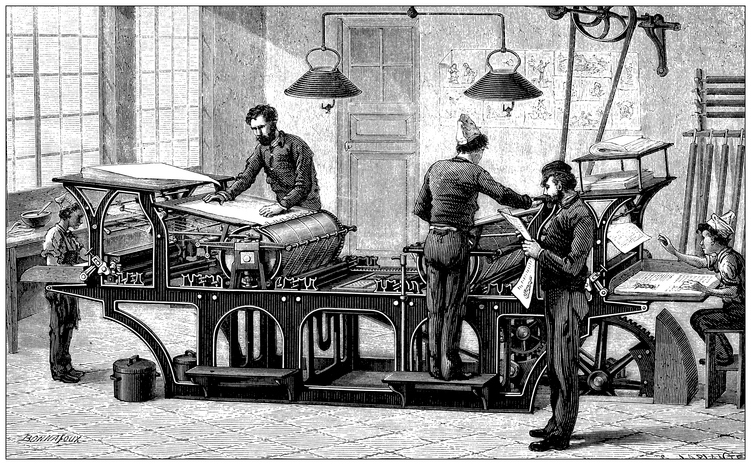
Modern history covers the period from 1500 on. Antiquity is everything before the year 500. Historians did not know what to do with the years in between. They called them the Middle Ages because they came between those other ages, which were more historically important. These developments shaped the idea of modernity as a worldview and a thing. And there was another influence that shaped modernity: printing.
The Invention of Printing
Printing Helped Shape Modernity, Credit: ilbusca
Today when you think of the holy scriptures, you think of the Bible. But the Bible didn’t exist in the Middle Ages. It only came about after the invention of printing. Before printing, people heard the holy scriptures read in a community setting.
Printing meant that people could take the Bible away and read it individually. Therefore, modernity meant that individuals could follow ideas that they got from books. One result was that the way people experienced the Christian faith changed.
Covid
Because of Covid, churches did not meet. Individuals went online and heard one voice telling them what to think. The people who were were unhappy with modernity and threatened by change heard about tradition and thought it might give them a sense of security.
Tradition
Where does the word tradition come from? Our English word comes from traditio. It means to hand over tradition. In the sense used by the Orthodox Church, this means handing over the good news, the message of Jesus Christ. You hand it over to other people, or pass it on.
But now, tradition is also a difficult concept. We sometimes wonder if something is a bad tradition. Tradition can be good or bad. The word tradition also leads to the English word traitor. For example, someone who hands their country over to the enemy. Or someone else who handed Jesus over to be crucified. So, tradition can be good or bad.
Traditionalism
You also find that people become Traditionalists, which is different from tradition. Traditionalists think tradition in itself is good and should be valued for its own sake. Rene Guenon and his followers, who taught early in the twentieth century, were the precursors of the people who are joining the Churches now. Today, new converts are bringing these Traditionalist ideas with them.
Rene Guenon was very unhappy with the modern world. And it’s true that modernity has its problems. One problem is that modernism is its own kind of ideology. Modernism teaches that modernity is good and everything else before it is inferior. It also teaches that things are getting better all the time. (In my opinion, we saw an example of this in Steven Pinker’s defense of liberalism.)
Modernism can put some people off. However, Steve Hayes argues that modernity is neither something to be worshipped and regarded as the best way, nor completely rejected. As Christians, we can look at modernity and evaluate different aspects from the point of view of Christian faith. We can see what’s good and bad, what we can cultivate and what we can try to reject. But to Traditionalists like Guenon, the modern world is altogether bad. For him, the earliest forms of religion were better.
Eugene Rose
Guenon thought primitive forms of religion were better. He influenced Eugene Rose, a young American. Rose converted at the age of 14 to the Methodist Church. The following information about Eugene Rose is from Wikipedia.
Rose studied Chinese philosophy at Pomona college. He also studied under Alan Watts at the American Academy of Asian Studies before entering the master’s degree program in Oriental languages at the University of California, Berkeley. He graduated in 1961 with a thesis entitled “‘Emptiness’ and ‘Fullness’ in the Lao Tzu”.
While studying at Watts’ Asian institute, Rose read the writings of French metaphysicist René Guénon. He also met a Chinese Taoist scholar, Gi-ming Shien. Shien emphasized the ancient Chinese approach to learning, valuing traditional viewpoints and texts over more modern interpretations. Inspired by Shien, Rose took up the study of ancient Chinese so that he could read early Taoist texts in their original tongue. Through his experiences with Shien and the writings of Guénon, Rose sought out an authentic and grounded spiritual tradition of his own. He became interested in the Russian Orthodox Church sometime after 1956.
Rose eventually became an Orthodox monk with the monastic name of Seraphim Rose. He and Gleb Podmoshensky, a Russian Orthodox seminarian, began a community of Orthodox booksellers and publishers, the St. Herman of Alaska Brotherhood. In March 1964, Rose opened an Orthodox bookstore next to the Holy Virgin Cathedral on Geary Boulevard in San Francisco. In 1965, the brotherhood founded the St. Herman Press publishing house, which still exists. Rose and Podmoshensky became monks in 1968 and transformed the Saint Herman of Alaska Brotherhood into a full-fledged monastic community.
Traditionalsim Found its Way Into the Writings of Seraphim Rose
Now we return to Steve Hayes’ narrative. The books published by Seraphim Rose’s St. Herman Press were in demand, as there were not many books and magazines about the Orthodox Church for the English-speaking world. So, Seraphim Rose’s publishing house made the Orthodox Church more widely known. But Guenon’s traditionalism shaped the presentation of the Herman Press. Seraphim Rose did not teach wrong doctrines. (According to the Wikipedia article, some of his teachings were controversial in his lifetime.) In fact, he warned against Traditionalism. But he made more of tradition than is generally done in the Orthodox Church. He taught Orthodox doctrines in a Traditionalist way. (My own Interpretation of Hayes’s narrative is that Traditionalist ideas are what had attracted Rose to the Orthodox Church in the first place and that’s how he understood it.)
Frank Schaeffer
Another teacher influenced by Guenon was Frank Schaeffer. Francis and Edith Schaeffer, Frank’s father and mother, were co-founders of L’Abri community in Switzerland. They were trying to enable Christians to witness to the Christian faith in the modern world. Francis wanted Christians to see how the Christian gospel could be presented to people who had a modernist understanding of the world. Francis was an American evangelical theologian, philosopher, and Presbyterian pastor.
Frank eventually went to America to study, and found that the modern world went against his values. As a result, he moved to a kind of right-wing understanding and tried to persuade his father to do the same. His father chose not to move in that direction, but Frank went on to write a series of books criticizing American culture as he saw it. The titles were catchy, in the words of Hayes. The title of one book was Sham Pearls for Real Swine. Frank believed that American culture was real swine. He attacked American culture until he discovered the Orthodox Church, which was more traditional. But because he had become a Traditionalist before joining the Orthodox Church, he continued to preach the same anti-modernist message he had preached when he was a Protestant.
An Orthodoxy With Teeth: Orthodox Bolsheviks
Steve Hayes heard him speak in 1995 at the Orthodox Mission Conference in Brooklyn. At that conference, Frank called for an Orthodoxy with teeth. He wanted the Orthodox Church to have teeth and attack American modern culture.
However, there was a Russian Orthodox Bishop in attendance who didn’t speak much English. Someone was whispering a translation in his ear. At the end of Frank’s speech the bishop said, You call for an Orthodoxy with teeth, but what will you do if those you want to bite grow bigger teeth and bite you back?…No! We have people like you in Russia who want to grow teeth like that and we call them Orthodox Bolsheviks.
Hayes explains that the Bolshevik period in Russia had ended just four years earlier. After Bolshevism ended, a survey showed that of all the Russian institutions in the early 1990s, the people trusted the Church the most. They did not trust politicians or academics, only the Church. Thousands of people were baptized in Russia after the fall of Communism, including a lot of people who had been in the KGB. Unfortunately, some of the new KGB converts’ practiced a method of persuasion that went, you do what we say and you believe what we say, or else. That was what the Russian bishop saw in Frank Schaeffer.
Frank eventually changed sides in the American culture wars. Now he calls himself a Christian atheist or an atheist Christian. He had joined the Orthodox Church not for what it was, but because he thought it would prop up what he already believed about the ordering of society. And when he stopped believing that, the secondary thing was less important and he drifted away from the Church. That’s the problem with anyone who comes to the Christian faith with an ulterior motive. They think Orthodoxy will provide a spiritual home for their already held beliefs, which already may be nationalist, racist, and exclusive. They think, we are in a group that is better than anyone else.
This has spilled over into quite a few Orthodox podcast groups.
Ortho Bros
Among the podcasters are people who come across as very arrogant, abrasive, and thinking, we are better than anyone else and you’d better follow us or else. It’s an Orthodoxy with teeth. People who follow them call themselves Ortho Bros and they come across as very abrasive and attack people.
But the Orthodox are not the only ones. There were other Traditionalist groups present in the 2020 riots. For example, Nick Fuentes preaches this right-wing message, often attacking conservative Americans and saying they should be radical.
Some Christian Traditionalists tend to be radical Right, racist, nationalist, and in some cases, neo-Nazi. Hayes calls out Jay Dyer in particular as being especially abrasive and attacking other people. Apparently, Jay promotes an orthodoxy with teeth, and if anyone disagrees with him he will dox them. This means getting documentation of everything a person has done and putting it online. People they approve of, they call ‘based‘. People they don’t approve of, they call ‘degenerate‘ or ‘gay‘.
When Right-Wingers Join the Orthodox Church
Some people who talk in this way joined the Orthodox Church when covid ended. The priests taught them, but they don’t really know where the new converts are coming from. They don’t realize the converts have a different lens.
The teachings of Father Seraphim Rose, who got the teachings from Guenon, were a milder version. but Traditionalism is no longer mild.
The philosophy of Traditionalism also came into the Orthodox Church through Alexander Dugin. Dugin is Russian, and during the Soviet period, he belonged to a circle of people who studied esoteric or occult religion. At that time, they studied East Asian religions in the light of Western occult understanding. But Dugin soon realized that Western occultism is modern–because it had appeared in the Renaissance. So, he followed Guenon in looking for the earliest versions of different religions. Another name for this focus is the Perennial philosophy. The Perennial philosophy teaches that there are basic ideas that underly all religions. Religion must keep these basic ideas.
When the Bolshevik regime fell in the 1990s, Dugin decided that the Traditionalist form of religion was identical with the Orthodox Church. He joined the Church, and he brought his Traditionalist ideas with him. In Russia, Traditionalism has spread to some of the clergy and also some of the people in government.
Dugin and Heidegger
According to Hayes, Dugin expresses his notion of the Russian world as, Russkiy Mir. (In the following article by Serghei Sadohin, Russkiy Mir is a doctrine. Sadohin compares it to the ideology of Martin Heidegger, which I have already warned against here.)
The German existentialist thinker Martin Heidegger, who profoundly influenced the Russian philosopher Alexander Dugin – an ardent proponent of the Russkiy mir doctrine – argued that there is only one ultimate truth: the truth of being. “The human is the place of the truth of being,” Heidegger says in his characteristically poetic, and sometimes obscure, way. Dugin found in Heidegger the philosopher who speaks to him about istina, but in a German way. “We have our special Russian truth,” he once told a baffled BBC journalist. Truth for Dugin is relative. As it was for Heidegger, who relativised truth to being, before anything else. Even Nietzsche before him said that “there are no facts, only interpretations.”
Hayes tells us that Dugin in particular spreads this doctrine. He has influenced people in Russia with the doctrine of Traditionalism. To be a Traditionalist, means you think tradition, regardless of its origin, is a good thing in itself.
Traditionalism is not the Same as Christian Tradition
Christian tradition hands on what it has received. It does not start again from scratch in each generation. It means following on from the generations before. Acts 2:42 reports the baptism of three thousand people. These people continued in four things: the apostles’ teaching; the apostles’ fellowship; the breaking of the bread; and the prayers. The Orthodox traditional understanding is that the Orthodox Church has continued in those four things from that day to this, without a break. There is continuity and that is what we call holy tradition. But not all tradition is holy, especially not all tradition of the Traditionalist philosophy is holy.
Christian Nationalism, Fascism, and Nazism
South Africa, Credit: LorenzoT81
There is also a third well-known traditionalist, a guy called Julius Evola, who was an Italian fascist.
Now we come to South Africa with something that in our day we regard as discredited. But it is suddenly having a revival in North America. That’s Christian Nationalism. In 1942, B. J. Vorster, one of the prime ministers of South Africa, said, ‘We stand for Christian Nationalism, which is an ally of National Socialism.’
We can call anti-Democratic governments ‘dictatorships’ if you like. But in Italy it was fascism, in South Africa it was Christian Nationalism, and in Germany it was Nazism. Christian Nationalism, as a philosophy or idea gave birth to apartheid, which eventually became an ideology in its own right. The word apartheid appeared in the 1930s from a Dutch Reformed missionary. In 1948 by D. F. Malan’s National Party adopted this word. It already had the philosophy of Christian Nationalism, but not the word. Apartheid was originally a slogan of the National Party, which was looking for a way to soften segregation.
Integralism is not Gospel. It is Ideology.
Christian Nationalism is growing today in North America. Hayes has mentioned its Orthodox roots, but it has other roots as well. In the Roman Catholic Church, Integralism wants to revive Christendom. By Christendom, they mean Christianity in alliance with secular power. They want to integrate the Church into the state. The state should be the instrument of imposing Christian values on everyone. But Hayse says this is not actually gospel. It is not good news because Christian values without Christ become an ideology. It’s no longer good news, just a set of ideas that you must accept or face the consequences.
In the Protestant world, there is a guy called Rushdoony. He believed that Christians should seek to control the government and the economy and have a kind of theocratic society. They call this idea Theonomy, which means applying God’s law. (Theonomy is a hypothetical Christian form of government in which society is ruled by divine law.) Rushdoony wanted to apply the Old Testament law to the state and make the commandments the constitution.
The New Apostolic Reformation
Another movement is the New Apostolic Reformation. This started as part of the Charismatic Revival in the 1950s and 60s, where a lot of people outside of traditional Pentecostal churches rediscovered the gifts of the Holy Spirit. There was a group that developed this new ecclesiology based on St. Paul’s list of some ministries in Ephesians. (here is an article about this Revival. It was a central influence in the January 6 riots.)
Ephesians says ‘he gave some to be apostles, some prophets, some evangelists, and some pastors and teachers.’ But they rigidified these five ministries and claimed they had disappeared after the apostolic age. One missiologist, Ralph Wimber, called this the BOBO theory of Church history: It teaches that the light of the gospel blinked off after the apostles died and blinked on again after the Reformation.
Ralph said the origin of this teaching was the Mormons. They called themselves the Latter Day Saints because they believe there were no saints in the middle. This is the same attitude as the historians who despised the middle. Winter said the idea that there are no saints in the middle is wrong, and he helped people see that. But people who held this ideology resisted Winter. They said pastors and teachers had disappeared and then restored during the Reformation. They said the Reformers were the revived pastors and teachers.
The New Apostolic Reformation and the Seven Mountains Mandate: a Long History
In the 18th century, there were people like John Wesley and other people in North America, traveling Evangelists, who said the Great Awakening was the Revival of the evangelists. Then, at the beginning of the 20th century, there was a Pentecostal Revival of the prophets. But now in the middle of the 20th century, they had a Revival of apostles. These people appointed themselves as apostles and started the New Apostolic Reformation (NAR).
Steve Hayes reports the following from one of these apostles, Bob Mumford. Mumford was a popular preacher in the 1970s. He taught this doctrine at the Hatfield Baptist Church and appointed the pastor as the apostle of Pretoria. God had given him Pretoria, according to Mumford.
The New Apostolic Reformation dealt with the Revival of these ministries. Then, in the 1970s, three evangelical leaders found that they had a common vision. The three men were Loren Cunningham, founder of YWAM; Bill Bright, founder of Campus Crusade for Christ; and Francis Schaeffer. Their vision came to be called Seven Mountains. The Seven Mountains were things in society that needed Christian influence, such as government, family, education, and various social institutions or centers of power.
Francis Schaeffer spread this teaching through L’Abri. He said he was helping people look at these things in the light of the Christian faith. Then, twenty-five years later, a man called Lance Wallnau said these seven mountains needed to be conquered, not just influenced. Christians must take them over.
The Cult of Donald Trump
At some point, Bob Mumford admitted to Hayes that these teachings had been wrong and that he repented for starting this movement. But someone named Peter Wagner, another missiologist, soon became the leader of the NAR. Lance Wallnau adopted the Seven Mountains theory. A lot of the people who accepted this teaching are now in what Hayes would call the Cult of Donald Trump. They were with the others in the January 6 riots.
Summary and Conclusion
So, this right-wing movement is in both the Orthodox and Western Churches. It seems to affect Generation Z in North America and Generation Zed all over the world.
The Seven Mountains Mandate (it’s called a Mandate in Wikipedia) has echoes of the Christian nationalism that we know from South Africa. If you follow it back, you will find that a Reformed theologian in the Netherlands, Abraham Kuyper, spoke about the spheres of sovereignty, and said that every social institution should have sovereignty in its own sphere. In other words, the Church should have sovereignty in religion, government, etc. This idea became very popular among the Christian Nationalists in South Africa. And the Seven Mountains Mandate is reworking it. Their roots are all intertwined. The tree that we are seeing grow from these roots is a lot of young Christians, from 15 to 30 or 35, especially males, who are right-wing.
Hayes has a question for the converts: What is primary? Is it the Christian faith? Is Jesus Christ the center of their lives? Or is it a political ideology and a political outlook?
He sees this as a kind of missiological and evangelistic problem, and it effects the Orthodox, Catholic, and Protestant Churches. This ideology is particularly influential because the young people are online and come from all over the world. Pastors and priests might not know what ideas they are bringing. They might find that the new converts seem to be speaking sound doctrine but then they go off into some conspiracy or anti-Semitic rant. These people largely got these ideas online and are coming into the fellowship of the church just as the church is reviving after covid, and it’s important that the Church realize where they are coming from and what kind of distortions they might be bringing to the understanding of the Christian faith.
Evelyn Waugh once called America ‘That land of waifs and strays’. Many people who are fortunate to live in the land of their ancestors look at Americans in that way. It’s rude, but mostly because it’s true. America as a country has an abbreviated history. The same can be said for immigrants and their descendants.
It’s rude also because most of the immigrants would have stayed put if they had been given a choice. Many were not wanted where they came from. If they weren’t literally chased out, they left in search of opportunities that were not available to them in the land of their ancestors. This includes aristocratic immigrants to the colonies.
That said, promises were made of liberty and brotherhood, and welcome. And many immigrants benefitted from those promises. For former immigrants and descendants to turn around and deny those things to other people is a betrayal of the idea of America. Likewise, the giving of one’s loyalty to another country while claiming to love this country is a betrayal. This point of view is important if we are to correctly interpret current events.
The Strangeness and Uprootedness of American Life
The writers of the American classics tried to make sense of the strangeness of being transplanted on this continent. They wanted to inspire their readers to create a new culture that did not repeat the mistakes of the old world. But several generations later Americans have forgotten the cause of that strangeness. They have lost the very context in which they exist.
The Threat of Radical Ideas
Losing one’s context is not only confusing, it is dangerous, politically speaking. Radical remedies are always available to people who are experiencing confusion, frustration and anger. It is important to point out that the radical political remedies being promoted today did not originate in the United States. They are actually hostile to the United States.
The European radical Right longs to return to a hierarchical society which actually existed. They want to create a system where ‘everyone knows their place’. Of course, they imagine their place to be somewhere near the top.
The American radical Right longs for something that has never existed on this continent. But they also picture themselves on top. What they both have in common is a contempt for political discourse and a personal desire to rule.
The US Supreme Court thinks it knows what is missing in American society. The conservative justices, or rather their secret backers, have decided that quality life looks and feels like an oligarchic theocracy. There are no precedents for such an arrangement in the United States, but they would like to ignore that fact. Furthermore, this lack of precedents was not an oversight. The Revolutionaries went to quite a lot of trouble to create something different from Europe. Nevertheless, the justices seem to think it makes perfect sense for a country that has never had kings and aristocrats to be ruled by people with pretensions to royalty.
American conservatives in all walks of life claim they are trying to save the republic. Maybe they are, but saving the American republic was never the aim of ‘The Conservative Revolution’.
The Conservative Revolution
In Germany during World War II, ‘Traditional’ elites hoped Nazism would get rid of the Weimar Republic and hand the reins of power back to them. Hitler was to be their front man.1 They never considered the possibility that the Nazis would rule in their own right. In their opinion, Hitler and his type were ‘the worst sort of proletarianized street-rabble’2. But the Nazis quickly secured their own power at the expense of the elites. Elite pretensions were exceeded only by Nazi pretensions.
In the United States today, there are people waiting in the wings to take power. They are not traditional elites. They are more akin to Nazis.
Spengler’s Predictions of Disaster
Frightful predictions of disaster are commonly used to turn up the political pressure. Such predictions made world war seem sensible a hundred years ago. Oswald Spengler was not a Nazi, but he was right-wing. He was a German philosopher of history in the early twentieth century best known for his book, The Decline of the West. He thought the best-case scenario, given Hitler’s takeover, was for Nazism to destroy the communists, socialists, and liberal Weimar democrats. This would clear the way for an aristocratic and intellectual elite. Spengler called his vision ‘Prussian socialism’3, and he saw himself as the new guardian, or philosopher-king.
Spengler’s Differences With the Nazis
To the Nazis’ way of thinking, Spengler was too aristocratic, monarchist, pessimistic, and not anti-Semitic enough. His challenge to Nazi racism was particularly unwelcome. Contrary to Nazi doctrine, Spengler thought Judaism was culturally wrong, not racially wrong. In his opinion, Judaism’s problem was its Magian character. He believed Judaism shared this trait with the late Romans, Mohammedans, and early Christian theologians such as St Augustine.
Spengler identified Judaism as a ‘Magian’ form of society with a cave-like conception of space that was intermediate between the classical Greek (‘Apollonian’) idea of the Gods having human characteristics and the West’s Faustian concept of an infinite universe. Magians were dualists who believed in an unrelenting struggle between good and evil. In such a belief system, the separation of politics and religion was theoretically impossible and intellectually meaningless. The Decline of the West argued that the late romans, Jews, Mohammedans, and early Christian theologians like Saint Augustine were all Magian.
Coogan. pp. 60-61
In addition, Spengler thought the Volk was a kind of ‘Magian’ distortion of the West’s notion of a free, individual, self-willed ‘I’ in favor of the collective herd. This part of his argument was actually aimed at the left, but it earned him the hostility of the NSDAP. Spengler’s death in 1936 solved a problem for the Nazi hierarchy. However, the Nazis continued ‘to glorify him as a German Virgil who had prophesied Hitler’s coming.’
The Fascist Mentality
Spengler’s books, The Decline of the West and The Hour of Decision created a generation of rightist intellectuals in Weimar Germany. This intellectual current has been ‘dubbed’ the Conservative Revolution’,4 and it consisted largely of a hostility to liberal notions of political discourse. But the elites were not supportive of Nazism. Spengler thought people like Hitler were a symptom of decline. The fascists either misunderstood or abused his basic premise.
Or maybe the fault was Spengler’s after all. His description of events seemed to demand some kind of ‘heroic’ response, even as he claimed nothing could be done.
Spengler’s Morphology of History: the Root of the Conservative Revolution
In The Decline of the West, Spengler developed a ‘morphology of history’. The following is his declaration of historical and cultural inevitability.
All the world’s great cultures, from Babylon, Egypt, China, and India up the the modern West, went through the same inevitable process of rise and fall in a series of vast organic historical life cycles. In its ascendent stage a society was best described as a ‘culture.’ this was a time of self-confidence, growth, and optimism, when both art and religion flourished and day-to-day life was infused with a sense of higher spiritual purpose and meaning.
Inevitably, Culture was superseded by a state of decay. This Spengler called ‘Civilization,’ an age dominated by money, greed, materialism, and a wide-spread sense of spiritual exhaustion and ennui. Europe (Spengler’s ‘Faustian culture’) entered the age of Civilization in 1789, the beginning year of the French Revolution. The inevitable last stage of Civilization would ‘Caesarism,’ a time when society becomes increasingly dominated by totalitarian strong men who overcome outworn forms of liberal parliamentary democracy. Given its unstable nature, Caesarism would inevitably lead to a series of horrific wars heralding the extinction of the culture’s life-cycle. Rather than deny or run away from the inevitable, the great challenge facing modern man was how to live a heroic and meaningful life in the violent ‘wintertime’ of the West.
Coogan, pp. 55,56
The next quote is Spengler’s fatalistic conclusion to Man and Technics:
We are born into this time and must bravely follow the path to the destined end. there is no other way. Our duty is to hold on to the lost position, without hope, without rescue, like that Roman soldier whose bones were found in front of a door in Pompeii, who during the eruption of Vesuvius, died at his post because they forgot to relieve him. That is greatness. That is what it means to be a thoroughbred. the honorable end is the one thing that cannot be taken from a man.5
In The Disinherited Mind, Eric Heller elaborated Spengler’s vision: “Caesarism reduced society to ‘a strict and rigid order’ of human ‘molecules’ trapped inside warring totalitarian states. Whether in victory or defeat, these societies would remain as sterile as Rome under the Caesars until this spiritually dead mass finally collapsed.“
Properly understood, this is not a call to battle. It is a set of theories, pessimistic interpretations of events, and predictions of inevitability.
A Banner to Rally Around
Instead of collapse, the fascists dreamed of cultural rejuvenation. Francis Parker Yockey first read Spengler’s Decline of the West while on a school break (from the University of Michigan at Ann Arbor). Yockey is a case study of the effects of Spengler’s theories. He maintained a near-religious belief in the vision of Oswald Spengler, but he completely disregarded Spengler’s conclusion.
As Coogan states in his book, Spenglerism is a difficult banner to rally around. Maybe Yockey and others were looking for a banner, but we’ll never know for sure. Francis Parker Yockey ended his life in a jail cell by means of cyanide. He was 42 years old. What we do know is that after reading Spengler, the remaining years of Yockeys life were consumed by his longing for a revival of German fascism.
Yockey operated in an unmapped world, a mysterious Atlantis whose contours are barely visible under every-shifting seas of time and deceit. His was a world of false identity, deep cover, and relentless travel throughout the United States, Europe, Canada, the Middle Ease, and Latin America. Because he was most at home in the twilight land of the fascist diaspora, a careful examination of his life can serve as an Ariadne’s thread through the labyrinth-like history of postwar fascism.
Coogan, p. 15
Francis Parker Yockey’s Version of Caesarism
Coogan’s opinion of the fascists in general is that they were incapable of grasping Spengler’s ‘Caesarian skepticism and contempt for humanity, the deep sense of the fleetingness of all phenomena.’ Yockey, for example, chose to believe that the coming of the Caesars, such as Hitler, actually indicated a potential rebirth for the West rather than a decline. In Yockey’s mind, Hitler was Napoleon reborn, and in his book, Imperium, he argued that ‘The Hero’ (Hitler) tried to realize the European Imperium, but like Napoleon, he fell victim to the barbarian Slavs.’ Nevertheless,in Yockey’s mind, ‘both Napoleon and Hitler became Hegel’s ‘history on horseback’.
Yockey’s vision has similarities with the American Right, but Yockey was unique in some ways.
[Yockey’s] attraction to both Spengler and Conservative Revolution theorists like Carl Schmitt made him virtually unique in the American far right. American supporters of Nazi Germany were usually German Americans, crude anti-Semitic nativists, or staunch conservatives who viewed Hitler as a heaven-sent bulwark against Bolshevism. Yockey was none of these. He was ideologically converted to a Nazified version of the Weimar “New right” Conservative Revolutionary current.
Coogan, p. 88
However, both of the far-right factions mentioned in this quote were supporters of Nazi Germany.
Yockey Meets the FBI, the American Legal System, and Reality
The FBI finally caught up with Yockey after years of evasion. Once in jail, he tried to recruit fellow prisoners into a daring escape plan. He also asked one of them to deliver a message to an address in Cuba. However, the prisoners immediately told on him. They didn’t like Yockey because he was ‘anti-U.S., anti-Negro, anti-Jewish, and, basically, anti-everything’. 6
Yockey was desperate to escape. His fear of the legal process was two-fold. In 1943, he had been honorably discharged from the army after being diagnosed mentally ill. After his arrest, it became clear that he was going to have to submit to psychological testing. Yockey believed this would hurt his credibility in the eyes of his clandestine associates. He was also afraid it would reveal who those associates were.
What Could Have Been
Francis Parker Yockey was born on the 18th of September, 1917 in Chicago to Louis Francis and Rose Ellen Yockey. The family was upper middle class and Catholic. Yockey’s mother studied at the Chicago Music College; Francis was a musical prodigy who could have had a career as a concert pianist. He also had a brilliant, photographic memory. Coogan thinks it’s likely that he was attracted to Spengler through his interest in art. (Coogan, p. 14)
Yockey was a cum laude graduate of Notre-Dame’s law school. After a brief stint in the Army during World War II, he served as an assistant district attorney in Detroit. Then, in 1946, he went to Wiesbaden, West Germany, as a U.S. government attorney assigned to the war crimes trials. Disgusted with what he saw, he abandoned his position and journeyed to the south of Ireland. Under the pseudonym ‘Ulick Varange,’ he wrote his magnum opus, Imperium: The Philosophy of History and Politics, in just six months. A massive neo-Spenglerian tome that called for the formation of a new European superpower, Imperium was first published in London in 1948. It is still sold today in right-wing bookstores in Europe and America.
Coogan, p. 14
Yockey’s anti-Americanism may have started when he identified America as the culprit in his father’s collapse and death from alcoholism. But there were plenty of like-minded scholars who were happy to take part in similar activities, up to a point. Unlike Yockey, many of them found a warm welcome in America’s military and educational establishments.
Meanwhile, Back in Europe
Besides Oswald Spengler and Carl Schmitt, Conservative revolutionaries included Ernst Jünger and Martin Heidegger. The content of their claims was intense and seductive. They speak of the decline and destruction of everything humans hold dear–in short, the inevitable unfolding of the terrible fate of man. Heidegger, for example, said that ‘Place is the locale of the truth of being’. According to David Harvey, in this, [Heidegger] was close to Aristotle, but he took it deeper. He was saying there is a certain truth that attaches to the notion of place, and that truth is essential to being or becoming.
Rene Guenon’s writings about the Kali Yuga are another example of intense content surrounding the fate of man.
What is most remarkable is that movement and change are actually prized for their own sake, and not in view of any end to which they may lead; this is a direct result of the absorption of all human faculties in outward action whose necessarily fleeting character has just been demonstrated. Here again we have dispersion, viewed from a different angle and at a more advanced state: it could be described as a tendency toward instantaneity, having for its limit a state of pure disequilibrium, which, were it possible, would coincide with the final dissolution of this world, and this too is one of the clearest signs that the final phase of the Kali-Yuga is at hand.
Rene Guenon, The Crisis of the Modern World, pp. 37,38
Interestingly, even though these thinkers are talking about events that humans can’t control, the insistence that the end is near is often paired with a political agenda. Guenon is a Traditionalist. Traditionalism is the ideology of Steve Bannon. And this is not the first time Guenon has been used in the service of authoritarianism.
We have seen that certain kinds of thinking can motivate people to pursue any agenda their leaders tell them to pursue. When Donald Trump told his followers that they have to fight or they won’t have a country any more, many of them fought and many of them went to jail.
As if reaching for ultimate shock value, Donald Trump’s campaign recently referenced Nazi Germany. The campaign’s claim to be pursuing a ‘Unified Reich‘ seems almost cartoonish if you ignore the sheer cheek of it all.
The Comparative Sanity of Edward Moor
The following is another way of thinking about the Kali Yuga concept. Edward Moor calls the Kali age ‘the present time’. On that everyone agrees. He goes on to explain that the end is tied to the incarnation of Kalki the Horse, an avatar that is yet to come.
Vishnu, mounted on a white horse, with a drawn scimitar, blazing like a comet, will, as minutely prophesied as to place, time, &c. end the present or Kali age, and renovate the creation with an era of purity. [This] is represented in pictures by an armed man leading a winged white horse…
Kalki, or Calci, (with the C hard) is otherwise called Kalenki, and Aswah; all said to mean a horse. But as Kal is Time, and in several dialects means both yesterday and tomorrow; or, more extensively, the past and future, may not the name Kalki, of this ender and renovator of ages, have some allusion to that idea, rather than be confined to the form in which it is to be manifested?
The Hindus, like most other people, have thus a prophetic tradition of the coming of a punisher and redemer. The Sybilline and Delphic oracles Foretold it. The Chinese, Japanese, Siamese, and other eastern nations, have been taught to expect such an event; an idea that seems to prevail so generally among people so distinct, as to be deducible only from a common source.
The Hindu Pantheon, p. 188
This paragraph seems to be a reference to the Axial Age theory, but in an informative tone rather than prophetic. According to the Axial Age theory, an event took place centuries ago with a universal effect. This event inspired the creation of world religions.
But the Axial Age took place between 800 and 300 BC. On what does Guenon base his assurance that the Kali Yuga will end? Where does Steve Bannon get the idea that it has something to do with Trump? The association of Guenon’s interpretation of the Hindu religion with Donald Trump is not a respectable way to do politics.
The Christian Zionists have their own dreams of end times. Both Israel and Donald Trump are key to Christian Zionist dreams. But this version of religious politics is just as disreputable as Steve Bannon’s Hindu version. The Christian Zionists seem determined to provoke the gory conflagration that their ideology says will result in the return of Jesus. Never mind that Israel is supposed to be Jewish. And secular. Also, that nothing in the Christian Zionist agenda is confirmed by Christian scriptures.
Kevin Coogan, Dreamer of The Day: Francis Parker Yockey and the Postwar Fascist International, Autonomedia, Brooklyn, New York, 1999, p. 77 ↩︎
The previous article focused on militant conservatism. But it didn’t go into detail on various types of conservatism, or on the characteristics of conventional conservatism. Nor did it explain how the character of conservatism varies from one nation to another. 21st century progressives are in the process of developing an international outlook, so awareness of ideological and organizational differences is crucial. The concept of conservatism is central to these differences. This article is a review of conservative ideology, politics and principles.
Summary of the Discussion So Far
To summarize the discussion so far, after the end of World War II, social scientists in the United States feared militant anti-communism and its negative influence on the civil rights movement and other campaigns. They believed anti-communist and anti-liberal ideas threatened peace and democracy. Many thinkers in the field of International Relations (IR) tried to create a stronger liberalism as part of their strategy. They believed they could accomplish this by borrowing conservative ‘insights’. The fusion of liberalism and the radical Right was called ‘realism’. Another name for realism is conservative liberalism. Postwar American International Relations developed in this context.
Considering this history, it is not surprising that conventional conservatism has faded into the background. Or maybe it would be more correct to say that conventional conservatism turned into realistic liberalism in the context of International Relations. The same thing happened to liberalism.
Arthur M. Schlesinger Jr. and Reinhold Niebuhr
Thinkers such as Arthur M. Schlesinger Jr. and Reinhold Niebuhr began to reformulate liberalism in a way that muted the radical, progressivist, egalitarian and utopian premises of the Progressive Era, and to talk about ‘original sin’, the inherent irrationality of human nature, and the limitations of political solutions to intractable problems of the human condition.1 At the same time, they denied that the process was distinctly conservative. Another one of IR’s stated aims was to remove utopian elements from liberal politics. According to Eric Goldman, ‘…liberalism gradually turned into a form of conservatism.’ (Cited by Drolet and Williams2)
Militant Conservative Ideas Continue
Militant conservative ideas continued to thrive, however, but not in the mainstream media. They were discussed in a ‘para-scholarly‘, sphere which enjoyed network connections with the political sphere. As a result, radical ideas have spread all over the globe.
In IR’s defense, these thinkers were influenced by the structural reality of American politics. Both Morgenthau and Niebuhr argued that there was no social basis for an ‘authentic’ conservatism in America. And they were right. According to Morgenthau, the great majority of Americans
have never known a status quo to which they could have been committed. For America has been committed to a purpose in the eyes of which each status quo has been but a stepping-stone to be left behind by another achievement. To ask America to defend a particular status quo, then, is tantamount to asking it for foreswear its purpose.
Hans J. Morgenthau, The Purpose of American Politics (Chicago: University of Chicago Press, 1960), pp. 296–7.
But, as the RIS article illustrated, the radical Right has already come very close to foreswearing America’s purpose. This will be discussed in more detail in subsequent articles. The purpose of this article is to provide a global perspective on conventional conservatism.
Conventional Conservatism
I’ll begin with the view of conservatism supplied by the RIS article. According to Drolet and Williams 3, conservatism is not a cohesive school of thought. ‘…conservatism is a counter-movement’. It is a collection of ideas, attitudes, and thinkers that oppose historical liberal and socialist ideas.The only time conservative ideology is coherent in a given time and place is when it’s confronted by rival ideological structures. Conservatives are particularly wary of proposals put forward by anyone perceived to be of the Left.
This seems to be how conservatism operates, although conservatives will probably object. The following summary is more neutral by comparison. It is taken from an article on Britannica.com.
Western Europe
Four great imperial dynasties fell in World War I: Russia, Austria-Hungary, Germany and Ottoman Turkey. Those dynasties had been the only remaining representatives of conservatism. Before the war, conservatism presumed monarchy, aristocracy and an established church. After the War, frustrated conservatives created parties to support nationalism in Germany, Italy, and other former allied countries. Then, beginning in the 1930s, the totalitarian Nazi regime either destroyed or coopted conservative parties in Central and Eastern Europe. (This will be explained in another article.)
Dynasties of World War I Credit: Jelle Wesseling
By 1946, socialism had been discredited in western Europe because of its inability to rebuild war-damaged economies. For this reason, many western Europeans returned to conservative politics. Of course, European conservatism no longer had aristocratic associations at this time. Conservative policies were attractive to voters because they promised economic growth, democratic freedoms, and the provision of social services by the state. For the rest of the twentieth century, European conservatism represented liberal individualism, social conscience, and opposition to communism.
Great Britain
The conservative party in Great Britain was very popular at the turn of the twentieth century. However, there was a Liberal interval. The Liberals were victorious in the general election of 1906, but they had already begun to lose trade union and working class supporters to the Labour Party. A Labour victory in 1924 ended the Liberal Party’s political relevance. For the next 40 years, conservatives formed the government. Their strength was largely the result of formerly Liberal, middle-class voters joining the Conservative Party. Today the Conservative Party in Great Britain is a union of Old Tory and Liberal interests combined against Labour.
The Interwar Period in Great Britain
British conservatism after World War I defended middle- and upper-class privileges and opposed socialism. During the 1930s, Conservatives followed a policy of appeasement ( a deal-making commercialist approach) with the Nazis. Appeasement failed and Britain entered the War.
State welfare services were extended after 1945, under the Labour government and mixed economy of Clement Attlee. When Conservatives returned to power in 1951, they left most of these innovations in place. In fact, they claimed they could do a better job than labour in administering the welfare state. They even went so far as trying to outdo Labor’s programs of social spending and the encouragement of new home construction.
This era of Liberal-Conservative accommodation ended with Margaret Thatcher. Thatcher’s conservatism stressed individual initiative, strident anti-communism, and laissez-faire economics. Her views had more in common with modern Libertarianism than the older conservatism of Burke. When she said, ‘there is no such thing as society‘ she repudiated the organic view of conventional conservatives.
David Cameron (2010-16) and Theresa May (2016-19) had less extreme views of individualism. They brought back some of the communitarian elements of conventional conservatism.
Continental Europe
In western Europe, conservatism was represented by two or more parties ranging from the liberal center to the moderate and extreme right. There are three types of conservative party in western Europe: agrarian (particularly in Scandinavia), Christian Democratic, and the parties allied with big business. These categories are general and may include combinations of these ideologies.
Italy
The Christian Democratic parties have the longest history. They emerged in the 19th century to support the church and monarchy against liberal and radical elements. Since World War I the dominant element in this party has been supporters of business. In Italy, clerical interests remain strongly represented.
The Christian Democratic Party has dominated governments in Italy since 1945. Since 1993, this has been under the name of the Italian Popular Party. The Christian Democratic Party was an alliance of moderate and conservative interest groups. It has formed a long series of government coalitions consisting of smaller centrist parties and the Italian Socialist Party. The Christian Democratic Party has never had a coherent policy and has been increasingly corrupt and politically ineffective, but it managed to exclude the large Italian Communist Party during the Cold War. The Italian Communist Party has been called the Democratic Party of the Left since 1991.
After the collapse of the Soviet Union communism was no longer seen as a threat to Europe, so the Christian Democrats lost much of their support. This coincided with the growth of other conservative and nationalist groups that had formerly been outside of mainstream of Italian politics. These include the Northern League, which called for the creation of a federated Italian republic, and the National Alliance (which, until 1994, was the Italian Social Movement). Many regarded the National Alliance as neofascist. In 1994 a new conservative party was founded by the media tycoon Silvio Berlusconi. Berlusconi’s party is called Forza Italia (“Go, Italy!”).
Germany
Germany was divided between Roman Catholics and Protestants, so the role of the church in the conservative party was not as significant as in Italy. However, Germany’s political climate has been conservative since World War II. This is illustrated by the fact that the Social Democratic Party of Germany has progressively eliminated the socialist content of its program. They even embraced the profit motive in a party congress at Bad Godesberg in 1959.
However, after 1950, the main Conservative Party, the Christian Democratic Union, adopted a program including support for a market economy and a strong commitment to maintaining and improving social insurance and other social welfare programs.
It was the Christian Democrats who presided over the unification of East and West Germany.
From the 1990s, German conservative ideology has included minimal government, deregulation, privatization, and the reining-in of the welfare state. These policies have been difficult to implement, however. Many Germans continue to support an extensive safety net of unemployment insurance and other social welfare programs.
France
There was no Christian Democratic Party in France to represent moderate conservative opinion. Instead, a large number of French conservatives supported parties like Rally for the Republic. (Rally for the Republic was renamed ‘Union for a Popular Movement’ in 2002, and ‘the Republicans’ in 2015.) This party espoused a highly nationalistic conservatism based on the legacy of Charles de Gaulle, president of France from 1958 to 1969. French conservatives also supported anti-immigration groups such as the National Front, which was led until 2011 by Jean-Marie Le Pen and subsequently by his daughter, Marine Le Pen. The National Front, some argued, was not so much conservative as reactionary or neofascist.
Gaullist Conservatism
Gaullist conservatism emphasized tradition and order and aimed at a politically united Europe under French leadership. Gaullists espoused divergent views on social issues, however. There are a large number of Gaullist and non-Gaullist conservative parties and it is difficult to categorized them. They lack stability and tend to identify themselves with local issues.
The Twenty-first Century
In the early 21st century, French conservatives were united by a number of developments. One was the theme of “law and order.” Law and Order was promoted by interior minister (and later president) Nicolas Sarkozy. Unemployed youths in suburban Paris and elsewhere—many of whom were immigrants or the children of immigrants—engaged in periodic rioting to protest their plight, and were met with stiff (and popular) police resistance.
The perceived threat to French values from immigrants, especially Muslims, also helped unite French conservatives. One of the values allegedly in danger was the conviction that public education should be strictly secular. When young Muslim women insisted on wearing veils to school, the French state reacted strongly. But this may have alienated Muslims from French society more than it reaffirmed French values.
In general, conservatism in Europe has exerted a pervasive political influence since the start of the 20th century. However, it has found expression in parties of very different character. Parties have been characterized by an absence of ideology and often by the lack of any well-articulated political philosophy. They have espoused traditional middle-class values however. They have also opposed unnecessary state involvement in economic affairs, and radical attempts at income redistribution.
Japan
Japan has had conservative rule since the beginning of party politics in the 1880s. The only exception was the military government during the 1930s and 40s.
Extensive social and political changes took place in Japan after the Meiji Restoration in 1868. Feudal institutions were abolished at this time, and western political institutions, such as constitutional government, were introduced. But in spite of these innovations, and the dislocations caused by rapid industrialization, politics continued to be shaped by traditional loyalties and attitudes.
The Liberal-Democratic Party
In 1955, the two most important conservative parties merged to form the Liberal-Democratic Party. Both parties had been dominated by personalities rather than by ideology and dogma. Subsequently, the allegiance of conservative members of the Diet was determined by personal loyalties to leaders of factions within the party, rather than commitment to policy. Today, an older Japan continues to influence the values, customs and relationships of Japanese conservatives.
The Liberal-Democratic Party has been linked with big business. Its policies aim to foster a stable environment for the development of Japan’s market economy. To this end, the party has functioned primarily as a broker between conflicting business interests.
Japanese Nationalism
In the early twenty-first century, there was a resurgence of Japanese nationalism. Much of it was centered on how to teach the history of Japan in the 20th century—particularly the period before and during World War II. Conservative nationalists insisted that the Japanese military had done nothing wrong and had acted honorably. They claimed that stories of widespread war crimes were fabricated by Japan’s foreign and domestic enemies. It is not known how pervasive and influential this resurgent nationalism might be.
The United States
Conservatism changed in the United States in response to the New Deal. America’s identity as a liberal country changed as well.
The New Deal Credit: Traveler1116
The New Deal was Not a Liberal Policy
After Franklin D. Roosevelt’s New Deal, the perception of the United States as an inherently liberal country began to change. The New Deal was the economic relief program undertaken in 1933 to help raise the country out of the Great Depression. This program greatly expanded the federal government’s involvement in the economy through the regulation of private enterprise, the levying of higher taxes on corporations and the wealthy, and the expansion of social welfare programs.
The Old Right
The Republican Party, drawing on the support of big business, the wealthy, and prosperous farmers, stubbornly opposed the New Deal. While Democratic liberals moved to the left in endorsing a larger role for government, Republicans generally clung to a 19th-century version of liberalism that called for the government to avoid interfering in the market. These staunch conservatives were known as the Old Right. They were powerful enough to prevent the US from entering World War II until after the Japanese attack on Pearl Harbor, Hawaii. However, their policy of fighting the New Deal did not help them at the polls.
In the first decades after the war, the United States, like Britain, gradually expanded social services and increased government regulation of the economy. However, in the 1970s, the postwar economic growth that the United States and other Western countries had relied on to finance social welfare programs began to slacken. This took place just as Japan and other East Asian nations were finally attaining Western levels of prosperity. And unfortunately, liberal policies of governmental activism could not solve the problem. (This article is non-committal about the cause of US stagnation.)
Neoconservatives
At this point a new group of mainly American conservatives, the so-called neoconservatives, arose to argue that high levels of taxation and the government’s intrusive regulation of private enterprise were hampering economic growth. They also claimed that social welfare policies were leading those who received welfare benefits to become increasingly dependent upon government. The neoconservatives generally accepted a modest welfare state. They were sometimes described as disenchanted welfare liberals. But they insisted that social welfare programs should help people help themselves, not make them permanent wards of the state. In this and other respects neoconservatives saw themselves as defenders of middle-class virtues such as thrift, hard work, and self-restraint, all of which they took to be under attack in the cultural upheaval of the reputedly hedonistic 1960s.
An Interventionist Stance
The neoconservatives also took a keen interest in foreign affairs. They adopted an interventionist stance that set them apart from the isolationist tendencies of earlier conservatives. Many of them argued that the United States had both a right and a duty to intervene in the affairs of other nations in order to combat the influence of Soviet communism and to advance American interests; some even claimed that the United States had a duty to remake the non-Western world on the model of American democratic capitalism. Among American political leaders, the chief representatives of neoconservatism were the Republican presidents Ronald Reagan (1981–89) and George W. Bush (2001–09). Its most articulate advocates, however, were academics who entered politics, such as New York Sen. Daniel Patrick Moynihan and Jeane Kirkpatrick, who served as ambassador to the United Nations during the Reagan administration.
During the Reagan era (the 1980s), more-traditional conservatives whose viewpoints harkened back to the Old Right remained resentful of neoconservatives for supposedly having co-opted and diluted American conservatism with a false brand of anticommunist “welfare statism.”
Paleoconservatives Try to Take the Party Back
The fall of the Berlin Wall (1989) and the collapse of the Soviet Union (1991) encouraged the “paleoconservatives,” as they were then identified by the conservative intellectuals Paul Gottfried and Thomas Fleming, to forcefully articulate their opposition to neoconservatism and to advocate new policies inspired by the Old Right’s ideological battles with New Deal Democrats.
Neoconservatives Counter with Accusations of Anti-Semitism, Racism, Isolationism, and Zenophobia.
Neoconservatives countered with long-standing accusations that the paleoconservative celebration of America’s Christian heritage and opposition to immigration from developing countries were indicative of the movement’s underlying anti-Semitism, racism, isolationism, and xenophobia.
The influence of paleoconservatism within the American right arguably reached a high point at the end of the 20th century in Pat Buchanan’s unsuccessful attempts to secure the Republican presidential nomination in 1992 and 1996 and in his failed campaign for president as the nominee of the Reform Party in 2000.
Drolet, J.-F., Williams, M. C. 2021. The radical Right, realism, and the politics of conservatism in postwar international thought. Review of International Studies 47, 273–293. https://doi.org/10.1017/S0260210521000103 ↩︎
In a previous article I wrote about Professor Wen Yang’s YouTube video in which he argued that the Anglo-Saxons are the worst people ever. He said this was the result of the Anglo-Saxons having missed the Axial Age. Interspersed with Yang’s portion of the video was a speech by Jeffrey Sachs. Both men use similar criteria to condemn the United States. Sachs blamed what he believes is a breakdown in Anglo-Saxon culture on the degeneration of Western Philosophy. I have argued that both arguments are flawed, and I refuted their claims in two articles. Sach’s focus on the influence of Niccolò Machiavelli in Western politics was the subject of one article. The other article was about Professor Yang’s claim that the Anglo-Saxons missed the Axial Age. This study led me to ask why they would make such false claims. I have concluded that the criticism of Anglo-Saxon countries is motivated by ideology. This article and subsequent articles will expand on this idea. This article will cover Realists and the Radical Right.
The Radical Right During and After World War II
Misrepresentation may not have been conscious on the part of Yang and Sachs. Currently, the rise of the radical Right is one of the most important challenges faced by the US government, but it is not mentioned in the field of International Relations. The ideologies of the radical Right have been forced underground since World War II, and sometimes its ideology creeps in unrecognized. Realists have tried to guide the conversation away from it, hoping it will go away. As a result, we are all shocked to discover that the radical Right has made a ‘comeback’.
A paper published in 2021 in Review of International Studies (RIS) 1 provides an explanation for this omission. Authors, Jean-François Drolet and Michael C. Williams, explain how and why the discipline of International Relations (IR) eliminated the radical right’s point of view.
This is not a condemnation of realists. It’s hard to argue with the rationale of those who carried out this plan. Social scientists feared the radical Right’s negative influence on the civil rights movement and other campaigns. And they saw anti-liberal ideas as a threat to peace and democracy. This is the context in which International Relations developed.
Today, radical Right ideas have burst into the open, and the realists’ fears have proven to be correct. At this time, it’s important to confront the fact that IR’s origins were framed as a battle between liberalism and realism. The Mearsheimer/Pinker debate, in which Steven Pinker defended liberalism and John Mearsheimer defended realism, is a good example.
The organization of this material
Drolet’s and Williams’ paper is a comprehensive treatment of this problem. It lays out a key part of the history of right-wing ideologies in the United States. It also discusses the people and organizations that fought them. I plan to divide this paper into sections and cover each one in its own article. This article will focus on the men and ideologies of the radical Right, as well as their influence in the United States.
The Failure of International Relations Credit: imaginima
The Failure of International Relations
In the past decade, transnational networks of the radical Right have made gains in Europe, North America and beyond. Governments and political parties with conservative foreign policies have increased as a result. These networks and parties routinely use the ideology of the radical Right to contest prevailing visions of the global order. Their aim is to weaken established forms of international governance.
Drolet and Williams argue in their paper that understanding the intellectual history of the discipline of IR will increase our understanding of right-wing thought, as well as the realist tradition. Their account should also help progressives develop a coherent identity and strategy.
Militant Conservative Ideas in Global Postwar Politics
Right-wing influencers were present in the West both during and after World War II. Much of the literature about these individuals focuses on European thinkers after 1948. Americans remain unaware that a similar influence was present in the United States during the same period. Right-wing ideologues were engaged with international security, geopolitics and Cold War strategy. Their ideology tended to be skeptical or hostile to liberal modernity. They insisted on racial hierarchies, cultural foundations, tradition and myth, as the basis of society.
Drolet and Williams focus on four influential conservative voices in American foreign policy and international affairs. They include Robert Strausz-Hupé; James Burnham; Stefan Possony; and Gerhart Niemeyer. These men were not unified theoretically. However, they were aware of each other’s work and knew each other personally. In addition, they often collaborated with each other and supported the same political causes.
All four men were backed by philanthropic foundations and engaged in Journalism and public debate. They wrote bestselling books and influential columns and lectured at US military and training colleges, and set up training programs based on their ideas. In addition to advising political leaders and candidates, they held government positions or consultancies. Surprisingly, they were also involved in the theory of International Relations. All of this activity took place while they held influential academic positions in leading American universities.
Robert Strausz-Hupé
Robert Strausz-Hupé immigrated to the United States from Austria in 1923. Initially, he worked on Wall Street and as editor of Current History Magazine. He joined the University of Pennsylvania’s political science department in 1940. Strausz-Hupé wrote more than a dozen books, including a book on international politics which he co-authored with Stefan Possony. In addition, both Strausz-Hupé and Gerhart Niemeyer were part of a Council on Foreign Relations study group in 1953 on the foundations of IR theory. In 1955, Strausz-Hupé established the Foreign Policy Research Institute (FPRI) at the University of Pennsylvania, with the backing of the conservative Richardson Foundation. He also founded its journal, Orbis. The FPRI quickly established ties to the military, causing Senator Fulbright to denounce them as reactionary threats to American Democracy.
Strausz-Hupé was a foreign policy advisor to Barry Goldwater in his 1964 presidential campaign. He also advised Richard Nixon in 1968, and served as US ambassador to NATO, Sri Lanka, Belgium, Sweden and Turkey.
The Influence of German Geopolitik
Strausz-Hupé’ is remembered today, for his geopolitics. His connections to the radical right come to light in this context. Geopolitical ideas and reactionary politics go together, according to Drolet and Williams.
Geopolitics became linked to organic state theories and global social Darwinism through nineteenth century theorists like Friedrich Ratzel or Rudolph Kjellen. Kjellen, a Swedish political scientist, geographer and politician was influenced by Ratzel, a German geographer. Ratzel and Kjellen, along with Alexander von Humboldt and Carl Ritter, laid the foundations for the German Geopolitik. Later their Geopolitik would be espoused by General Karl Haushofer. Haushofer influenced the ideological development of Adolf Hitler.
Haushofer visited Landsberg Prison during the incarceration of Hitler and Rudolf Hess by the Weimar Republic. He was a teacher and mentor to both men. Haushofer coined the political use of the term Lebensraum, which Hitler used to justify crimes against peace and genocide.2
German Geopolitik’s Political and Cultural Turn
German Geopolitik was inseparable from expansionism, racial or societal international hierarchy, and inevitable conflict. It became more political and cultural through radical conservative thinkers like Oswald Spengler, Moeller van den Bruch, and Carl Schmitt. Culture, race and myth developed as its core, and its urgent focus became the fate of the West.
Spengler insisted Western Civilization was in terminal decline, but Moeller was not so pessimistic. Moeller argued that Germany and Russia were young and vibrant cultures that could escape the decadent Anglo-American Civilizations and flourish in a continental partnership that would dominate the future. Similarily, Haushofer held that Eurasian land power was the geographic pivot of history, and viewed the ‘telluric’ Eurasian land powers as inescapably at odds with the ‘thalassocratic’ Anglo-American sea powers.
Geopolitics in a European and German setting was profoundly conservative and often reactionary. Many of its proponents rejected liberal visions of politics and were especially hostile towards the United States and Britain. German Geopolitik advocated a political geographic determinism opposed to the idea of a Euro-Atlantic partnership. They claimed Europe was the true West. Europe was not part of the Atlantic world, but an alternative to it.
Making America Geopolitical
Strausz-Hupé and other European émigrés taught geopolitics in America. Edmund Walsh, founder of Georgetown University’s School of Foreign Service, joined them in this task. These men taught a version of the Cold War that was a geopolitical critique of liberal modernity. They argued that the Cold War was evidence of a deeper civilizational and metaphysical crisis. These statements had the appearance of analytic objectivity, but the appearance was used to justify a blunt form of power politics.
These men purportedly avoided the German formulation of geopolitics. Unfortunately, Strausz-Hupé’s description of German geopolitik was based on his racial categories and assumptions about European colonialism. He argued that there were two distinct versions of geopolitics. In his version, statesmen used geopolitics to achieve a balance of power. In the Nazi version, geopolitik was used to destroy the balance of power and wipe out all commitments to the shared Christian heritage of Western civilization. German geopolitik had been turned into the doctrine of nihilism and the antithesis of the principles of civilized order because it had given up the trappings of Western Civilization.
Strausz-Hupé Borrows Key Concepts from German Geopolitik
Strausz-Hupé himself doomed this right-wing attempt to distinguish between German geopolitik and American geopolitics. First, he endorsed the German neo-Darwinian vision of international relations as an everlasting struggle for world domination. He proposed that regional systems must be established, each one clustered around a hegemonic great power. Finally, geography and technical mastery designated America as the new epicenter of the West. All the races of Europe would use America’s military capabilities to create a stable world order out of the defeat of the Axis Powers. But there was one condition.
Everything depended on the US leading the fight against Communism and creating an order under which a federated Europe could be subordinated within NATO. Anything short of this, including benign interpretations of the USSR’s motives would be disastrous.
In Strausz-Hupé’s view, liberals failed to recognize that periods of peaceful, competitive coexistence were as much a part of the communist war plan against the Free World as periods of aggressive expansion. Liberalism and containment-focused realists were not capable of sharing Strausz-Hupé’s global vision. Instead, Strausz-Hupé suggested abandoning containment and using superior military power to ‘rollback’ and ultimately destroy communism. The United States must develop a military posture and strategic doctrine that maintained nuclear deterrence, but allowed America to fight limited wars and prepare for the possibility of a total nuclear war.
James Burnham
James Burnham agreed with Strausz-Hupé’s anti-Communism, power politics and attacks on liberal decadence. Burnham was a philosophy professor at New York University from 1929 to 1953. He lectured frequently at the Naval War College, the National War College, and the John Hopkins School for Advanced International Studies, and was a co-editor of William F. Buckley’s National Review. Burnham also contributed a weekly foreign policy column to Buckley’s magazine and wrote a number of bestselling books on politics and international relations.
Burnham had started out with the radical left as one of Trotsky’s leading American disciples. But he broke with Marxism. Subsequently, he wrote The Managerial Revolution, predicting that the coming order would be a world-conquering managerial technocracy and run by a New Class of engineers, administrators and educators. These technocrats would wield power through the interpretation of cultural symbols, the manipulation of state-authorized mechanisms of mass organization, and economic redistribution.
Burnham’s Foreign Policy
Similar to Strausz-Hupé, Burnham believed liberalism is incapable of understanding the brutal Machiavellian realities of politics. Also similar to Strausz-Hupé, he borrowed his ideas from Europe. He wrote a book on political theory and practice, entitled The Machiavellians. In this book, he identified a group that had been influential in Europe but almost unknown in the United States. The Machiavellians included Gaetano Mosca, Georges Sorel, Robert Michels and Vilfredo Pareto. Burnham claimed their writings held the truth about politics and the preservation of political liberty.
He argued that all societies are ruled by oligarchs through force and fraud, and that cultural conventions, myth and rationality are all that holds them together. However, a scientific attitude toward society does not permit the sincere belief in the truth of the myths. Democracy itself was a myth designed and propagated by elites to sustain their rule under secular modernity. If the leaders are scientific, they must lie. Liberty requires hierarchical structures, cultural renewal and the primacy of patriotism, all of which were against the liberal consensus.
The Machiavellian World View
Burnham worked on a secret study commissioned by the Office of Strategic Services in 1944 to help prepare the US delegation to the Yalta Conference. In the resulting book, The Struggle for the World, he argued that the Soviet Union had become the first great Heartland power. Therefore, the only alternative to a Communist World Empire was an American Empire. The American Empire would be established through a network of hegemonic alliances and colonial and neocolonial relationships. This was Burham’s response to the revolutionary ideology and continuous expansion of the Soviet Union.
In place of appeasement, he advocated a policy of immediate confrontation. Containing Communism, and overthrowing Soviet client governments in Eastern Europe would be the goal. Intense political warfare, auxiliary military actions, and possibly full-scale war would be the method.
Machiavellianism in Vietnam
This debate extended to the Vietnam War. Burham attacked the ‘Kennan-de Gaulle-Morgenthau-Lippmann approach because it over-emphasized the nationalist dimension of the Cold War at the expense of what he believed was its more fundamental counter-revolutionary character. He said the realists’ analysis seemed plausible, but they failed to grasp the broader geopolitical and metaphysical consequences of a withdrawal–a communist takeover of the Asian continent. He admitted that entering the war may have been a strategic mistake, but it had become America’s ultimate test of will.
Burnham maintained a holistic approach to social theory even though he renounced Marxian theories of universal history. Like Strausz-Hupé, he saw the Cold War as geopolitical and metaphysical. He thought sacrifice was needed for survival, and America’s liberal philosophical and cultural commitments were not up to the task. He expanded on this idea in his book, The Suicide of the West.
Stefan Possony: Race, Intellect, and Global Order
Stefan Possony, also a collaborator of Strausz-Hupé, was also from Austria. He was involved in conservative foreign policy debates in the US for almost 50 years. He held research positions at Princeton’s Institute for Advanced Study, the Psychological Warfare Department at the Office of Naval Intelligence, and the Pentagon’s Directorate of Intelligence. In addition he taught strategy and geopolitics at Georgetown. In 1961, he became Senior Fellow and Director of International Studies at the Hoover Institute at Stanford. Also similar to Strausz-Hupé, Possony served as a foreign policy advisor to Goldwater’s presidential campaign. Like Burham, he advocated an ‘offensive forward strategy’ in the Vietnam War. Possony became an advocate for President Reagan’s Strategic Defense Initiative in the 1980s.
Possony’s Theory of Racial Hierarchies
Possony was also interested in racial hierarchy. Racial geopolitics was central to his vision of international order. He co-authored Geography of the Intellect with Nathaniel Weyl. In this work, the authors tried to demonstrate the racial hierarchy and geographic distribution of intellectual abilities and their implications for foreign policy. They argued that world power and historic progress depended on racially determined mental capacities and the ability of an elite to influence society’s direction. And they concluded that intelligence is directly connected to the comparative mental abilities of different races. The people with the largest amount of creative intellectual achievement since the Middle Ages are within the Western political orbit. Hence, the West’s geopolitical dominance.
However, Possony and Weyl argued that Western dominance was threatened by technological advancement and demographic dynamics. This process allowed the less able to out-reproduce the elites. They echoed Spengler with this argument.
As societies reach the peaks of civiization and material progress they face the threat of application of a pseudo-egalitarian ideology to political, social and economic life – in the interests of the immediate advantage of the masses who, for political reasons are told that if all men are equal in capacity, all should be equally rewarded. The resources of the society will be thus increasingly dedicated to the provision of pan et circenes (bread and circuses) – either in their Roman or modern form. Simultaneously, excellence is downgraded and mediocrity must fill the resulting gap. As the spiritual and material rewards of the creative element are whittled away, the yeast of the society is removed and stagnation results.
Page 283 – 284
Selective Genetic Reproduction
Selective genetic reproduction via artificial insemination was proposed as a partial response. This followed Hermann J. Muller’s ‘positive eugenics’. Possony argued that through artificial insemination, a small minority of the female population could multiply the production of geniuses in the world.
Possony and Weyl also argued that America’s aid policies and support for decolonization were misguided. This was similar to arguments proposed by Burnham and Strausz-Hupé. They reasoned that such policies are based on the incorrect assumption that men, classes and races are equal in capacity, and that human resources can be increased by education. These policies have unleashed the forces of savage race and class warfare in Africa and the Middle East. They also force the emigration and expulsion of the European elite. And the European elite is the only elite.
Treason of the Scholars
In addition to these classic tropes, these men argued that the West’s decline was partly due to the ‘treason of the scholars.’ In other words, treason of liberal intellectuals who are guilty of spreading specious egalitarian ideals. Such ideals sow envy, anxiety, dissent and disloyalty among the masses. The treasonous ‘pseudo-intelligentsia’ must be supplanted by a creative minority.
Gerhart Niemeyer
Gerhart Niemeyer was a native of Essen, Germany. Like Burnham, he began his career on the left as a student of the social democratic lawyer Hermann Heller. He emigrated to the United States in 1937, via Spain, and taught international law at Princeton and elsewhere before joining the State Department in 1950. He spent three years as a specialist on foreign affairs and United Nations policy. After two years as an analyst on the Council of Foreign Relations, he became a Professor of Government at Notre Dame University. He remained there for 40 years.
His 1941 book, Law Without Force, was part of a postwar attempt to relate international law to power politics. It was influenced by Hermann Heller’s conception of state sovereignty and by Niemeyer’s despair over ‘the politically naive legalism of the Weimar left’.
Criticism of International Law
Niemeyer believed modern international law was unrealistic by nature and that it was partly responsible for the unlawfulness of ‘international reality’. He claimed that during the nineteenth century, international law had been transformed by the rise of liberalism into a mere instrument for managing the common affairs of the bourgeoisie. It now served the ideal of an interdependent global society of profit-seeking individuals. Subsequently, the rise of authoritarianism had made legal norms obsolete. Since international order is established through law, the law must be renovated based on Niemeyer’s criteria.
The Influence of Eric Voegein, Buckley, Goldwater, and Traditionalism
Niemeyer was influenced by Eric Voegelin, and he became a Traditionalist during his time at Notre Dame University. For decades, he was a friend of William F. Buckley. He was considered an expert on Communist thought, Soviet politics, and foreign policy, and was commissioned by Congress to write The Communist Ideology. This work was circulated in 1959-60. Like Strausz-Hupé and Possony, he worked as a foreign policy advisor on the Goldwater campaign. Subsequently, he served as a member of the Republican National Committee’s task force on foreign policy from 1965 to 1968.
Metaphysical Meaning of the Cold War
Niemeyer believed that political modernity is a uniquely ‘ideocratic’ epoch where dominant ideologies strive for new certainties in order to remake the world. Voeglin called this ‘political gnosticism’. The result is a world dominated by ruthlessness, absolutism, and intolerance in which logical murders and logical crimes made the twentieth century one of the worst in human history.
These convictions led him to a radical vision of the Cold War. In his view, the Cold War became an explicitly conservative metaphysical phenomenon. Liberals failed to see that the Soviet Union was not simply a great power adversary but an implacable enemy drivin by gnostic desires of the ‘Communist mind’. He further argued that the Communist mind was a ‘nihilistic and pathological product of modernity’. So, it was natural for people to fear Liberalism as superficial, ignorant of mankind’s demonic possibilities, given to mistaken judgments of historical forces, and untrustworthy in its complacency.
Niemeyer believed the world is at a spiritual dead end. Political orders rest on a matrix of customs, habits, and prejudices underpinned by foundational myths. So, the solution is a mystical awakening that recognizes the importance of mystery and myth in political life.
What They Had in Common
All four of these thinkers were fixated on space, resources, and national power, but they were also tied to a narrative of the ‘crisis of man’. This last item led to a reactionary critique of liberal modernity. By casting the Cold War in metaphysical terms, they could argue that the USSR was an extreme embodiment of the pathologies of political modernity demanding radical responses. If modern liberalism was not up to the task of fighting the Cold War, radical conservatism would have to take over. Otherwise, the West would be destroyed.
Thinkers in the Field of International Relations Response to the Radical Right
These men were not authoritarians, but they expressed misgivings about democracy and liberal modernism. The thinkers in the field of IR were sympathetic to such concerns, but they did not fear liberal idealism as much as they feared militant conservatism’s foreign policy, including its support for military confrontation and nuclear adventurism. Its sympathy for McCarthyism was another concern.
Some of the IR field’s most important early thinkers took up this challenge. They systematically attacked militant conservatism’s ‘Machiavellian’ politics and geopolitical theorizing. They also used conservative insights to develop what they thought was a liberalism capable of withstanding pseudo-conservative attacks. Unfortunately, this resulted in Conservative Liberalism, which became a key part of realism.
The Battle Lines: Cold War America and The National Review Magazine
The National Review was founded in 1955 by radical conservative William F. Buckley. Buckley aimed to create a movement to address the most ‘profound crisis’ of the twentieth century. He argued that this crisis was a conflict between the Social Engineers and the disciples of truth who defend the organic moral order’.
The National Review was a reaction to the advances of organized labour, racial desegregation, women’s emancipation, and the ‘satanic utopianism of communism’. It was also a response to the conformist conservatism of establishment Republicans. Buckley’s magazine was an important platform for the confrontational style of right-wing politics.
Jean-François Drolet and Michael C. Williams, The radical Right, realism, and the politics of conservatism in postwar international thought, Review of International Studies (2021), 47: 3, 273–293 doi:10.1017/S0260210521000103 ↩︎
There are core philosophical differences between Europe and the ‘Anglo-Saxon nations’ of Great Britain and the United States. Europeans seem to be aware of this, but the American people are not, maybe because the American educational system does not identify America as Anglo-Saxon. Instead, we are encouraged to think of ourselves as a melting pot with a diverse heritage. As a result, I believe we are poorly equipped for dialogue with the rest of the world. On the other hand, I suspect our leaders are aware of their Anglo-Saxon identity. If so, this might explain their recent behavior. Are they operating on the premise of Anglo-Saxons v the World? More importantly, is America’s behavior inspired by hubris, or are Americans responding to a sense of isolation?
I recently watched a video attributing the turmoil in the world to a breakdown in Anglo-Saxon philosophy and politics. In that video, Professor Wen Yang attributed the current turmoil in the world to a cultural and spiritual lack in Anglo-Saxon philosophy. He included the United States in the Anglo-Saxon category because he considers the US an extension of the British Empire.
Yang has issued a challenge that should not go unanswered. If we the people are considered Anglo-Saxons by virtue of where we live or who our allies are, we had better be able to respond to such accusations. The purpose of this article is not to introduce a new cause, but to explore what the Anglo-Saxon label means for conversation and analysis.
Is Anglo-Saxon Culture Uncivilized Compared to the rest of the world?
Credit: duncan1890
In Yang’s opinion, the Anglo-Saxon problem is very old. But while his argument might provide an explanation for the behavior of the United States in recent decades, his premise that the Anglo-Saxons missed the Axial Age can be disputed. Yang specifically attributes the behavior of the US and her allies in the Middle East to a lack of Axial Age influence and a resultant breakdown in Anglo-Saxon philosophy.
The Axial Age is a term coined by the German philosopher Karl Jaspers. It refers to broad changes in religious and philosophical thought that occurred in a variety of locations from about the 8th to the 3rd century BCE. As we will see, Yang’e analysis implies that the Anglo-Saxon nations have remained uncivilized and irreligious while other cultures progressed spiritually and morally. In this context, it might even be racist. Is Anglo-Saxon culture uncivilized compared to the rest of the world? However one answers this question, the Axial Age argument is not useful or even accurate.
The British Contribution to the Debate
Alan Macfarlane, an authority on Anglo-Saxon culture, has a completely different interpretation of the influence of the Axial Age. There is scholarly consensus that it was Japan that missed the Axial Age, and that Japan was the only world civilization to never experience it. Furthermore, the consequences of missing it were not necessarily negative.
Macfarlane explains the Axial Age as follows: for the civilizations that were affected by it, the world they knew was separated from an ideal philosophical world that was held in opposition and tension to that world. This resulted in the creation of world religion. The Japanese never separated their world. Therefore, Japan is not an actual civilization. Japan is an ancient shamanic civilization.
Macfarlane reached this conclusion independently, but he has since discovered that Robert Bellah1 and Shmuel N. Eisenstadt2 discovered it as well.
Apparently, missing the Axial Age does not lead directly to an Anglo-Saxon-type society.
Is America Really Anglo-Saxon?
Now we have to confront the question of whether America really is Anglo-Saxon. According to Alan Macfarlane, the United States does not have a key ingredient of Anglo-Saxon culture: boarding school. Boarding school was so influential in British culture and economics, another explanation would be needed for the presence of Anglo-Saxon characteristics in the United States.
What is an Anglo-Saxon? Origins of Europe and Britain
According to Macfarlane, the origin of the Anglo-sphere was the Anglo-Saxon invasions after the fall of Rome. Anglo-Saxon society had a peculiar family system. They had small, nuclear families, but they sent their children away to boarding school. Public education (the British name for boarding school) is the oldest institution in Britain, and it goes back to the Anglo-Saxon period. In Britain, children were, and still are, sent away between 8 and 13 years old. Macfarlane argues that this custom had the effect of splitting economic and social unity.
Romantic Love and Common Law
The children who are sent away are no longer a member of the unit of production in that household. This practice led to the development of romantic-love marriage, in addition to its economic effects. Romantic love was not inspired by the troubadours. It was a natural result of boarding school. Love was a self-choice.
Boarding school also had common law effects. The development of Britain’s legal system was unique. British law protected the individual, in contrast to law on the Continent, which did not protect the individual. However, Europe has adopted many aspects of British law, so this difference is no longer noticeable.
The British Trust
The trust, is another interesting feature. A trust is a non-government hybrid unit that turns things into people and vice versa. It was devised as a vehicle to get around the king’s inheritance tax. All of the major British economic institutions were trusts. And Anglo-Saxon trusts became a key device for modern capitalist democracy. However, the British trust is not like the corporation on the Continent.
Trusts explain how the Catholic Church can exist in Britain. Religions set themselves up as trusts. Trusts made non-conformity possible.
Trusts also explain the relation of Britain to its empire. First, trusts can be dissolved. The British empire disappeared in 20 years because the empire was a trust. Another an important difference with Continental empires is that in Britain, these relations often continued as part of the Commonwealth after they were ‘dissolved’.
Continental empires on the other hand, were were familistic, relational, and therefore, difficult to break out of. And once a part of the Continental empire broke away, it was out for good.
The Cruel Streak in Anglo-Saxon Culture
Finally we get a suggestion that these cultural practices have had both good and bad effects. On the negative side, there is a cruel streak in Anglo-Saxon culture. British society is based on confrontational, competitive, games, which are formed as clubs. Everything is individualistic and contractual. Parliament is a game, life is a game. And all of the games have teams. The Anglo-Saxon world is unfair in many ways, but it is made tolerable by humor. Humor in capitalist society acts like myth in other societies.
The Need for Understanding
There is tension between the Continent and Anglo-world. However, Macfarlane aims to promote peace by describing the natural characteristics of civilizations. He argues that ignorance of these characteristics can lead to misunderstandings, which are more serious today because a rapid rise in population has resulted in pressure on resources and migration. Several spheres are being mixed together. This has never happened before. These factors, combined with rapid changes in technology, have created a confused world. His books include: How to Understand Each Other3, and China, Japan, Europe and the Anglo-Sphere, a Comparative Analysis4. His point of view is a valuable addition to this discussion.
Conclusion
Anglo-Saxons may have a well-developed sense of humor, but clearly, there is nothing funny about the United States’ behavior in recent decades. Analysis is important, but the Axial Age doesn’t explain what we’re seeing. On the other hand, an understanding of Anglo-Saxon culture might be a good place to start.
I was going to compare Anglo-Saxon and Continental philosophy, but I realized the focus should be on the Axial Age. The following papers deal with philosophical differences and might be useful for further exploration:
Two Traditions of Liberalism by James H. Nichols, Jr. This is a review of João Carlos Espada’s book The Anglo American Tradition of Liberty: A View from Europe.
The Anglo-Saxon Conservative Tradition5 by Rod Preece. This book can also be read on JSTOR. Preece argues that the distinguishing mark between old and new conservatism is not between the old world and the new but between Anglo-Saxon nations and others. Anglo-Saxon ideology is best understood as Lockean liberalism.
The Axial Age and Its Consequences, Edited by Robert N. Bellah and Hans Joas, Harvard University Press, 2012 ↩︎
EISENSTADT, SHMUEL N. “The Axial Age : The Emergence of Transcendental Visions and the Rise of Clerics.” European Journal of Sociology / Archives Européennes de Sociologie / Europäisches Archiv Für Soziologie, vol. 23, no. 2, 1982, pp. 294–314. JSTOR, http://www.jstor.org/stable/23997525. Accessed 27 Mar. 2024. ↩︎
Alan Macfarlane, How to Understand Each Other, CAM Rivers Publishing, 2018 ↩︎
Alan Macfarlane, China, Japan, Europe, and the Anglo-sphere, CAM Rivers Publishing, 2018 ↩︎
Rod Preece, “The Anglo-Saxon Conservative Tradition.” Canadian Journal of Political Science / Revue Canadienne de Science Politique, vol. 13, no. 1, 1980, pp. 3–32. JSTOR, http://www.jstor.org/stable/3230084. Accessed 25 Mar. 2024. ↩︎
Considering the agricultural benefits being secured by the EU through its Association Agreement with Ukraine, one wonders if NATO expansion in Ukraine was a bluff. The United States is getting everything it wants with Ukraine’s farmland and infrastructure. The deep state is in Ukraine, and it’s agribusiness. Cargill is a key player in Ukraine and other NATO countries. Cargill may have had something to do with the new members of NATO, Sweden and Finland. It may also have had something to do with Switzerland’s decision to sanction Russia.
Ukraine War and Volatility of Food Prices Credit: simplehappyart
The curious case of Switzerland
On February 24, 2022, the day Russia invaded Ukraine, the only remaining neutral countries in Europe were Austria, Ireland, Sweden, Finland and Switzerland. Now there are only three. Finland joined NATO in 2023 and Sweden joined on March 7, 2024. Today, there is support for NATO membership in each remaining neutral country. Russia’s invasion of Ukraine is cited as a reason to give up neutrality. But a majority in each country values neutrality. Curiously, Switzerland resisted joining NATO, but it imposed sanctions on Russia. Some say this behavior is not consistent with Switzerland’s neutrality.
The one thing that makes sense of the behavior of both Switzerland and the United States is agribusiness. Cargill has had a presence in Ukraine for more than two decades. Cargill is a private US company, but Cargill International SA is located in Geneva, Switzerland. Maybe Switzerland stands to gain from Ukrainian farmland. NATO expansion in Ukraine may be a bluff, but Ukraine’s real estate market is for real.
Agribusiness is part of the deep state
On January 12, 2014, pro-Western Ukrainians descended on Kiev’s Independence Square to protest President Viktor Yanukovych’s government. On the same day, Cargill paid $200 million for a stake in Ukraine’s UkrLandFarming. Two months later, in March 2014, J. P. Sottile identified the coup in Ukraine as a corporate annexation project. It can also be argued that it was a land grab. Under Yanukovych’s regime, the Ukrainian real estate market had been closed. Volodymyr Zelenskyy opened it in June of 2021.
According to Sottile, agribusiness is part of the deep state. Normally the deep state is associated with the oil and defense industries, but this association ignores America’s heavy subsidization of agriculture. For two decades, the Cold War alliance between corporations and foreign policy has prepared the ground for Ukraine’s break with Russia.
I would argue that companies like Cargill were instrumental in this preparation. This pattern was already established during World War II. In 1942, Cargill began to build ships for the US Navy and towboats for the Army. More recently, in March 24, 2023, Cargill CEO Brian Sikes met with USAID administrator Samantha Power to discuss “areas of collaboration in support of USAID’s efforts to bolster democratic bright spots, support farmers in Ukraine in response to Russia’s full-scale invasion of the country, and galvanize action on climate-smart food systems.”
Business is good in Ukraine
There have been claims of business instability in Ukraine, but these claims are deliberately misleading. Business activity in Ukraine is brisk. However, Morgan Williams, President and CEO of the US-Ukraine Business Council, has been claiming that Ukrainian businesses are not making future plans or expanding operations. He has to know this is not correct. Since 1992, Williams has been advising American agribusinesses on investing in the former Soviet Union. In addition to his position with the US-Ukraine business Council, he is Director of Government Affairs at the private equity firm SigmaBleyzer. Finally, Van A. Yeutter serves with him on the US-Ukraine Business Council’s Executive Committee. Yeutter is the Vice President for Corporate Affairs at Cargill.
The UkrLandFarming investment wasn’t Cargill’s first purchase in Ukraine and Russia. In December 2013, Cargill announced the purchase of a stake in a Black Sea grain terminal at Novorosslysk on Russia’s Black Sea coast. Aside from its ability to scope out and purchase Ukrainian businesses, Cargill and other big agriculture companies, have benefitted from volatility in food prices, a direct result of the Ukraine War. Today, the Cargill family is America’s wealthiest agricultural family.
Where do 21st Century Progressives fit in this picture?
In 2015, I cited agribusiness as a key focus for progressives. I now believe everything that has happened since that time has been a distraction from this focus. When you also consider its nefarious activities in foreign countries, it is clear that agribusiness is a malevolent presence on the earth.
Agricultural policies are central to human liberty, autonomy and survival. Without the ability to grow quality crops, we can’t provide the world’s population with its most basic requirement–sustenance. In addition, we can’t manage land and water resources or address climate change. Finally, we can’t plan community structure, or provide gainful employment for community members. Agribusiness corporations have usurped all of these functions.
It’s good that this focus has become more clear. Unfortunately, now we know that no one is listening to us.
Cookie Consent
We use cookies to improve your experience on our site. By using our site, you consent to cookies.