
Category: Christianity in the World

  • The Wilderness Crucible

    The Wilderness Crucible

    Reading Time: 7 minutes

    I wrote Justice of the Rupture  after our attempt to elect Bernie Sanders to the presidency. Shortly afterward, Nina Turner, the national co-chair of Sanders’ 2020 campaign, identified the nature of our grief when she said “Progressives are in the wilderness“. Nina was raised in the church. She was talking about the wilderness that Jesus experienced after his baptism. Sadly, the entire country is here with us today. The important thing at this time is to recognize it for what it is. The wilderness crucible is not a punishment. It’s an opportunity.

    The Wilderness Crucible
    The Wilderness

    Biblical Theology and Modern Application 

    The wilderness narrative of Jesus is not merely a historical interlude but a profound spiritual, psychological, and metaphysical blueprint for navigating civilizational crisis. This article explores the structural nuances of the text across the synoptic Gospels and examines its Old Testament typologies. It will then analyze the symbolic anatomy of the three temptations and apply these insights to contemporary Americans.

    The three-fold dimension of the wilderness framework is adapted from classic synoptic gospel analysis (Matthew 4:1-11/Luke 4:1-13), utilizing Deuteronomy 6-8 as the primary textual subtext for testing national identity under deprivation.

    The American Wilderness Shift

    America is shifting from an era of radical comfort to an age of profound multi-directional volatility. When a society conditioned on radical comfort, predictable material prosperity, and geographic invulnerability faces friction from several directions at once (macroeconomic, geopolitical, and domestic hyper-polarization), it defaults to the exact pathologies tested in the wilderness. As we enter a cultural wilderness, the original temptations of Jesus are bound to repeat themselves as systemic pathologies. The biblical framework provides a precise diagnosis:

    The Bread Crisis (Economic Anxiety & Material Idolization)

    When inflation, resource scarcity, and economic volatility threaten the modern standard of living, the natural temptation is to compromise ethics for survival. This is the ‘stones to bread’ trap. Americans are tempted to believe that physical, financial security is the ultimate good, leading to frantic consumerism, hoarding, and an abandonment of neighborly solidarity. The remedy of Jesus requires recognizing that structural crises are moments to realign with baseline moral truths and spiritual realities, rather than worshiping economic metrics.

    The Temple Pinnacle (Political Radicals & The Illusion of Immunity)

    Under multi-directional threat, citizens often demand public, structural guarantees of safety, or fallback into the toxic presumption that ‘America is inherently immune’ to the laws of historical collapse. This manifests psychologically as a demand for a performative savior or a weaponized civil religion that expects God (or the State) to validate our specific group or nation without demanding our repentance. Testing God via institutional hubris replaces quiet civic duty and moral accountability.

    The Mountain Kingdoms (The Allure of Authoritarian & Machiavellian Power)

    Faced with geopolitical instability and domestic breakdown, the temptation to embrace corrupt mechanisms to achieve protective ends becomes overwhelming.  This mirrors the offer of all earthly kingdoms. Americans are increasingly tempted to look to total political control, institutional weaponization, and Machiavellian compromises to preserve their comfort. The wilderness teaches that acquiring power at the expense of our foundational values is an absolute metaphysical and structural defeat.

    The Purpose of the Desert

    The fundamental error of Israel was viewing the wilderness as an unmitigated punishment to be escaped at all costs, leading them to long for the slavery of Egypt just for its food security. Jesus demonstrated that the wilderness is actually a place of essential purgation. For modern Americans, this era of disruption is not merely an inconvenience; it is a crucible. It strips away the illusion that comfort equals safety, exposing our idols, and offering an opportunity to build an unshakeable inner resilience that does not depend on outward geopolitical or economic tranquility.

    Core Analytical Frameworks of the Desert

    As we have seen, the Modern American application of the wilderness is based on a more ancient framework. This includes the synoptic comparison (Matthew, Mark, and Luke), and the Old Testament typology.

    The Synoptic Comparison

    Each Gospel writer anchors the wilderness differently. Mark framed it as a sudden, violent cosmic boundary shift where the spirit ‘drives’ Jesus into an apocalyptic war with wild beasts and angels. Matthew positioned it as a royal, legal debate over the fulfillment of structural righteousness, culminating on a high mountain. Luke emphasizes Jesus’ perfect humanity under intense dependency on the Holy Spirit, shifting the final temptation to the pinnacle of the religious establishment in Jerusalem.

    Gospel Key Theme & Framing Distinct Elements
    Mark Cosmic Urgency & war. Wild animals, angels.
    Matthew Royal Messiah & law. Mountain, kingdoms.
    Luke Perfect Human & Spirit. Temple, pride.

    Old Testament Parallels & Israel’s Reversal

    In the Old Testament portion of the analysis, the wilderness acts as a diagnostic mirror for a nation. First, the story of Jesus represents a 40-day/40-year reversal. Jesus enters the precise geographical and spiritual microcosm where the corporate ‘son’ (Israel) failed during their 40-year journey.

    In addition, this typology includes the Deuteronomy strategy. Every scriptural response Jesus makes after his temptations is from Deuteronomy 6 and 8. These verses are a sort of manual given to Israel to explain why God allowed them to be hungry.

    Theological Analysis

    The nature of the wilderness also encompasses three additional dimensions: the spiritual dimension; the psychological dimension; and the metaphysical dimension. The wilderness of Jesus was a spiritual and metaphysical battleground designed to test his messianic identity and obedience.

    Historical and Psychological Analysis

    Jesus’ wilderness was an intense period of physical deprivation and preparation that mirrored Israel’s 40 years in the desert. The idea that Jesus succeeded where Israel failed is a common interpretation.[1, 2, 3, 4, 5] He also succeeded where Adam failed. But we shouldn’t forget that Jesus was a product of both Israel and Adam. Christian theology tells us he succeeded for the entire human race.

    The Spiritual Dimension

    In Christian theology, the wilderness was a direct confrontation between the divine and the demonic.[1, 6]

    Cosmic Showdown

    The Spirit affirmed Jesus as the Son of God at his baptism; immediately the Spirit led him into a spiritual crucible where Satan tested him.[1, 7]
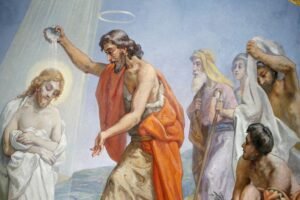
    The Baptism of Jesus (godongphoto)

    Messianic Purpose

    The temptations were spiritual tests of his mission. Would he rely on miraculous power for personal needs (turning stones into bread), seek worldly domination, or test God’s protection?[8, 9]

    The Word as Weapon

    Jesus overcame this spiritual adversity by utilizing the spiritual authority of scripture (quoting Deuteronomy), demonstrating that spiritual victory comes from reliance on the Word of God.[10]

    The Psychological Dimension

    The wilderness tested the limits of Jesus’ humanity, representing an extreme test of mental resilience, focus, and human endurance.[7, 11, 12]

    Vulnerability

    After forty days and nights without food, Jesus experienced acute physical hunger, emotional exhaustion, and severe isolation.[7, 13]

    The Human Condition

    The ultimate test of doubt, ambition, and the temptation to take the path of least resistance to achieve his goals was a psychological ordeal.[2, 8, 13, 14, 15]

    Identity and Calling

    The wilderness was a period of mental clarity where Jesus rejected human desires and embraced the psychological and emotional suffering necessary for his ultimate destiny on the cross.[2, 13]

    The Metaphysical Dimension

    In biblical tradition, the wilderness is a place outside of human society, often viewed as a metaphysical realm of chaos, desolation, and spiritual danger.[1, 16]

    Kingdom of Darkness vs. Kingdom of Light

    The encounter with Satan involves metaphysical phenomena. This encounter demonstrates an attack by the Kingdom of Darkness on the Kingdom of Light. For example, Satan transports Jesus to a high mountain to see all the kingdoms of the world, only to change his location in another moment to the pinnacle of the temple. First he tempts Jesus with power and control over the kingdoms of the world. then he tempts Jesus to demonstrate a dare-devil leap into space in order to be rescued by God. They were metaphysical phenomena, but the effects of Jesus’ capitulation would have been real. [8, 13, 17, 18]

    Transcendent Intervention

    The Gospel of Mark further emphasized the metaphysical nature of the wilderness. In this Gospel, Mark notes that Jesus was ‘with the wild animals, and angels were ministering to him’. This verse bridges the physical world with the transcendent realm.[4, 16, 19]
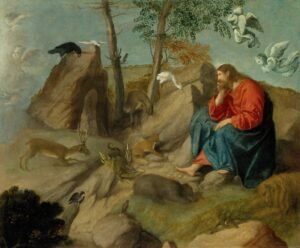
    Angels Ministered to Him


    Ultimately, the wilderness represents three things. It represents a physical location, a severe mental trial of Jesus’ human faculties, and a spiritual-metaphysical triumph over the forces of evil.[6, 20, 21, 22]

    Is the Wilderness Only a Place of Passive Meditation?

    Some might object that the course laid out in this article is too limited. We seem to be left with an important question: is true wilderness resilience simply a retreat into passive meditation? The wilderness does have something to say about physical strategy. This will be the subject of the next article.

    Looking Ahead: The Mask of the Machine

    If this financial machinery is so oppressive, how does it survive without constant revolt? The answer lies in the concept of civilization itself. The machinery requires a moral alibi to justify its control. In the next article, we will step back to analyze the concept of civilization through its fiercest critics–from Edward Said’s exposure of imperial rhetoric to the ancient narratives that viewed the rise of the city as a fundamental fall from human grace. We will look at how culture is weaponized to hide the financial trap, and how humanity has historically attempted to discredit the machine’s narrative.


    (In the preparation of this work, digital research assistants and language modeling tools were utilized to organize source texts, verify historical timelines, and cross-reference literary citations.)

    [1] https://www.youtube.com

    [2] https://www.new-covenant-church.com

    [3] https://feedingonchrist.org

    [4] https://learn.ligonier.org

    [5] https://bibleproject.com

    [6] https://www.youtube.com

    [7] https://medium.com

    [8] https://www.logos.com

    [9] https://www.logos.com

    [10] https://connectionpointchurch.org

    [11] https://www.wildernesstrek.org

    [12] https://lifespringschristianchurch.org

    [13] https://www.youtube.com

    [14] https://swedenborg.com

    [15] https://www.viewchurch.co

    [16] https://www.behindthegospels.com

    [17] https://www.youtube.com

    [18] https://tidings.org

    [19] https://laurenbdavis.com

    [20] https://renewcm.com

    [21] https://scripturecentral.org

    [22] https://storage2.snappages.site


  • A Message From the Iron Age

    Reading Time: 2 minutes

    This is completely off the subject of what we’ve been talking about here but I’m in a hurry to tell you about it. What I’m going to say is more pleasant to think about than the madness going on all around us. This is a message from the Iron Age.

    The Ancient Egyptians and Picts Had Something in Common

    I would like to share with you something the Picts and the ancient Egyptians had in common. I believe I’m the first person to figure it out. Either that or the scholars are keeping it secret. They claim no one can decipher the symbols carved by the Picts on their stone slabs in Scotland. However, I’m going to argue that the Picts were doing the same thing the Egyptians were doing in their temples, tombs and coffins. They were making maps and writing instructions to aid the dead in their journey to the next life.

    It is known that the ancient peoples had contact with each other. For that reason I think it’s safe to assume that the Pictish and Egyptian religions were similar. They both focused on the hazardous journey everyone must take when they die. The Egyptians made maps and wrote instructions on their temples and tombs. The Picts made standing stone slabs to mark their graves and carved them with plants, animals, hybrid creatures, and miscellaneous symbols. The clue that the Picts had the same intention as the Egyptians is the Pictish cross slabs.

    After the the Picts were converted to Christianity, they carved crosses on the back side of the standing slabs. This tells me they were carving instructions for the dead, like the Egyptians. Why? Because that was the purpose of the symbols on the front of the slab. The Picts obviously took Jesus’s promise literally, and the cross served the same purpose as the other symbols.

    In my Father’s house there are many dwelling places. If there were not, would I have told you that I am going to prepare a place for you? And if I go and prepare a place for you, I will come back again and take you to myself, so that where I am you also may be. Where I am going you know the way.

    Thomas said to him, “Master, we do not know where you are going; how can we know the way?”

    Jesus said to him, “I am the way and the truth and the life. No one comes to the Father except through me.

    John 14:2-6

    The Picts took this to mean that Jesus will return for them when they die and take them to his Father’s house.

  • With Best Wishes, I am, Sincerely, Donald Trump

    Reading Time: 2 minutes

    I was surprised recently to learn that Donald Trump has been signing his tariff documents “With Best Wishes, I am, Sincerely, Donald Trump.” The reason for my surprise is the last time Jair Bolsonaro ran for office in Brazil he boasted that only God could oust him, and he was promptly ousted.

    Bolsonaro Loses His Election

    I commented on Bolsonaro’s brazenness at the time. He seemed to have no fear about what God might actually think about a politician claiming His support. It seemed reasonable to assume that when someone makes such a declaration in public and for their own advantage, they present an opportunity for God to agree or disagree. We can’t say for sure if God had anything to do with what happened, but the election didn’t go well for Bolsonaro.

    I Am, He Whispers

    It could be argued that Donald Trump learned from what happened to Bolsonaro, even if he didn’t quite believe it had anything to do with God. He’s been signing his tariff documents “I am”, but in an unobtrusive way, as though it’s part of his signature. Perhaps he’s doing it that way because then he can deny that’s what he meant. However, it is not us he will have to convince if worse comes to worse. So what exactly does Trump mean by his use of this phrase?

    What Does “I Am” Mean?

    Several Old Testament texts use the phrase “I am.” In Exodus 3:14, Moses asks Yahweh (God) for His name and God responds, ‘“I AM WHO I AM.” In John 8, Jesus uses the Greek phrase ἐγώ εἰμι (egō eimi – literally: “I – I Am”) to refer to himself. This phrase occurs 21 times in that Gospel. Considering Trump has been telling the world he’s the ‘chosen one’, it’s not likely he doesn’t understand the significance of signing “I am” on his official documents. Maybe he really believes it. But then why the timidity?

    Either he really believes it and is willing to take the consequences, or he knows it’s not true. But as it is, instead of openly stating egō eimi, it’s more like a whisper. Why whisper if it’s true? And if it’s not true, I think it would be a bigger offense than Bolsonaro claiming God’s support for a political office. Especially since the Trump Administration is not behaving in a Godly way and they know it. They’re acting more like the devil.

    If Trump were to continue this practice now that it’s out in the open, he would be openly declaring that he is Yahweh/Jesus. I don’t think he wants to go there. This needs to stop.

  • The Right is Passing Judgment on the Left

    Reading Time: 4 minutes

    This video published just a few hours ago indicates that the Right is doubling down on the claim that Kirk was shot by Tyler Robinson. Turning Point USA has issued a statement saying there was no exit wound in Kirk’s neck after he was shot with a .30-06 caliber bullet. Apparently, the bullet was stopped by his strong neck bones because he is a man of steel. This has unpleasant implications. It implies that the propaganda surrounding this assassination is going to be maintained. Because the alleged assassin has been identified as a member of the Left, the Right is passing judgment on the Left.

    The Accusations Are Not Going Away

    I regret to tell you, reader, what this means. It means outrageousness, and not truth, is the point. And because of its similarities with the JFK assassination, I think we have to assume outrageousness was the point there too. Whoever did this to Charlie Kirk is saying they can do whatever they want and no one can stop them. And when the authorities publicly ignore evidence in the public domain, they seem to be saying it’s all a joke. In my opinion, there is no response from the Left that will make this go away.

    Taking Refuge in the Epistle of James

    In this article, I’m taking the opportunity to share what James the Just says about judging one’s neighbor. I have been writing a series on the Epistle of James on my other website, but I’ve only got as far as James 1:11. I’m writing this here because I think these verses are particularly relevant in this context. The verses I would like to share are James 4:11-12. Please pay close attention to the conclusion in the commentary by James B. Adamson. I think it’s the best response to the Right’s accusations.

    James 4:11-12

    11.  Do not speak ill of one another, brothers. He that speaks ill of his brother and passes judgment on his brother is speaking ill of the law and passing judgment on the law; but if you pass judgment on the law, you are not a servant of the law but a judge of it.
    12. There is one dispenser of law and judge, he who has power of life and death. And who are you, that you pass judgment on your fellow? (Translation by Adamson, p. 175-6)

    Previously in this chapter, James has focused on the temptations of the tongue. “Who are you to judge another?” He has made it clear that the failure to control the tongue is a form of self-righteous pride.

    The Word Brother

    11. The word brother is repeated three times in verse 11. Some have argued that James is talking to hypercritical Christians, anti-Pauline Christians, or Gnostic teachers. Adamson disagrees. He believes this signals a change of tone and a fresh appeal. This verse refers to all who submit to the world, and especially the proud (4:10). It is a warning. It is also an echo of James’s previous verses, 1:26; 2:12, 13; and 3:10. (Please hover your cursor over the verses if you want to read them.)

    Evil Speaking Kills Three Persons

    The Old Testament denounces evil speaking more often than any other offense, both against God (Numbers 21:5) and man (Psalms 49:20). Slander was called the third tongue because it killed three persons: the speaker, the spoken to, and the spoken of. It has been said there is no salvation for anyone who slanders his neighbor.1 Here Adamson compares James’s view of the seriousness of slander to what Christ said in Matthew 7:1. James equates slander of a fellow Christian with breaking the Christian Torah2, because the interests of both are the same.

    Hillel said, “Judge not your neighbor before you find yourself in the same situation.3

    The Difference Between Judging and Doing the Law

    The difference between judging and doing the law is carefully explained. Man must obey the law, not judge it. To set oneself above the law is to usurp the divine prerogative. In fact, the Rabbis taught that judging our neighbor leads to the graver sin of judging God. Respect for law and order is necessary for the health of modern society, but James reminds us that God is the source of all law. So, what is at stake in a ‘permissive society’ is respect for the authority of God himself. (From the context of this commentary, I think he means a society that permits Christians to judge one another.)

    James 4:12 is the Most Important Point in the Entire Section

    Adamson thinks the next verse, James 4:12, is the most important point in the entire section. The section in question is James 4:4 to 5:8. For ease of reading I’l repeat James 4:12 here.

    There is one dispenser of law and judge, he who has power of life and death.
    And who are you, that you pass judgment on your fellow?

    (Adamson believes Matthew 10:5-42 makes the same point, especially verses 15, 22, and 28.)

    James’s Personification of the Law

    12. James personifies the law and he seems to identify it as the brother. In his view, “any slander or judgment of a brother implies not only an active disregard of Torah but also an attitude of superiority reserved solely for God, who is the omnipotent Lawgiver and Judge.

    This is a characteristic Jewish monotheistic doctrine of God’s supreme sovereignty. Rabbi Ishmael spoke on God as the final source of judicial authority: “Judge not alone; for there is none save One that judgeth alone.” Adamson also quotes Dibelius: “Truly, the Eternal destroys life and sustains.” and “One he casts down and the other he raises up….”

    Adamson’s Conclusion: Salvation (or its Opposite) at the Last Judgement

    Adamson believes James is referring to ‘salvation’ or its opposite at the Last Judgement (5:9).

    The point is clinched with a devastating question. The disjunctive pronoun is sarcastic, emphasizing the sheer folly of the world to judge, while the vigorous proleptic ‘you‘ serves to widen the gulf between God’s judgment and man’s. ‘And who are you that pass judgment on another?’ To which John Wesley replies: ‘A poor, weak, dying worm.’ For James, as for us, however, the best answer is scornful silence. (Adamson, p. 178)

    1. Derek Erets Zuta 1: Midr. R. Deut. vi. 9; Cohen, Everyman’s Talmud, p. 99; SB 1, pp. 226ff., 905. ↩︎
    2. On this as Jewish Torah, see Oesterley, Knowling. ↩︎
    3. Aboth ii. 4; see b. Shab. 127a; Matt. 7:1f.; John 12:31. ↩︎
  • American Religion and the Iraq War

    Reading Time: 5 minutes

    Considering the un-peaceful tendencies in the Christian religion is it logical for a Christian to work for a peaceful future? The belief in the apocalyptic end of the world seems to work in the other direction. Many American Christians supported the Iraq War and justified their support by citing the Book of Revelation. Were they obeying the internal logic of the Christian religion, or were they mistaken? Considering the fact that Christians outside of the United States were not so supportive it’s likely they were mistaken. But we can’t say for sure until we study it further. The following Gallup survey might explain the relationship between American religion and the Iraq War.

    You might think this question has already been answered. After all, the Iraq War was a disaster, and therefore a mistake. But the morality of Christian support for the war should not hinge on whether the war was a success. It should hinge on whether Christian support for the war was consistent with Christian teachings. 

    In the process of writing this article I’ve learned that Christian teachings are not really central to the problem. If the problem were Christian error we might be able to blame it on believers’ mistaken interpretations of scripture. The Book of Revelation comes to mind. If scripture is the problem, it would make sense to study it and try to root out the error. But now I think the problem is worse than that. To illustrate, I’ll use surveys of Christian attitudes about the war.

    The first study is a combination of Gallup surveys conducted in 2005 and early 2006, written up by Frank Newport. It was published in March of 2006 on Gallup.com. The second study is written by Joseph L. Cumming. It was Based on a 2003 Survey by the Pew Forum on Religion and Public Life (This article is no longer available on the Internet).

    The Statistics

    There are four categories in the first analysis of American religion: Protestant, other Christian, Catholic, other religion, and no religion.  The initial results indicate a difference between denominations in support for the war. The least supportive was the category of other religion and no religion (42% and 38% respectively). At the top of the scale were Protestants and other Christian (55% and 53% respectively). Catholics were less likely than protestants and other Christians to support the war, but only slightly (48%). (Please see the results in graph-form on the Gallup website. Keep in mind that Gallup measured the ‘war is a mistake’ question, so higher numbers on the graphs indicate less support for the war and lower numbers indicate more support for the war.)

    What Do the Statistics Say About American Religion Versus Party Affiliation?

    At first glance this might seem to imply something negative about religion in general and about Protestantism in particular. But it’s more complicated than that. The results indicate that we’ve been giving religion far too much credit. This suspicion first arises with the significant relationship between religious identification and party identification. Protestants were most likely to be Republicans and Republicans were most likely to support the war. Likewise, we can explain the tendency for Catholics to be less supportive of the war by the fact that a higher percentage of Catholics are Democrats. And finally, those with no religion were significantly less likely to be Republican and more likely to be independents than the general American population. In short, Democrats in each group were highly likely to believe the war was a mistake, Republicans were the least likely, and independents were in the middle.

    Frequency of Attendance

    Frequency of church attendance was also a significant factor. Here, the biggest difference was between those who attend church seldom or never and those who attend monthly or more often (38% and 56% respectively). Other Christians who attend church more often were less supportive of the war however.

    Still, when you consider that those who attend church more often are more likely to be Republican, party affiliation remains the most influential factor. In a graph of the three major partisan groups: Republican, Independent and Democrat, according to church attendance and the belief that the war was a mistake, Democrats are highly likely to say the war was a mistake regardless of church attendance, Republicans are highly unlikely to say the war was a mistake, and independents are somewhere in the middle. A modest relationship remains within Republican and independent groups between church attendance and views on the war, but no strong pattern appears related to attendance among Democrats.

    The Influence of Christianity on Moral Decision-Making

    This survey was conducted March 13-16, 2003, by the Pew Forum on Religion and Public Life: Joseph L. Cumming, The Iraq War and Christian Faith, April 20, 2004, Based on a 2003 Survey by the Pew Forum on Religion and Public Life

    The facts did not support the guiding premise of this study. The premise was that decisions about war are profoundly moral decisions. Given Christianity’s ‘just war’ theory which limits the circumstances under which a country is justified in going to war, Christian decision-making about war should be shaped by Christian faith. The results again indicate that secular influences predominate. Political convictions seem to be changing Christian beliefs rather than the other way around.

    Christianity Was Not Very Influential in Support for the Iraq War

    In the week before the U.S. commenced hostilities in Iraq, only 10% of Americans considered their religious beliefs to be the most important influence in shaping their attitudes about the war. Only one third reported that religious leaders had had at least some influence on their views, and only 11% considered religious leaders to have been highly influential. However 53% said friends and family influenced their views on the war and 43% said political commentators influenced them.  Just before the war Americans favored military action by a nearly 2:1 ratio, despite the fact that high-ranking Christian religious leaders had spoken out publicly about the moral implications of the proposed war. So what happened?

    The Responsibility of the Clergy Versus American Cultural Isolation

    One response might be to hold the local clergy responsible. Only 14% of them took an anti-war position, seven per cent were publicly in favor of the war, and 75% took no position or did not speak about the war at all. But appearances may be deceiving. Researcher Ralph Premdas attributes the problem to ‘inter-communal antipathies’ present in society at large and reflected in the attitudes of churches and their adherents. He argues that clergy and believers are trapped within the ‘claims of their own ethnic or cultural community’, and he draws the conclusion that American isolation has robbed Christian decision-makers of the full benefit of their faith in making important decisions.

    “…it is only through a multinational, multiethnic universal church that the many-colored wisdom of God can be adequately known, and it is only together with all the saints (from all nations and all ages) that we may fully grasp the multidimensional love of Christ. That is, if we wish to consider these questions in an authentically Christian way, then we must listen to the voices of believers in Christ from other nations—especially believers in the Middle East and in other Islamic nations.”

    Premdas provides a hopeful ending to a disturbing study. Unfortunately American Christianity has always been conjoined with American politics. However I have found an encouraging answer for my question about whether it makes sense for a Christian believer to promote peace. Christian support for the Iraq War had very little to do with the Christian religion.  The bad news would be that the United States is a ship without a rudder.

    See Also: Ecological Conversion: Think in a New Way