
FornI wrote Justice of the Rupture after our attempt to elect Bernie Sanders to the presidency. Shortly afterward, Nina Turner, the national co-chair of Sanders’ 2020 campaign, identified the nature of our grief when she said “Progressives are in the wilderness“. Nina was raised in the church. She was talking about the wilderness that Jesus experienced after has baptism. Sadly, the entire country is here with us today. The important thing at this time is to recognize it for what it is. The wilderness crucible is not a punishment. It’s an opportunity.

The Wilderness Crucible: Biblical Theology and Modern Application
The wilderness narrative of Jesus is not merely a historical interlude but a profound spiritual, psychological, and metaphysical blueprint for navigating civilizational crisis. This article explores the structural nuances of the text across the synoptic Gospels and examines its Old testament typologies. It will then analyze the symbolic anatomy of the three temptations, and apply these insights to contemporary Americans. America is shifting from an era of radical comfort to an age of profound multi-directional volatility.
The three-fold dimension of the wilderness framework is adapted from classic synoptic gospel analysis (Matthew 4:1-11/Luke 4:1-13), utilizing Deuteronomy 6-8 as the primary textual subtext for testing national identity under deprivation.
The American Wilderness Shift
When a society conditioned on radical comfort, predictable material prosperity, and geographic invulnerability faces friction from several directions at once (macroeconomic, geopolitical, and domestic hyper-polarization), it defaults to the exact pathologies tested in the wilderness. As we enter a cultural wilderness, the original temptations of Jesus are bound to repeat themselves as systemic pathologies. The biblical framework provides a precise diagnosis:
The Bread Crisis (Economic Anxiety & Material Idolization)
When inflation, resource scarcity, and economic volatility threaten the modern standard of living, the natural temptation is to compromise ethics for survival. This is the ‘stones to bread’ trap. Americans are tempted to believe that physical, financial security is the ultimate good, leading to frantic consumerism, hoarding, and an abandonment of neighborly solidarity. The remedy of Jesus requires recognizing that structural crises are moments to realign with baseline moral truths and spiritual realities, rather than worshiping economic metrics.
The Temple Pinnacle (Political Radicals & The Illusion of Immunity)
Under multi-directional threat, citizens often demand public, structural guarantees of safety, or fallback into the toxic presumption that ‘America is inherently immune’ to the laws of historical collapse. This manifests psychologically as a demand for a performative savior or a weaponized civil religion that expects God (or the State) to validate our specific group or nation without demanding our repentance. Testing God via institutional hubris replaces quiet civic duty and moral accountability.
The Mountain Kingdoms (The Allure of Authoritarian & Machiavellian Power)
Faced with geopolitical instability and domestic breakdown, the temptation to embrace corrupt mechanisms to achieve protective ends becomes overwhelming. This mirrors the offer of all earthly kingdoms. Americans are increasingly tempted to look to total political control, institutional weaponization, and Machiavellian compromises to preserve their comfort. The wilderness teaches that acquiring power at the expense of our foundational values is an absolute metaphysical and structural defeat.
The Purpose of the Desert
The fundamental error of Israel was viewing the wilderness as an unmitigated punishment to be escaped at all costs, leading them to long for the slavery of Egypt just for its food security. Jesus demonstrated that the wilderness is actually a place of essential purgation. For modern Americans, this era of disruption is not merely an inconvenience; it is a crucible. It strips away the illusion that comfort equals safety, exposing our idols, and offering an opportunity to build an unshakeable inner resilience that does not depend on outward geopolitical or economic tranquility.
Core Analytical Frameworks of the Desert
As we have seen, the Modern American application of the wilderness is based on a more ancient framework. This includes the synoptic comparison (Matthew, Mark, and Luke), and the Old Testament typology.
The Synoptic Comparison
Each Gospel writer anchors the wilderness differently. Mark framed it as a sudden, violent cosmic boundary shift where the spirit ‘drives’ Jesus into an apocalyptic war with wild beasts and angels. Matthew positioned it as a royal, legal debate over the fulfillment of structural righteousness, culminating on a high mountain. Luke emphasizes Jesus’ perfect humanity under intense dependency on the Holy Spirit, shifting the final temptation to the pinnacle of the religious establishment in Jerusalem.
The Old Testament Typology
In the Old Testament portion of the analysis, the wilderness acts as a diagnostic mirror for a nation. First, the story of Jesus represents a 40-day/40-year reversal. Jesus enters the precise geographical and spiritual microcosm where the corporate ‘son’ (Israel) failed during their 40-year journey.
In addition, this typology includes the Deuteronomy strategy. Every scriptural response Jesus makes after his temptations is from Deuteronomy 6 and 8. These verses are a sort of manual given to Israel to explain why God allowed them to be hungry.
But the nature of the wilderness also encompasses three additional dimensions: the spiritual dimension; the psychological dimension; and the metaphysical dimension.
Theological Analysis
The wilderness of Jesus was a spiritual and metaphysical battleground designed to test his messianic identity and obedience.
Historical and Psychological Analysis
Jesus’ wilderness was an intense period of physical deprivation and preparation that mirrored Israel’s 40 years in the desert. The idea that Jesus succeeded where Israel failed is a common interpretation.[1, 2, 3, 4, 5] He also succeeded where Adam failed. But we shouldn’t forget that Jesus was a product of both Israel and Adam. Christian theology tells us he succeeded for the entire human race.
The Spiritual Dimension
In Christian theology, the wilderness was a direct confrontation between the divine and the demonic.[1, 6]
Cosmic Showdown
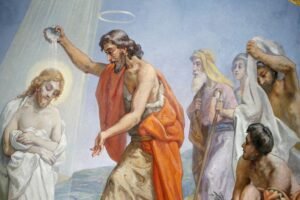
The Spirit affirmed Jesus as the Son of God at his baptism; immediately the Spirit led him into a spiritual crucible where Satan tested him.[1, 7]
Messianic Purpose
The temptations were spiritual tests of his mission. Would he rely on miraculous power for personal needs (turning stones into bread), seek worldly domination, or test God’s protection?[8, 9]
The Word as Weapon
Jesus overcame this spiritual adversity by utilizing the spiritual authority of scripture (quoting Deuteronomy), demonstrating that spiritual victory comes from reliance on the Word of God.[10]
The Psychological Dimension
The wilderness tested the limits of Jesus’ humanity, representing an extreme test of mental resilience, focus, and human endurance.[7, 11, 12]
Vulnerability
After forty days and nights without food, Jesus experienced acute physical hunger, emotional exhaustion, and severe isolation.[7, 13]
The Human Condition
The ultimate test of doubt, ambition, and the temptation to take the path of least resistance to achieve his goals was a psychological ordeal.[2, 8, 13, 14, 15]
Identity and Calling
The wilderness was a period of mental clarity where Jesus rejected human desires and embraced the psychological and emotional suffering necessary for his ultimate destiny on the cross.[2, 13]
The Metaphysical Dimension
In biblical tradition, the wilderness is a place outside of human society, often viewed as a metaphysical realm of chaos, desolation, and spiritual danger.[1, 16]
Kingdom of Darkness vs. Kingdom of Light
The encounter with Satan involves metaphysical phenomena. This encounter demonstrates an attack by the Kingdom of Darkness on the Kingdom of Light. For example, Satan transports Jesus to a high mountain to see all the kingdoms of the world, only to change his location in another moment to the pinnacle of the temple. First he tempts Jesus with power and control over the kingdoms of the world. then he tempts Jesus to demonstrate a dare-devil leap into space in order to be rescued by God. They were metaphysical phenomena, but the effects of Jesus’s capitulation would have been real. [8, 13, 17, 18]
Transcendent Intervention
The Gospel of Mark further emphasized the metaphysical nature of the the wilderness. In this Gospel, Mark notes that Jesus was ‘with the wild animals, and angels were ministering to him’. This verse bridges the physical world with the transcendent realm.[4, 16, 19]
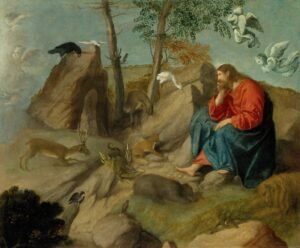
Ultimately, the wilderness represents three things. It represents a physical location, a severe mental trial of Jesus’ human faculties, and a spiritual-metaphysical triumph over the forces of evil.[6, 20, 21, 22]
Some might object that the course laid out in this article is too limited. We seem to be left with an important question: is true wilderness resilience simply a retreat into passive meditation? There is a connection between the wilderness and physical strategy. This connection will be dealt with in the next article.
(In the preparation of this work, digital research assistants and language modeling tools were utilized to organize source texts, verify historical timelines, and cross-reference literary citations.)
[2] https://www.new-covenant-church.com
[3] https://feedingonchrist.org
[4] https://learn.ligonier.org
[10] https://connectionpointchurch.org
[11] https://www.wildernesstrek.org
[12] https://lifespringschristianchurch.org
[15] https://www.viewchurch.co
[16] https://www.behindthegospels.com
[18] https://tidings.org
[20] https://renewcm.com
[21] https://scripturecentral.org
[22] https://storage2.snappages.site