Category: Mythology and Religion

Tracing mythological meanings of events and ideologies in the United States and the World
  • Justice of the Rupture

    Reading Time: 6 minutes

    Lately I’ve been thinking about the temptations of Jesus in the wilderness.  He fasted for 40 days and was hungry. During this time in the wilderness the devil tempted him three times.  The first temptation had to do with Jesus’s hunger. The second temptation, as I understand it, was connected with the human need for validation in the eyes of other people.  But the third temptation was something else altogether.  Matthew chapter 4, verses 8 and 9 imply that the ‘devil’ has the power to bestow ‘the kingdoms of the world, and the glory of them,’ if we will only worship him.  Jesus’s resistance to these temptations represents the justice of the rupture.

    And when the tempter came to him, he said, If thou be the Son of God, command that these stones be made bread.

    But he answered and said, It is written, Man shall not live by bread alone, but by every word that proceedeth out of the mouth of God.

    Then the devil taketh him up into the holy city, and setteth him on a pinnacle of the temple,

    And saith unto him, If thou be the Son of God, cast thyself down: for it is written, He shall give his angels charge concerning thee: and in their hands they shall bear thee up, lest at any time thou dash thy foot against a stone.

    Jesus said unto him, It is written again, Thou shalt not tempt the Lord thy God.

    Again, the devil taketh him up into an exceeding high mountain, and sheweth him all the kingdoms of the world, and the glory of them:

    And saith unto him, All these things will I give thee, if thou wilt fall down and worship me.

    Then saith Jesus unto him, Get thee hence, Satan: for it is written Thou shalt worship the Lord thy God, and him only shalt thou serve. (Matthew 4: 1-10) 

    The Cosmic Tyranny

    In recent years I’ve begun to think of the earth as surrounded by a closed system and ruled by a sort of cosmic tyranny. I imagine at the head of this cosmic order sits the ‘prince of this world.’  You can call him whatever you want–Matthew called him ‘the devil’.  So, when Jesus resisted the devil’s temptations, he was waging a cosmic resistance.  According to the article cited below, this cosmic resistance represents the justice of the rupture.  If I understand it correctly, this remains the central drama of mortal life.  It is the fundamental necessity of the entire human race–the only path to freedom.

    This Identifies the Christian God as the Same God Worshipped by the Jews

    I believe that this is what the Christians mean when they say their God is the same God worshipped by the Jews.  There is a cosmic order that wields power over the Earth and her inhabitants. But there is another power directly opposed to the cosmic order.  (Hopefully it is obvious that I am not talking about Jewish or Christian esotericism and the loosely related secret societies that capitulate to the cosmic order.)

    Unfortunately, the major religions of our day have taken on much of the lore of the cosmic order.  This happened quite early in Christianity’s journey through history.  Also unfortunate is the fact that the so-called Christian ‘reformers’ failed to recognize this problem.  This is doubly unfortunate because it is not only the central problem of religion.  Again, it is the central problem of mortal existence.  The failure to recognize this fact taints everything, including the current political environment.

    The Cosmic Resistance

    J. Leavitt Pearl sees this cosmic resistance in the scripture that tells of Jesus’s baptism.

    John the baptizer appeared in the wilderness, proclaiming a baptism of repentance for the forgiveness of sins.  And people from the whole Judean countryside and all the people of Jerusalem were going out to him, and were baptized by him in the river Jordan, confessing their sins.  Now John was clothed with camel’s hair, with a leather belt around his waist, and he ate locusts and wild honey.  He proclaimed, “The one who is more powerful than I is coming after me; I am not worthy to stoop down and untie the thong of his sandals.  I have baptized you with water; but he will baptize you with the Holy spirit.”  In those days Jesus came from Nazareth of Galilee and was baptized by John in the Jordan.  And just as he was coming up out of the water, he saw the heavens torn apart and the Spirit descending like a dove on him.  And a voice came from heaven, “You are my Son, the Beloved; with you I am well pleased.” (Mark 1:4-11, as quoted by J. Leavitt Pearl)

    For Pearl the key phrase is, “He saw the heavens torn apart.”  It is too easy to pass over this phrase. This may be due to what followed it. It is followed by the dramatic description of the Spirit descending like a dove and a voice coming from heaven and saying to Jesus, “You are my Son, the Beloved; with you I am well pleased.”  But according to Pearl, “The tearing open of the cosmic order is the descent of the True Justice of God, waged against the empires of this world who rule under the banner of ‘order and justice,’ but whose ‘justice’ is always only violence and oppression.”

    An Apocalyptic Text

    Pearl calls the gospel of Mark an apocalyptic text and describes John as an apocalyptic figure, but his focus is on what happened in the heavens.  “…the tearing apart of the heavens is a locus classicus of apocalyptic imagery, found in both…Isaiah 64:1, and…Revelation 6:14.”  (To risk belaboring the point, the heavens of the cosmic order are not exactly friendly to this tearing apart.)

    The heavens of the Biblical world were not only a spiritual domain and the home of God and other spiritual beings. “…they were equally the heavens above–the skies, the vault across which the stars moved in their predictable patterns.  Thus, the heavens were the domain of order and regularity. And despite their extreme complexity, their interpretation could be mastered by a skilled astrologist.” But apparently, cosmic order and regularity can be challenged.

    When this domain is torn open with Jesus’s baptism, it indicates a “rupture, a radical inbreaking of something genuinely new.  But, this arrival of the new necessarily takes the form of a disruption of the delicate harmony of the cosmos, epitomized by the heavens.”

    Pearl goes on to explain that these two opposing forces–the cosmic order and the order represented by Jesus–represent two kinds of justice: the Justice of the whole and the Justice of the rupture.  To further explain his argument, he cites Slavoj Zizek’s book, The Fragile Absolute, and Zizek’s description of the cosmic order represented by paganism:

    Against the ‘pagan notions of cosmic Justice and Balance,’ wherein ‘an individual is ‘good’ when he acts in accordance with his special place in the social edifice…and Evil occurs when some particular strata or individuals are no longer satisfied with this place, ‘Zizek contrasts Christianity, which ‘asserts as the highest act precisely what pagan wisdom condemns as the source of evil: the gesture of separation, of drawing the line, of clinging to an element that disturbs the balance of the All’ (118-121, as quoted by Pearl)

    Comparing the Capitol Insurrectionists

    Those who supported the recent insurrection at the Capitol, would like to tell us that theirs is a worthy cause. But what exactly were they fighting for? What were they fighting against? Wasn’t their leader supporting the status quo disguised as a rebel? They were fighting against the justice of the rupture.

    This may not be obvious on the surface, because their type of conservatism is not American. The American system doesn’t belong to European  conservatism. In contrast to Europe, it is the prototype of a rebel. The American system was enabled by a rebellion. So, the insurrectionists were fighting against a phenomenon that was perfectly legal under the American constitution. They were fighting against the results of a free election.

    Pearl tells us that the pagan as described by Zizek is no different from (conservative) Edmund Burke in his Reflection on the Revolution in France, or white moderates who condemned Martin Luther King Jr.’s tactics as ‘extremist’. This type of character is also no different from Fox News pundits who bemoaned the ‘disruption’ of Black Lives Matter protests.  They call these revolutionary tactics ‘evil’ because they disrupt a stable order.

    The Conservative Path of Supposed Safety

    Pearl admits that the rupture represents a risk but, alternatively, the path of supposed safety leads to the Justice of the whole, as exemplified by the philosopher Martin Heidegger who interprets ‘justice’ as ‘Compliance–that is harmonization.’  In fact, Heidegger elevates compliance and harmony to ontological principles.  The writings of Heidegger were influential in the rise of Nazism.

    Pearl contrasts Heidegger’s justice with an alternative account of justice, a justice of the rupture.  For this he cites Jacques Derrida, for whom justice is the domain of the future.

    Justice emerges as a call or a demand for responsibility to the Other.  It cannot be calculated or anticipated, because justice, if there is such a thing, is always a risk, as Derrida notes in, “The Force of Law.” (947)

    The prophet Isaiah, (64:1-2), and the Book of Revelation (6:12-15) each describe a similar view of justice as that of Derrida.  It is a justice that casts down the powerful, the oppressors.  It is a justice that destroys the class and caste boundaries that order our world, so that ‘everyone, slave and free’ find themselves on an equal footing.  For John, any social, political, or economic order that is built on oppression, built on the backs of ‘slaves–and human lives’ (Revelation 18:13) is an order that must be torn open.

    Conclusion and Caution

    (I don’t want to end this article without mentioning Pearl’s examples of the risks involved in the justice of the rupture.  These include the Terror of the French Revolution and the Stalinism that resulted from the October Revolution.  I don’t think any of us are willing to risk such things if we can avoid them, and there are things that must be understood if we want to make these kinds of failure less likely.  The challenge to the cosmic order represented by Jesus’s response to his temptations in the wilderness are central to this understanding.  We must know which order we serve and which order we fight.  Otherwise, failure is almost certain.  The cosmic order stands ever ready to creep in and take over from those who remain unaware.)
  • Adam, Noah and the Snake-king

    Reading Time: 8 minutes

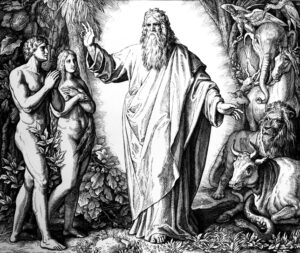
    In a previous article we learned that the words ‘Man’ and ‘Woman’ in the second chapter of Genesis have been translated from īš and ‘iššă. It seems possible that, in addition to Adam, Noah and the Snake-king have something to do with the Christian story of Adam and Eve. This article will explore three possible conclusions:

    The first man and woman of Genesis 2 were deities.
    These deities were Siva and Parvati, who is also Osiris and Isis.
    Humans had no part in a catastrophe called the Fall of Man. (This statement is probably too simplistic.)

    What Exactly were the First Man and Woman?

    There is evidence that īš and ‘iššă have the general meaning of ‘Lord’. Following are two examples provided by Edward Moor:

    “When they consider the divine power exerted in creating, they call the deity Brahma, in the masculine gender also; and when they view him in the light of destroyer or rather changer of forms, they give him a thousand names: of which, Siva, Isa, or Iswara, Rudra, Hara, Sambhu, Mahadeva, or Mahesa, are the most common…

    “Mahesa is maha, great, and Isa, Lord; the epithet is prefixed to many names of gods…”

    The Hindu Adam, Swayambhuva, is called ‘the first of men’, but he is clearly something more than human.

    “Swayambhuva, or the son of the self-existing, was the first Manu, and the father of mankind: his consort’s name was Satarupa. In the second Veda the Supreme Being (Brahm) is introduced in this way: ‘From me Brahma was born: he is above all; he is pitama, or the father of all men: he is Aja and Swayambhu, or self-existing.’ From him proceeded Swayambhuva, who is the first menu: they call him Adima (or the first, or Protogonus): he is the first of men; and Parama-Parusha, or the first male. His help-mate, Pracriti, is called also Satarupa: she is Adima, (the feminine gender) or the first: she is Visva-Jenni, or the mother of the world: she is Iva, or like I, the female energy of nature; or she is a form of, or descended from, I: she is Para, or the greatest: both are like Mahadeva, and his Sacti (the female energy of nature), whose names are also Isa and Isi. [mfn]Moor, Edward, F.R.S. “The Hindu Pantheon”. T. Bensley, London. 1810[/mfn]

    Siva and Parvati

    In “The Hindu Pantheon” īš and ‘iššă are more strongly associated with Siva and Parvati. And Moor associates Siva/Parvati with the Egyptian goddess Isis. Because Hinduism is fundamentally monotheistic, many deities who have their own attributes melt into each other and become one. It is also true that each of the deities has a consort, but the consorts can be reduced to one as well. The goddesses, in turn, are merely the female energy or ‘sacti’ of their lord. For this reason, the Supreme Being of any particular sect, whether it is Vishnu, Siva or Brahma, is said to be a hermaphrodite, with male and female attributes combined.   So it is not really clear in what way the mythology should be applied to human men and women.

    Original Sin

    For Christians, the doctrine of original sin is at least partly responsible for policies concerning women, but that doctrine is not a universal belief. Judaism and Islam have no such doctrine, but they have all proscribed the rights and equality of women to some degree.  This is particularly true of Islam. So there seems to be a common tendency that aligns with the conception of woman as portrayed in the story of the Fall of Man, and which is independent of the doctrine of Original Sin. It could be argued that a rationale for subjection is the main function of the story of the Fall of Man.  But on the other hand, maybe it is the attempt to say in mythological language what really happened.  We just don’t happen to understand the language.

    Creation Stories in Other Cultures

    There are similarities in the creation stories of many cultures between Noah and Adam. For example, Noah and Adam both had control over animals, as did the Chinese Shang-te, the Hindu Siva, and the Greek Hermes. Additional shared elements include the ark and the dove.

    In Chinese mythology, the Yin, or darkness, or the female principle is the ovum mundi and becomes the Earth, the ark or the Great Mother. Heaven, or Shang-te is the son of Earth, (or the ark), as he is ‘born’ from her womb. But he is also the builder of the ark, and the creator of Mother Earth. So she is his daughter. And since they are both born from the same circle, they are brother and sister. Heaven or Shang-te marries his mother or daughter or sister. In other words, their union is incestuous.

    Since Eve was created from Adam’s rib they are brother and sister, or father and daughter. This is true of the Greek Jupiter and Juno and of the Hindu gods, as well. “Brahma, the Supreme Being of Hinduism, is an androgynous conjunction of Adam and Eve, the universal parents of the human race.” [mfn]The Chinese Recorder and Missionary Journal”. Vol. 4, Rozario, Marçal & Co. Foochow, 1872. p. 217[/mfn]

    Similarities Between Adam and Noah

    It is interesting that Chinese, Hindu and Greek myths also identify the snake with both Adam and Noah. The woman seems to be connected indirectly.  Ancient legends say that in the golden age there was no distinction of sex.  According to Plato, “in the first arrangement ordained by Jupiter there were neither human politics, nor the appropriation of wives and children, but all lived in common upon the exuberant productions of the earth.” It was the hero-god, also called the snake-king, who instituted marriage.

    In Greek mythology marriage was instituted by Cecrops. Cecrops was a native of Egypt, who led a colony to Athens about 1556 B.C. He was a culture hero who introduced the worship of Zeus Hypatos, and forbade the sacrifice of living things. His marriage decree came about in this way:

    “He was arbitrator at the ‘strife’ of Athena and Poseidon. The women, who exceeded the men by one, voted for Athena, and to appease the wrath of Poseidon they were henceforth disenfranchised and their children were no longer to be called by their mother’s name. The women’s decision came as a shock to old Cecrops and he forthwith instituted patriarchal marriage.”

    All of the hero-gods of Greece were serpents.

    “Cecrops is a snake, Erichthonios (Cecrops’ son) is a snake, the old snake-king is succeeded by a new snake-king…What the myths of Cecrops and Erichthonios tell us is that, for some reason or another, each and every traditional Athenian king was regarded as being also in some sense a snake.”

    Adam, Noah and the Snake King
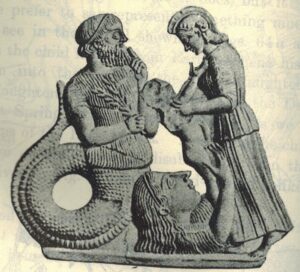
    Cecrops, Epilegomena & Themis, Fig. 63

    Jane Ellen Harrison thinks this came about because of the ceremonial carrying of snakes or figures of snakes. This was like the carrying of phalloi, a fertility charm. A Hermes of wood was the votive-offering of Cecrops, and it was possibly snake-shaped. [mfn]Harrison, Jane Ellen. Epilegomena & Themis. University Books, New York. 1927[/mfn]

    Shang-te

    In Chinese mythology, the dragon is the symbol of Shang-te. In this way, the Chinese gods resemble the fish-gods Vishnu and Dagon. The serpent was the symbol of the transmigrating diluvian god, who was reborn.  It was also the token of regeneration for those initiated into the mysteries.

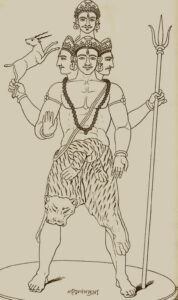
    Shang-te also gave the first couple coats of skins and instituted marriage.  In Hinduism, Siva is depicted with a coat of skins.

    Adam, Noah and the Snake-King
    Siva and His Coat of Skins, The Hindu Pantheon
    Christian Missionaries thought these were non-Christian myths

    Demon-god, Hero-god, and snake-king are the terms used by Christian missionaries in the Chinese Recorder. In that publication, these names referred to non-Christian myths. But according to the same publication, Shang-te’s dragon is identical with the serpent in the Garden of Eden.  However, in the biblical story, it was God Yahweh who provided coats of skin and instituted patriarchal marriage.

    Patriarchal marriage is clearly implied in the following verse:

    “I will make intense your pangs in childbearing.
    In pain shall you bear children;
    Yet your urge shall be for your husband,
    And he shall be your master.” (Genesis 3:16)

    In the Anchor Bible notes on verse 16 concerning ‘pangs in childbearing’, we are told that this is a parade example of hendiadys in Hebrew. The literal rendering would read “your pangs and your childbearing,” but the idiomatic significance is “your pangs that result from your pregnancy.” [mfn]Speiser, E.A. “Genesis: The Anchor Bible”. Doubleday & Co. Inc. New York, 1986[/mfn]

    And the sentence Yahweh pronounced on the serpent becomes more interesting as well.

    God said to the serpent:

    I will plant enmity between you and the woman,
    And between your offspring and hers;
    They shall strike at your head,
    And you shall strike at their heel. (Genesis 3:15)

    It seems the serpent who became the mortal enemy of the woman and her offspring (perhaps in their human character) was the serpent-king.  Both male and female are affected.  The verse says “the woman and her offspring”.  

    In a strict comparison with the Chinese myth, the serpent-king would be God Yahweh and also his son, Adam/Noah.  (According to the Anchor Bible, the deity in the Garden of Eden was “God Yahweh” rather than “Yahweh”.  This may be the personal name of another deity.)

    Possibly, these myths refer to a political development that has adverse consequences for the woman and her offspring.

    Jesus

    In the following verses from the New Testament, Jesus seems to have claimed membership in the ranks of the demon-gods.

    “For as the lightning, that lighteneth out of the one part under heaven, shineth unto the other part under heaven; so shall also the Son of man be in his day.

    But first must he suffer many things, and be rejected of this generation.

    And as it was in the days of Noe, so shall it be also in the days of the Son of man.

    They did eat, they drank, they married wives, they were given in marriage, until the day that Noe entered into the ark, and the flood came, an destroyed them all.

    Likewise also as it was in the days of Lot; they did eat, they drank, they bought, they sold, they planted, they builded;

    But the same day that Lot went out of Sodom it rained fire and brimstone from heaven, and destroyed them all.

    Even thus shall it be in the day when the Son of man is revealed.” (Luke 17:24-30)

    Lot’s connection with Noah in this passage is explained by the fact that Lot was saved from the destruction of Sodom and Gomorrah, which he believed had destroyed the whole world. He also had incestuous relations with his daughters. Something similar may have happened between Noah and his son Ham. This is the pattern of a snake king.

    In the Chinese Recorder,

    “This Demon-god or First Man or Noah is a reappearance of Adam in his deified character…or ‘Imperial Heaven’, and also the Son of Noah as being the eldest of the triplication Fuh-he, Shin-nang, Hwang-te; or Shem, Ham, and Japhet…. ‘Noah, in every mythological system of the pagans was confounded, or rather identified with one of his three sons. Fab. Vol. I. p. 343. Vishnu (one of the triplication of Bram or Monad) appears distinct from Menu (First Man) and personates the Supreme Being: yet, single, he is certainly Noah or Menu himself: as one of a triad of gods springing from a fourth still older deity (the Monad, or elder Noah) he is a son of Noah. Ibid. vol. II. 117. Considered then as Noah, we find Jupiter (the elder Monad or Chaos) both esteemed the father of the three most ancient Cabiri (Cælus, Terra, and First Man), and himself also reckoned the first of the two primitive Cabiri (Cælus and Terra); Bacchus being associated with him as the younger. This however is a mere reduplication, for Jupiter and Bacchus are the same person. &c., i. e. the First Man.”

    This, in turn, agrees with the following etymology of īš and ‘iššă.

    “Linguistically, the name Issa (‘Isa) is the Aramaic form of the Arabic Al-‘Ays, meaning ‘the water of the male’, in reference to the masculine semen, the suffixed ‘a’ in ‘Isa being the Aramaic definite article. Related to this term is the Arabic ‘Aysh, meaning ‘life’ (as in Al ‘Ayyash). The Jesus of the ‘I am’ statements was none other than the God Jesus who was Al ‘Isa or Al ‘Ays–the ultimate source of the fertilizing ‘power’ of the male.” Al ‘Ays is ‘the God of Semen’, and Al ‘Ayyash is the ‘Life-Giving God’. [mfn]Salibi, Kamal, S. “Who was Jesus?: Conspiracy in Jerusalem. Tauris Parke Paperbacks, 2007[/mfn]

  • The Genealogy of Adam and Eve

    Reading Time: 2 minutes

    The central tendency and probably the major cause of error in modern religion is the determination to separate male and female and define them as superior or inferior in relation to each other. Even today the Catholic Encyclopedia states that women are inferior to men. “The female sex is in some respects inferior to the male sex, both as regards body and soul.”

    Today, writers don’t use those terms. They might use the word ‘difference’, for example. However, the general sentiment remains the same. Christian fathers, such as Tertullian, who was born 160 AD, remain influential. Tertulian condemned all women for the part Eve played in the Garden of Eden.

    The Garden of Eden is first mentioned in the second chapter of Genesis. However, some have argued that this chapter is actually an independent creation story. In the first chapter, ‘P’ or the priestly source does not mention the Garden of Eden. He only tells us that the Elohim created the earth. The Elohim also created humans, male and female.

    The Genealogy of Adam and Eve
    Genesis 1, credit: RapidEye

    The second chapter of Genesis was written by the J source. J stands for Jehovah. This source tends to be more politically minded. He writes of the birth of gods, or of the man-god. In this version, Yahweh creates man; then he creates the woman from the man.

    This is the version that dictates the world’s social relations and organization.

    In verse 23,

    “Said the man, This one at last is bone of my bones and flesh of my flesh. She shall be called Woman for she was taken from Man.”

    Genesis 2
    Yahweh Creates Adam and Eve, Credit: gldburger

    The Anchor Bible notes that Woman and Man are translated from ‘īš and ‘iššā. E. A. Speiser says this assonance has no etymological basis in Hebrew. [mfn]Speiser, E.A. “The Anchor Bible: Genesis”. Doubleday & Company, Inc. 1986[/mfn]

  • The Warrior and His Gods

    Reading Time: 12 minutes

    In “The Stakes of the Warrior” Georges Dumézil uses his theory of the tri-functional structure of Indo-European society as a framework for the analyses of stories belonging to three different areas of the world; India, Scandinavia, and Greece. His comparative study includes the Scandinavian saga of Starkaor, the Indian tale of Sisupala (or Shishupala), and the Greek story of Herakles.[mfn]Dumézil, Georges. The Stakes of the Warrior. Translated by David Weeks. Ed. With introduction by Jaan Puhvel, University of CA Press, Berkeley, LA, London. 1983[/mfn]  In each story, the warrior commits sins and his gods demand sacrifice.

    In each story the hero sins against each of the three Indo-European functions–the functions of the sovereign, the warrior, and fertility or sexuality. In the process he fails in the very duties and responsibilities that give his life meaning. An important element in each story is the rivalry of two deities who take an interest in the life of the hero, and are directly or indirectly responsible for his crimes.

    Starkaor/Starcatherus and Odin

    For the Scandinavian tale of Starkaor there are two sources. One is the Gesta Danorum of Saxo Grammaticus (1150–after 1216). The other is the Gautrekssage, which is a redaction of the poem, the Vikarsbálkr, from the 13th or 14th century. The saga also adds additional material from ancient sources. Saxo calls the hero Starcatherus; the saga calls him Starkaor.

    Starkaor

    Starkaor/Starcatherus is either a giant, or he has giant ancestry. In the saga, his grandfather was a giant but he has a human form. In Saxo he is born with extra arms and Thor prunes them off, giving him a human appearance. The child begins life under the patronage of Othinus or Odin, but also under the hostile and watchful eye of Thor, who hates giants in general, and according to the saga, Starkaor in particular.

    Odin’ Has Designs on Starkaor

    The people of Herthjófr take little Starkaor and Vikar in after their fathers are killed in battle. Hrosshársgrani, one of Herthjófr’s men, raises Starkaor. However, Hrosshársgrani is really Odin in disguise, and he has dark designs on Starkaor. When they are still boys, Odin decides that Starkaor will bring him Vikar as a sacrifice.

    After living for nine years with Hrosshársgrani, Starkaor helps Vikar reconquer his realm, and accompanies him on many victorious expeditions. Vikar’s fleet is “becalmed” during a Viking expedition. King Vikar and his crew have a “magical consultation” and determine that Odin wants a man of the army to be sacrificed by hanging. They draw lots and the king is chosen. After this shocking development they postpone deliberations until the next day.

    The Forest Assembly

    Hrosshársgrani acts during the night. He wakes Starkaor, and takes him to forest on a nearby Island. They come upon a strange assembly in a clearing.

    “A crowd of beings of human appearance are gathered around twelve high seats, eleven of which are already occupied by the chief gods. Revealing himself for who he is, Odin ascends the twelfth seat and announces that the order of business is the determination of the fate of Starkaor…The event comes down to a magical-oratorical duel between Odin and Thor.”

    Thor’s Curses and Odin’s Blessings

    Thor hates Starkaor because his grandfather was a giant. He hates him even more because long ago his grandfather abducted a young girl. This was Starkaor’s grandmother. When Thor rescued her, he found that she actually preferred the giant over the “Thor of the Æsir”! In consequence of a lasting grudge, Thor imposes Starkaor’s first curse before the council of the gods, “Starkaor will have no children.”

    Odin compensates for this curse. “Starkaor will have three human life spans.”

    It continues in this way, the gods taking turns.

    Thor says “He will commit a villainy in each.”

    Odin answers, “He will always have the best arms and the best raiments.”

    Thor: “He will have neither land nor real property.”

    Odin: “He will have fine furnishings.”

    Thor: “He will never feel he has enough.”

    Odin: “He will have success and victory in every combat.”

    Thor: “He will receive a grave wound in every combat.”

    Odin: “He will have the gift of poetry and improvisation.”

    Thor: “He will forget all he has composed.”

    Odin: “He will appeal to the well-born and the great.”

    Thor: “He will be despised by the common folk.”

    Odin’s Price: The Sacrifice of King Vikar and Starkaor’s Exile

    As they return to the ship, Odin informs Starkaor that he must pay for the assistance he has just received. Starkaor must put Vikar in a position to be sacrificed. Then Odin will take care of the rest. Starkaor agrees to help Odin.

    The next day Starkaor suggests to the king that they carry out a mock sacrifice and Vikar agrees. Starkaor bends down the limb of a tree and fastens a noose to it and also around Vikar’s neck. Then Starkaor takes a magic reed-stick given him by Odin and thrusts it at the king saying, “Now I give thee to Odin.” Then he releases the branch. The reed-stick becomes a spear and pierces the king. The branch springs up and drags the king into the leaves, where he dies.

    “From this deed Starkaor became much despised by the people and was exiled from Hördaland.”

    The Warrior and His Gods
    The Sacrifice of King Vikar. Credit: hayatikayhan

    The Exploits and Sins of Starcatherus

    Now we depend on Saxo’s version. Starcatherus accomplishes many admirable exploits in his long career.  But after the death in battle of another master, a Swedish king, he shamefully flees from the battlefield. Next, he joins an army of Danish vikings. Starcatherus eventually serves the Danish king, Frotho, where he is a “model of martial virtue”.

    For his third sin he allows conspirators to bribe him and he kills another master, the Danish king Olo. He has already sinned against his duty to kings and his duty as a warrior. In taking a bribe for the murder of Olo he sins against the morality of the third function–not through sexuality but through greed.

    The hero has been aging during his three life spans but he keeps all of his strength until after the third crime. Finally old age, his many wounds, and his crimes burden him to the point where he wishes for his own death. He doesn’t want to die shamefully of old age so he looks for a warrior who will give him an honorable death. Providentially he meets Hatherus, the son of one of the conspirators in the murder of Olo. He confesses that he is the one who killed Hatherus’ father, (Starcatherus killed all of the conspirators).  Hatherus agrees to behead him in exchange for the money that Starcatherus received for killing Olo. Starcatherus also wishes to give Hatherus his invulnerability and tells him to stand between his head and his body after his death. In a moment of suspicion, however, Hatherus stands back and does not accept this gift.

    Sisupala and Kṛṣṇa

    Dumézil says the character of Kṛṣṇa in the Mahabharata poses problems. His story is probably a transposition of the myth of an ancient Viṣṇu. But the relationship of Kṛṣṇa/Viṣṇu provides structure comparable to the tale of Starkaor/Starcatherus.

    The story of Sisupala is not central to the cosmic conflict in the Mahabharata. Aside from his three crimes, Starcatherus was a perfect example of a defender of kingship, a warrior and a teacher. However, the Indian hero is the reincarnation of a demon that Viṣṇu has already killed twice in past lives. We learn of his previous lives after he challenges the proceedings of Yudhisthira’s sacrificial ceremony. This information, and the story of the hero’s birth, provide the justification for his hostility to Kṛṣṇa.

    A Dark Prophecy at Sisupala’s Birth

    Sisupala was born into the royal family of the Cedis. He had three eyes and four arms and he uttered inarticulate cries like an animal. His parents had decided to expose him, but they heard a disembodied voice saying that this was not the “Time” for the child’s death. He was to be slain ‘by the sword, and his slayer would be the lord of men.

    His mother demands to know “who shall be the death of this son!”

    The voice answers,

    “He upon whose lap his two extra arms will both fall on the ground like five-headed snakes and that third eye in the middle of the child’s forehead will sink away as he looks at him–he shall be his death.”

    Kṛṣṇa

    As soon as the child is placed in Kṛṣṇa’s lap, these predictions come true. Sisupala’s mother witnesses the fulfillment of the prophecy and she is fearful for her son. She asks Kṛṣṇa to forgive the “dereliction of Sisupala”.

    (Because of Sisupala’s physical similarities to Rudra/Śiva, and also because of his name, which is said to be a transposition of paśupati or lord of animals, this story is similar to the story of Starkaor/Starcatherus in its conflict between two divinities, in this case Rudra/Śiva and Kṛṣṇa/Viṣṇu.)

    Sisupala’s Offenses

    Kṛṣṇa promises that he will forgive one hundred offenses, even though they may be capital offenses. But by the time Sisupala challenges the proceedings of Yudhisthira’s sacrificial ceremony he has exhausted his one hundred offenses. His tirade against Krṣṇa is the one hundred and first offense. However, only five offenses are listed. The five sins, which Kṛṣṇa recited to the kings assembled at Yudhisthira’s ceremony are:

    1.  “Knowing that we had gone to the city of Prāgjyotiṣa, this fiend, who is our cousin, burned down Dvārakā, kings.”
    2.  “While the barons of the Bhojas were at play on Mount Raivataka, he slew and captured them, then returned to his city.”
    3.  “Malevolently, he stole the horse that was set free at the Horse Sacrifice and surrounded by guards to disrupt my father’s sacrifice.”
    4.  “When she was journeying to the country of the Sauvīras to be given in marriage, the misguided fool abducted the unwilling wife-to-be of the glorious Babhru.”
    5.  “Hiding beneath his wizardry, the fiendish offender of his uncle abducted Bhadrā of Viśāla, the intended bride of the Karūṣa!’

    Sisupala’s Offenses Against the Three Functions

    The sins are assigned to different functions. The first and second offenses have to do with the warrior function. The third offense has to do with sovereignty. And the forth and fifth offenses have to do with sexuality. However, they were all offenses against the king.

    Sisupals’a Execution

    Kṛṣṇa continues,

    “For the sake of my father’s sister I have endured very great suffering; but fortunately now this is taking place in the presence of all the kings. For you are now witnesses of the all-surpassing offense against me; learn also now the offenses he has perpetrated against me in concealment.”

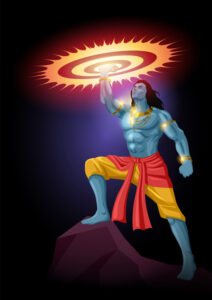
    Sisupala does not relent. He continues to scold those who honor Kṛṣṇa, who is “no king”. Finally Kṛṣṇa throws his discus, cutting off Sisupala’s head. A sublime radiance rises from the “body of the king of the Cedis, which, great king, was like the sun rising up from the sky; and that radiance greeted lotus-eyed Kṛṣṇa, honored by the world, and entered him, O king…”

    The Warrior and His Gods
    Lord Kṛṣṇa and His Discus

    There is no mention of corresponding consequences after each of Sisupala’s sins and he does not offer himself for death as Starcatherus did. Also another king, Jarāsandha, is mentioned, although he has no part in the story itself. Sisupala, although a king in his own right, is said to be Jarāsandha’s general, giving him the same position as Starcatherus, who served kings but was not himself a king. Jarāsandha is accused of holding Kṛṣṇa’s clan in jail, with plans to sacrifice them. In other words, he was under contract to Rudra/Śiva, just as Starkaor/Starcatherus was under contract to Odin. This provides another correspondence between the Scandinavian and Indian stories. However, in the Indian version human sacrifice is not as believable as it is in the Scandinavian tales. Also Śiva has no particular interest in kings, as Odin does. This only makes the Indo-European framework of both stories more apparent.

    Herakles and his gods, Hera, and Athena

    In the Greek story of Herakles, genders are reversed–the rival deities, Hera and Athena, are female. Dumézil makes an interesting observation–the rival deities in the first two stories answer to no superior judge or authority. But in the tale of Herakles, the patriarchal Zeus is given the final word.

    Herakles’s Birth and Abandonment

    Herakles’ birth is told by Diodorus Siculus (iv, 9, 2-3). When Herakles was born he was not monstrous or demonic but he had a certain excess. He was the son of Zeus and Alkmene. Zeus had taken the appearance of Alkmene’s husband, Amphitryon, in order to beget an exceptional king who would rule over the descendants of Perseus. But when Hera learned of his plans she was jealous. She caused the labor pains of Alkmene to slow down and the result was that another heir, Eurystheus, was born first. Zeus then decreed that Herakles would serve Eurystheus and perform twelve labors. In this way he would earn immortality.

    Alkmene abandoned her baby out of fear of Hera. Athena and Hera found him, and Athena gave him to Hera who began to nurse him. This saved his life. However he bit her and she pushed him away. Dumézil suggests that this is like the story of Sisupala, whose deformities disappeared at the touch of the very god who was destined to kill him. Hera is the sovereign whose first concern is to exclude Alkmene’s son from royalty and demote him to a champion. Athena is the warrior and becomes Herakles’ most trusted friend. The patronage of Athena and the enmity of Hera are a constant theme in Herakles’ life. As for his attitude to the two higher functions, the kingship and the labors, (or fights) he does not attempt to replace the king. He serves him and is sometimes rewarded, but his first sin actually involves his hesitation over entering the king’s service. Starkaor/Staratherus serves kings ostentatiously. Sisupala is a king who voluntarily serves as a general of another king.

    The Sins and Penalties of Herekles

    For his hesitation in obeying Zeus and entering the service of Eurystheus Hera strikes him with madness, causing him to kill his own children. He is consigned by Eurystheus to perform twelve labors as well as additional sub-labors.

    His next sin is the killing of an enemy by a shameful trick, rather than in fair combat. For this sin he contracts a physical disease. At this point he has no choice but to become a slave of Omphale, Queen of Lydia.

    The penalties are not cumulative with Herakles and he is cured of them each time, until the last one. After a new series of “free” deeds he forgets that he has just married Deianeira, and he takes another lover. Deianeira sends him a cloak that she thinks contains a love potion. However, it contains the poisoned blood of Nessos and it gives Herakles an incurable burn. Two of his companions consult the oracle at Delphi in his behalf and Apollo tells them,

    “Let Herakles be taken up to Mount Oeta in all his warrior gear, and let a pyre be erected next to him; for the rest, Zeus will provide.”

    The Death of Herakles

    When all is made ready, Herakles voluntarily climbs onto the pyre and asks each one who comes up to him to light it. No one but Philoktetes has the courage to light the pyre, and Herakles gives him his bow and arrows. Immediately after Philoktetes lights the pyre “lightening also fell from the heavens and it was wholly consumed.”

    But later the arrows caused the death of Philoktetes.

    Herakles's Pyre
    The Pyre. Credit: Ian

    Summary: Three Myths Compared

    The strongest similarities are between Greece and Scandinavia.

    1.  The divinities who oppose each other over Herakles and Starkaor are those of the 1st and 2nd functions. The ones in India (Krṣṇa/Viṣṇu and Rudra/Śiva) don’t fit in the tri-functional structure but they compare to Odin and Thor in other aspects.

    2.  Herakles is reconciled after his death with the sovereign Hera, wife of Zeus. The one who benefits from the death of Starkaor is Höṑr, (Hatherus) who is close to Odin, (the sovereign, and dark god comparable to Śiva). Sisupala is reconciled with Krṩṇa/Viṣṇu.

    3.  Herakles and Starkaor are similar in their basic nature. Herakles has no demonic component and Starkaor is made human. But Sisupala remains demonic and Sivaistic.  Neither Herakles nor Starkaor provoke the deity who persecutes them. Sisupala does however, although Krṣṇa does not persecute him.

    4.  Herakles and Starkaor are more interesting than the deities, but Sisupala is just an incorrigible Indian Loki in the career of Krṣṇa.  The reader is on the side of Starkaor and Herakles, and also on the side of Athena, but only as Herakles’s helper. The Indian story is more complementary to Krṣṇa/Viṣṇu, and against Sisupala.

    5.  The deaths of Herakles and Starkaor are good and serene. That of Sisupala is the result of a “frenzied delirium”.

    6.  A young man is asked to kill the hero in the stories of Herakles and Starkaor–but not in the story of Śiśupāla.

    7.  In the stories of Herakles and Starkaor the gift or payment is ambiguous. The arrows kill Philoktetes and Hatherus chooses not to receive the essence of Starkaor.

    8.  The types of Herakles and Starkaor are the same, a wandering hero, redresser of wrongs, given to toil

    9.  Both are educators.

    10.  Both are poets.

    Other similarities tie India and Scandinavia together, in contrast to Greece

    1.  Śiśupāla and Starkaor are born with deformities. Heracles is not.

    2.  The Indian and Scandinavian legends make much of a royal ideology. The Greek legend outlines the opposition of Erystheus and Herakles but does not dwell on it.

    3.  The faults of Sisupala and Starkaor are foreordained. Sisupala’s fate is decided by his demonic ancestry. Starkaor’s is decided by lots.

    4.  Given that Jarāsandha completes the legend of Sisupala, India and Scandinavia both charge the heroes with the human sacrifice of kings. The Greek legend does not.

    5.  Starkaor and Sisupala are both beheaded. Herakles is burned.

    6.  The deities in the stories of Starkaor and Sisupala have no higher judge. Krṣṇa/Viṣṇu and Rudra/Śiva don’t answer to Brahma, for example. The divinities in the Greek story are supervised by Zeus.

    There aren’t as many similarities between Greece and India, but the failings of Sisupala and Herakles are similar.

    1.  The first sin offended a god in the case of Herakles who resisted the command of Zeus; and a sacrificer in the case of Sisupala who stole the king’s sacrificial horse. In Starkaor’s case his failing resulted from an excess of submissiveness towards a god.

    2.  The second sin in the case of Sisupala and Herakles involves the unworthy betrayal of a warrior. For Starkaor it was a shameful flight on the battlefield.

    3.  Sisupala and Herakles have no particular prejudice against the sensuous aspect of the third function, but Starkaor, who is ruled by Odin and Thor, condemns this kind of weakness.

    See Also: The Occult Foundations of American Healthcare

  • American Civil Religion and the Enlightenment

    Reading Time: 4 minutes

    In his theory of American Civil Religion, Robert Bellah attempted to attribute America’s sense of community to a common religious factor independent of the church. He said that a specifically American ideology has worked to form a homogenous and unified culture from unrelated immigrants. Because of the United States’ unique beginning, Civil Religion is uniquely crucial to Americans’ sense of unity.[mfn]Bellah, Robert Neelly, The Broken Covenant: American Civil Religion in Time of Trial. University of Chicago Press. 1992[/mfn] However, it was Jean-Jacques Rousseau who first argued that every society needs a purely civil profession of faith to integrate all members. For this reason, the idea of civil religion should be examined in the context of the Enlightenment. This article will explore American Civil Religion and the Enlightenment, and the influence of these movements on modernity.

    Civil Religion Failed Americans in the Iraq War

    Surveys have shown the concept of Civil Religion is a useful model in analyses of American attitudes.[mfn]Baker, Wayne. America’s Crisis of Values: Reality and Perception. Princeton University Press. 2006[/mfn]However, after the attack on the Twin Towers some were shocked when they observed that the concept has no brakes. Americans, both Republicans and Democrats, went willingly to war in Iraq based on questionable evidence for the presence of al Qaeda and weapons of mass destruction. Apparently Civil Religion provides no moral compass. In fact, since the fall of the Soviet Union, ‘civil religion’ has been a euphemism for a religion of war. The Enlightenment has been criticized in similar ways.

    One goal of the Enlightenment was the end of Europe’s Absolutist political organization.  Although Absolutism had been a response to the religious wars of the Reformation, it was seen by the ‘Philosophes’ as an unnecessary annoyance.  Two additional Enlightenment concerns were the equality of man and the place of morality in politics.

    The Enlightenment

    The Enlightenment was an historical period beginning with the eighteenth century and ending with the French Revolution in 1789. The term Enlightenment also refers to a method of thought developed during this period, which remains influential in political theory. The movement has always inspired a certain degree of mistrust. In the eighteenth century, the term ‘philosophe’ was meant to distinguish Enlightenment writers from other philosophers. The Philosophes were considered ‘popularizers’ of a doctrine, working to influence public opinion in their favor. In the most violent years of the French Revolution, the ideas of the Enlightenment were further discredited because of their perceived role that revolution.

    The Enlightenment Replaced Thomas Hobbes’ Absolutism

    The theory of political Absolutism, which the Philosophes worked to discredit, is attributed to Thomas Hobbes, who observed during the turmoil following the Reformation that humans fear each other. Hobbes argued that an external sovereign was necessary to maintain order in society. But Enlightenment thinkers had a very different view of human nature, arguing that reason creates a virtuous public individual.

    In the Absolutist pursuit of peace, Hobbes had declared that personal beliefs must remain private. Publicly, people were expected to agree with the religion of the monarch. But the Philosophes had no memory of the religious conflicts that Absolutism had tried to address. This ‘forgetfulness’ has been an enduring characteristic of modern political rhetoric, one result being that Enlightenment assumptions were in conflict with the experience of the past1.

    Deism: the Religion of the Enlightenment

    The Enlightenment’s religion was deism, which holds that although God created the world, he is no longer directly concerned with the trials and tribulations of humanity. According to critic Reinhart Koselleck, Enlightenment thinkers put reason and the will of society in the place of God (p. 56). In retrospect, it seems clear that one of the unforeseen functions of the Absolutist state was to transition from the Christian focus on the heart of man to the Enlightenment’s obsession with society as a whole. Along the way, the foundation of western thought became a philosophy of materialism.  Now all causes are economic or social.

    In this view, in my opinion, Capitalist ideology and Marxist ideology can be seen as two sides of the same materialist coin. Critics have argued that if the Enlightenment was not successful it is because the system had no transcendent values. Such a system degenerates to physical, biological, and economic considerations, and causes more problems than it solves.

    Unrestricted Capitalism Belongs to the Enlightenment, Not to Christianity

    Strangely, although Enlightenment thought has become inseparable from Christianity their former differences are no longer discussed. In an older critique from the Catholic point of view, Hilaire Belloc argued that both Absolutism and Enlightenment were solutions for society in lieu of former religious solutions and interpretations. More specifically, he argued that unrestricted capitalism was not a Christian concept. True to his religious point of view, he also argued that capitalism was only made possible by changing social circumstances and by Calvin, who divorced good works from the possibility of human salvation. The only motivation left for industry was personal economic gain.[mfn]Belloc, Hilaire. The Crisis of Civilization. Fordham University Press. New York. 1937, pp. 116, 126[/mfn]

    The Guilds

    Of course, the guilds and city-states of the middle Ages were another restraining influence on unbridled capitalism. The guilds saw capitalism as different from the economy of the free cities only in its requirement for large amounts of capital. Guild rules guarded against this type of competition making it possible for the common man to become a master of his craft and establish his own shop. The cities of the middle Ages had become free by petitioning the king for a charter. In this way they had cut out the middlemen in the collection of rents and taxes, including Catholic bishops who were an integral part of the feudal system and who collected rents in their own behalf.

    Conclusion

    The theory of civil religion assumes that other countries differ from America because they share a cultural and religious background Americans never had. However, Europe and America were involved in many of the same philosophical and political debates. And both countries have struggled to find a basis for community in lieu of the church’s influence.

    1. Koselleck, Reinhart. Critique and Crisis: Enlightenment and the Pathogenesis of Modern Society. Oxford, New York. 1988, p. 39 [↩]