Category: Mythology and Religion

Tracing mythological meanings of events and ideologies in the United States and the World

  • Desperados

    Reading Time: 2 minutes

    desperado is a desperate or reckless person, especially a bold criminal or outlaw. The term is most commonly associated with dangerous characters from the American Old West who were pushed by desperation to commit violent acts. That word now describes the government and political system of the United States of America. In this and subsequent articles I will address the desperados directly.

    Rational Versus Irrational Empires

    If responsible leaders of an empire want to protect the well-being of citizens, it is to their credit. Citizens depend on the world’s domestic and international economies and they contribute to the Empire. Rational leaders operate accordingly.

    By this standard, you are irrational. You act as if everyone but you is expendable. In reality, the end of empire is not your calamity alone. It affects all of us. You are trying to come out on top with a worldview that is not even real. This is the behavior of desperados.

    The Example of Cain

    Consider the story of Cain. In the book of Genesis, Cain killed his brother Abel in a fit of jealous rage. Banishment was the punishment for murder in those days, and Cain’s punishment for spilling his brother’s blood was to be sent away by himself. The spilling of another’s blood on the ground was an offense against the land, and such a person could not remain among his people. It would put them all in danger. But who exactly sent Cain away?

    Cain Was Not Banished by a Race or Class of People. He Was Banished By God.

    Some of you think God was unfair when he chose Abel’s sacrifice over Cain’s. So, because you sympathize with Cain’s state of mind, you excuse his crime. It has come to the point that you identify as a race or even a nationality in competition with the descendents of Abel. This too is madness. The Bible says it was God who banished Cain, not a race or class of people. You might be able to defeat entire groups of people, but you are no match for God.

  • Project 2025, Opus Dei & the Mormons?

    Reading Time: 6 minutes

    I’ve been re-reading an article from my files about the Mormon Mafia and the JFK assassination by John F. Sweeney. I haven’t written about Sweeney’s paper and I don’t intend to write about it today. It is quite damning and I don’t want more trouble in my life than I’ve already had. Another reason I haven’t written about it is the hundreds of JFK assassination theories that already exist. No, instead this article is about a book cited by Sweeney, The Cleansing of America1 by Willard Cleon Skousen. My question: Is it true what some are saying that we should be connecting Project 2025, Opus Dei & and Mormons?

    Project 2025, Opus Dei & the Mormons
    Conspiracies

    If you like to research the books you read, as I do, I should warn you that Cleon Skousen’s book is on another level of believability. It does not depend on sources. In fact, it doesn’t depend on reality at all. Skousen claims to know God’s plan for the United States and the World. And as we all know too well, such beliefs are the political currency of our time.

    Cleon Skousen Left Instructions For Future Publication of His Book

    According to the preface, this book represents years of writing and speaking about prophecy and the latter days relative to the United States. Skousen told his family that he wrote it for them, but he didn’t feel comfortable going public with it until the time was right. He left instructions for future publication and assured his family that they would know when the time was right. It would be a chaotic time with many horrors. For example, people would abandon the constitution. (Apparently the time was right in 2010.)

    Skousen: “The Restoration of the Gospel is What Peter Had in Mind When He Talked About ‘The Restitution of All Things”

    According to the Introduction, this book is a sequel to The Majesty of God’s Law. Skousen relied ‘almost entirely on the Bible and standard secular sources’ for that first book. However, for this prophecy concerning the last days in America he had to use the marvelous works of the Restoration (The Book of Mormon). Skousen believed the restoration of the Mormon Church fulfilled the Apostle Peter’s vision of the ‘restitution of all things’.

    Summary of the Introduction

    The central theme of The Cleansing of America is the preparation of America for six major purposes:

    • The restoration of the Constitution
    • The adoption of God’s law
    • The introduction of a Zion society under the Law of Consecration with individual stewardships.
    • The great last gathering of Israel
    • The coming of the ten tribes
    • The building of the New Jerusalem
    Chapter 1: The Divine Destiny of America

    In chapter one we learn that the end goal is the ‘divine destiny of America’. But first, nine things must happen:

    America Must Be Cleansed so that the Restored Gospel can Flood the Earth and Prepare Israel for the Last Gathering

    • The message of the restored gospel must flood the earth in order to search out the remnants of Israel and prepare them for the great last gathering. This has increased since 1989 because the world has opened up.
    • But first we must cleanse America. The near future will see the fulfillment of the time of the gentiles in America. At that time, the wickedness of the gentiles will have so thoroughly sinned against the gospel and desecrated the land that it will go beyond the further endurance of God.

    The Earth Will be Cleansed by a Scourge. The scourge Will Eliminate Wickedness among the Gentiles and Church Members.

    • The Lord says the means of this cleansing will be a desolating scourge, which will eliminate the elements of wickedness among the gentiles as well as the members of the church.

    Church Members Will Be Called to Flee to America Before it is Sealed Off

    • After America is cleansed, the members of the church worldwide will be called to flee to America before it is too late. Also, those who do not want to be drafted into the military world dictatorship will be called to flee to America before it is sealed off.
    • The Western hemisphere will then be sealed off so that it cannot be attacked. The roaring seas will prevent anyone from reaching America either by sea or by air.

    America Will Be the Only Peaceful Place on Earth, Allowing the People to be Organized According to God’s Law.

    • The scripture says at that time America will be the only place on the face of the earth where there will be peace. This will allow the people to be organized according to God’s law. Zion’s cities will be built up to provide freedom, peace and prosperity for the inhabitants of all faiths and the new Jerusalem will be set up as the capitol to govern the entire land.

    Jesus Will Appear to the Jews and Leaders of the Military Dictatorship After the Battle of Armageddon

    • After the Battle of Armageddon, Jesus will appear to the Jews and the leaders of the military dictatorship will be wiped out. With only a sixth of the army surviving, the battered remnants will flee back to their homes. America will no longer need to be sealed off. Thereafter, the New Jerusalem in America will be the Zion from which shall go forth the law with the word of the Lord from Jerusalem.

    After the Fall of Gog and Magog, the Remaining Nations Will Fight Among Themselves. The Ten Tribes Will Journey To America and Then Go Out Again to Warn the Nations.

    • After the fall of Gog and Magog, following the Battle of Armageddon, the remnants of the remaining nations will be fighting and quarreling among themselves. Meanwhile, the ten tribes will make their miraculous journey to the temples in America. Twelve thousand will be chosen from each of the tribes. These 144,000 will go out among the nations to warn them for the last time. Those who reject their message will be sealed up to destruction at the time of Christ’s second coming.

    Before the Second Coming Gigantic Changes Will Take Place on the Surface of the Earth.

    • And just before the second coming there will be many gigantic changes on the surface of the earth. The continents and island will become one land. The mountains will be lowered, the seas will be forced back to the poles, and the earth will be restored to its paradisiacle glory just as it was before the Fall.

    According to Skousen, the Lord has said that all of these things must occur before the ushering in of the millennium. If that’s the agenda, where we are now on this continuum?

    The Signs of the Times (According to Skousen)

    “The hedonistic disintegration of the culture in recent years is virtually unbelievable. All the elements of rot and corruption which have destroyed three previous civilizations on this continent are now spreading the same poisonous decadence on every level of American society.

    Who would ever have guessed that America would outlaw Bible reading, prayer, or the ten commandments in public schools? Or legalize the abortion of 40 million American babies in a single generationor tolerate a flood of murders, robberies, violent assaults and rapes exceeding that of any other nation in the world? [W]ho would have thought that with the hundreds of millions spent to build prisons, the most dangerous types of criminals would be turned loose on the streets because officials claimed they had no room to hold them? Or the filth pouring out in books, magazines, television and motion pictures? [Who woud have believed] the thousands of children being sexually abused, even by their own parents? Or the legalizing of sodomy as an optionally judicially protected lifestyle and calling it part of the new morality?” (Skousen, Chapter 1)

    Skousen then informs the reader that many prophets have predicted doom for this nation. They have said the only way to avoid destruction is for the entire people to repent. However, not one of the prophets believed repentance would take place. Not even Maroni, the last prophet of the Nephites.

    The Importance of Civilizational Decline in Right-Wing Scenarios

    I explained in a previous article the importance of civilizational decline in right-wing scenarios. In this book, Skousen spins his own version of certain doom for the United States. His warns the gentiles who are strangers to the law of God that the sword of the justice of God will come upon them if they fail to repent.

    Don’t Give Goodness a Bad Name

    It’s a terrible thing to hold someone’s religious beliefs up to ridicule. But if those beliefs result in judging and physically destroying entire nations, they mock the patience and good will given to the Mormons by the American people.

    No doubt as members of the human race we all have much to repent for, the Mormons Church included. I’m not thinking so much of church members who have strayed. I’m thinking of the church’s leadership.

    Was Skousen’s prophecy of a scourge behind Donald Trump’s failure to act during the Covid crisis? Are South African refugees members of the church fleeing to America before it is sealed off. Could the imprisoning of immigrants have something to do with building a Zion society?

    This may sound farfetched, but what else can explain the unflinching cruelty of the current administration?

    1. The Cleansing of America, W. Cleon Skousen, Valor Publishing Group, April 2, 2010. ↩︎
  • Misogyny is Part of a Complex Ideology

    Reading Time: 7 minutes

    Often misogyny is part of a complex ideology. But it’s not clear which came first–the misogyny or the supporting ideology. For committed misogynists, hatred is a preference. Francis Parker Yockey and Baron Julius Evola were both misogynists. Kevin Coogan attributes this in large part to occult influences. The most prominent source of far right occult beliefs in the postwar period was Theosophy.

    Helena Petrovna Blavatsky

    Among Yockey’s possessions when the FBI arrested him was a citation for the June 1937 issue of The Theosophical Forum, an American journal of the Theosophy Society. The Russian-born mystic, Helena Petrovna Blavatsky founded the Theosophical society in New York City in 1875. In 1888, she published her book, The Secret Doctrine. Blavatsky’s doctrine basically turned the evolutionary worldview on its head. However, she had no intention of replacing evolution with biblical creationism. Her work resulted in countless forms and expressions of mischief.

    Root Races

    According to Blavatsky, the world has seen the rise and fall of seven “Root Races”. This rise and fall has taken place many times over. Now (in Blavatsky’s time) the Aryan, or fifth Root Race, dominates the world. However, the Aryans are at the end of a karmic cycle.

    Blavatsky taught that the Kali-Yuga was a time of great destruction. But its end was coming. This meant the beginning of the new Sixth Root Race. And the Sixth Root Race would begin the ascendancy of man toward the highest, Seventh Root Race of god-men.

    Curiously, Blavatsky’s Root Races were not biological entities. They were psychic entities. But in spite of this, her arguments were very influential for the racist right in both Germany and Austria. They ‘proved’ the Aryans were distant spiritual descendants of the highest root race, descended from the degenerate Atlantean tribes who themselves descended from the original god-men.

    Traditionalism vs Evolutionism

    The subterranean world of the high occult enveloped Yockey. Thanks to his occult interests, he saw himself as part of an underground elite, a secret new race of god-men. He wrote extensively about polarity and he developed sado-masochistic inclinations. To understand him, it is necessary to examine the writings of Julius Evola, the most important and most influential fascist high-occultist in postwar Europe.

    In his book, Revolt Against the Modern World. Evola argued that every epoch has its own myth. Democratic evolutionism is the Kali-Yuga’s myth. The myth of the new age, however, will be the Traditional worldview.

    Tradition teaches that mankind did not come from lower forms. It has higher origins. The lower represents a degeneration from the higher. Like Blavatsky, Evola claimed that today’s Aryans are the spiritual descendants of the highest root race. This highest root race was a ‘divine’ race. But it mixed its seed with the inferior human race, and so it is no longer with us.1

    Tradition, in more recent eras, developed a variety of myths referring to races as bearers of civilization and to the struggles between divine races and animal, cyclopic, or demonic races. They are the Aesir against the Elementarwesen; the Olympians and the heroes against giants and monsters of the darkness, the water, and the earth. They are the Aryan deva fighting against the asura, the enemies of the divine heroes; they are the Incas, the dominators who impose their solar laws on the aborigines who worshipped ‘Mother Earth’.

    Julius Evola, as quoted by Kevin Coogan p. 304

    As mentioned in a previous article, Evola was an early critic of Yockey’s Imperium. However, he merely thought Yockey was unrealistic about the timeframe of the fascist takeover. Evola and Yockey agreed on their basic ideology.

    René Guénon

    René Guénon was also an important figure in the European occult underground. Evola and Guénon had a disagreement about man’s relationship to the gods, however Guénon’s Traditionalism remained important within the European far right. And although Guénon eventually converted to Islam, he remained close to ‘traditionalist’ elements of the Catholic Church.

    Guénon taught that the modern age’s interest in democracy, mass culture, and materialism are all manifestations of the Kali-Yuga. The Kali-Yuga has infected thinking to the point where Western philosophy is purely human in character. Now philosophy is merely part of the rational order, which is inferior.

    The ideal order is a sort of genuine supra-rational and non-human traditional wisdom. Humans can’t achieve this kind of wisdom because ‘Truth’ is not a product of the human mind. It exists independently of ourselves. All we can do is apprehend it (Coogan, p. 294).

    Evola embraced this argument completely. He shared Guénon’s hatred of ‘mere human logos’. He believed that all the Renaissance had accomplished was to usher in the exaltation of the individual. Greece’s true zenith was not in the time of Socrates. It was during the mythical Heroic Age of Heracles.

    Traditionalism and the Un-human Ideal

    A human-like ‘personal God’ did not rule Evola’s universe. It was ruled by a numen. He defined a numen as an immutable naked force, an essence free of passion and change, one which creates distance with regard to everything which is merely human, a solar realm of Olympic peace and light, of divine regality. Borrowing from Guénon, he claimed this vision of pure being, the Hindu Satya-Yuga, corresponded in the West to Hesiod’s Golden Age.

    Like Spengler, he believed fascism was valuable only because it would bring on the dissolution of the old world in the Kali-Yuga. The old world’s destruction was necessary in order for the new age to arise. For Evola, fascism was merely a political form of Dada.

    Coogan on The Hermetic Tradition

    To help his readers understand Evola’s argument about God, Coogan examines Evola’s 1931 book The Hermetic Tradition. He reports that when Avaloka, a journal devoted to Hermetic thought, published a review from a section of Evola’s book, The Tree, the Serpent, and the Titan, the journal’s editor, Arthur Versluis, warned his readers that there is something Promethean, if not Luciferian, in Evola’s perspective. Coogan agrees (Coogan p. 296).

    The World Tree

    According to Evola’s ideology, the tree is an axis mundi joining two worlds: the solar world of immortality and timeless knowledge (Being) and the telluric world of Mother Earth (Becoming). This view associates Becoming with women, earth, and chaos symbols like dragons.

    In his book, Evola examines the dual symbolism of the Tree, namely its identification with notions of immortality and supernatural knowledge as well as its association with fatal and destructive forces like dragons, serpents, and demons. But of course Evola is talking about the World Tree. Coogan identifies three famous trees representing universal force. They are the Tree of the World, and the two biblical trees: the tree of life and the tree of knowledge. Each of them symbolizes the universal force linked to supernatural knowledge, immortality, and the power of domination. This universal force has a feminine nature.

    Misogyny is based on a complex ideology
    The Idea of a Danger. Credit: George Cotayo
    A Danger or a Promise?

    These trees also contain the idea of a danger. On the one hand, the tree symbolizes a temptation which brings ruin and damnation upon the one who succumbs to it. But it is also the object of conquest which transforms he who dares to undertake it into a God. It might even transfer the attributes of divinity and immortality from one race of beings to another.

    Adam tried to eat from the Tree of Knowledge and become godlike. He failed. But according to some legends, others have succeeded. These include the Hindu god Indra, Odin, Mithras, and Heracles. The legends tell us

    …of an undertaking which involved risk and a fundamental uncertainty. In Hesiod’s Theogony, and typically in the legend of the king of the Woods, Gods or exceptional men are seen as taking possession of power which can pass, along with the attributes of divinity, to whoever knows how to seize it…But among those who make the attempt, some force a way and triumph, and others fall, paying for their daring, experiencing the fatal effects of that same [primordial female] power.

    Julius Evola, as quoted by Coogan, p. 297

    Coogan objects to Evola’s presentation of this drama. He thinks the real question is whether man should even attempt to rival the gods. In mythology there are only two answers to this question, and they are in opposition to each other. They are the ‘magico-heroic’ answer and the religious answer.

    According to the magico-heroic view, he who attempts to become one with the gods but fails, is simply a being whose fortitude and good fortune were not equal to his daring. In the religious interpretation, however, such misfortune is changed to guilt, the heroic attempt [is changed] to a sacrilegious and cursed act not because of its failure, but in itself.

    Coogan, p. 297

    Adam

    Misogyny is Part of a Complex Ideology
    What happened to Adam is the only thing that could have happened to him. Credit: Grafissimo

    Coogan argues that what happens to Adam is the only thing that could have happened to him. Adam becomes one who has sinned. He has no alternative, therefore, but to seek expiation, and above all to renounce the wish which led him to that undertaking. The idea that the conquered can still think of reconquest, or intend to hold firm to the dignity which his act has earned him, appears from the religious perspective as ‘the most reprehensible Luciferism’ (Coogan p. 298). Yet, the heroic viewpoint persists.

    Hermes

    The Hermetic tradition represents the heroic viewpoint. Hermes is not only the messenger of the Gods; he is also one who succeeds. He takes from Zeus his scepter, from Venus her belt, and from Vulcan, the tools of his allegorical craft. In Egyptian tradition, Hermes became Hermes Trismegistus. He is the figure of one of the Kings and masters of the primordial age who gave man the principles of a higher civilization.

    The Fallen Angels

    Fallen Angels
    From Their Union Sprang the Nephilim or Watchers. Credit: francescoch

    We also have the account of fallen angels in the Book of Enoch. Coogan argues that it wasn’t merely their desire for the women that caused their downfall. There is power in woman’s relationship with the Tree, and power is what the angels were really after. When the angels became united to power, they fell and came to earth. They alighted on a high place of the earth (Mount Hermon), and from their union with the women sprang the Nephilim or Watchers. The Watchers teach the Royal Hermetic Art by which man can control the Gods.

    Evola updated and reissued The Hermetic Tradition in 1948. This was three years after the defeat of the ‘Heroes’ in World War II. For Evola, losing the war was not a metaphysical punishment. It was a simple defeat. He never stopped pursuing the quest for power/knowledge, for immortality, for domination over the Tree/Female. The Hermetic Tradition is a vision of a new race of men/gods.

    What Guénon and Evola Had in Common

    According to Coogan, Guénon was different than Evola. He thought Catholicism was the only tradition that could provide the ruling mythos for Europe (p. 300). But I think Coogan gives Guénon too much credit. In Guenon’s scheme, the elite will rule the world using primordial teachings found in several distinct traditions. But that is a discussion for another time.

    1. Kevin Coogan, Dreamer of the Day: Francis Parker Yockey and the Postwar Fascist International, Autonomedia, Brooklyn, New York, 1999, pp. 291-292 ↩︎

  • European and American Fascism Are Connected

    Reading Time: 5 minutes

    Where did Christian nationalism come from? What’s so special about Carthage? Both of these concepts have echoes in the European Right. In other words, European and American Fascism are Connected.

    The Christian Nationalist Party

    Francis Parker Yockey and two associates launched the European Liberation Front (ELF) sometime in late 1948 or early spring 1949. His associates were John Anthony Gannon and Guy Chesham. ELF’s manifesto was The Proclamation of London. ‘Even at its height, the ELF only had about 150 supporters. Its main task seems to have been the production of anti-American neutralist propaganda.’1 (p. 175)

    In either late 1949 or early 1950 Yockey returned to America hoping to find poitical and financial supprt for the ELF from the Christian Nationalist Crusade (CNC), the largest American far-right group in the immediate postwar period. The group’s founder, the Reverend Gerald L. K. Smith, was a flamboyant demogogue and fanatical anti-Semite who began his career as an advisor to Louisiana Govrnor Huey Long, After Long’s assassintation, Smith helped co-found the Union Party with Father Coughlin and Doctor Francis Townsend. Smith lived in Detroit during World War II and enjoyed the patronage of Henry Ford. In 1947 he created the Christian Nationalist Crusade/Christian Nationalist Party as the postwar continuation of his America First Party.

    Kevin Coogan p. 220

    The St. Louis Police Department gave the FBI a memorandum about this meeting. Yockey gave a speech under his pen name of Ulick Varange. The subject was the underground working of the party in France, Germany, England, and Belgium.

    All remarks at meeting were directed against the Communitst, Jews, Negroes, and Republican and Democratic Parties…VARANGE stated that he attended the trials at Nuremberg and other places and spoke of the unfairness of the trials and the importance of the testimony of the Jews. He also stated that we will have a Nuremberg trial in this country some day…

    St Louis Police Department memorandum, as reported by Coogan, p. 221

    Beyond Right and Left

    In the last article, Marco Tarchi said Tolkien, the fantastic, the saga, had made a ‘group-mind’ possible. This quote is from his programmatic Beyond Right and Left. (By beyond, he means the conventional definitions of these two positions.)

    There is a recent American book arguing the same thing. It’s author, Verlan Lewis is currently making the rounds in the United States. Several YouTube channels have interviewed him. In this one, the hosts seem a little uncomfortable with Verlan’s arguments. They may not have been aware of its echo in the European Ultra Right.

    Richard Mellon Scaife and The League to Save Carthage

    In the foyer of Richard Mellon Scaife’s Pittsburg mansion stood a brass elephant on a mahogany stand. Visitors might have thought it was the mascot of the Republican Party. This would have made sense because Mellon’s forbearers had been a financial mainstay of the Republican Party for a century. They were founders of Mellon banking, Alcoa Aluminum and the Gulf Oil Empire. But this elephant was actually paying homage to Hannibal, the fabled military strategist. Hannibal had scaled the Alps on elephant back to launch a surprise attack on the Roman Empire. This homage to Hannibal served as inspiration for a private organization that Scaife founded in 1964.

    In his 2009 unpublished memoire, Scaife claimed to describe a ‘richly conservative life’. He likened his secret organization of wealthy men to the Romans who failed to prevent the fall of Carthage. He called them the League to Save Carthage. They waged a strategic war of ideas aimed at sacking American politics. According to Jane Mayer, Scaife’s memoire serves as a secret tell-all about the building of the modern conservative movement.2

    In his memoire, Scaife estimated that in a period of fifty years he had spent a billion dollars on philanthropy. Over $600 million of that had gone into influencing American public affairs.

    Bachofen Claimed Rome’s Destruction of Dido’s Carthage was a Spiritual Struggle

    Chapter 32 of Coogan’s book covers Evola’s Revolt Against the Modern World. In this chapter, Evola describes a strong emphasis on the masculine, as opposed to the feminine. Coogan cites Evola’s use of Johann Jakob Bachofen’s justification for this view in The Myth of Tanaquil (Die Sage von Tanaquil).

    Rome’s central idea…the idea underlying its historical state and its law, is wholly independent of matter, it is an eminently ethical achievement, the most spiritual of antiquity’s bequests to the ensuing age. And here again it is clear that our Western life truly begins with Rome. Rome is the idea through which European mankind prepared to set its own imprint on the entire globe, namely the idea that no material law but only the free activity of the spirit determines the destinies of peoples.

    Campbell, introduction to Myth, Religion and Mother Right p. 1, (as quoted by Coogan p. 307)

    Bachofen has had a covert influence on both the Left and the Right. He was a great influence on Julius Evola. Thanks to Bachofen, Carthage has become a central idea for the Ultra Right.

    ‘Marx and Engels praised Bachofen’s concept of primitive communism in early societies. Evola, however, emphasized the Bachofen who believed that the transition of human society from matriarchy to patriarchy was the crucial moment in the evolution of human freedom.’3

    ‘Bachofen believed that Rome’s destruction of Dido’s Carthage was a spiritual struggle. It was a clash primarily of Grundanschauungen, spiritual ideals, and not of merely economic and political interests’ (Coogan p. 308). Integral to this argument was Bachofen’s claim about Christianity and other Oriental cults of late Imperial Rome. He claimed they were not merely foreign incursions:

    ‘On the contrary, [they] marked the re-emergence of an attitude to nature, history, and the state that had always been there but that Rome had tried to suppress’– namely its underlying matriarchy.

    Grossman, Basle and Bachofen, p. 175 (As quoted by Coogan, p. 308)

    Along the same lines, Evola argued that Heracles was the West’s first great mythic hero. Heracles dominated the Tree/Female life force principle by obtaining ‘Hebe, everlasting youth. By contrast, Dionysus stood for a ‘Chthonic-Poseidon from of manhood (Coogan, p. 306).

    Ultra Right Influence All Over the World

    In 1951, Francis Parker Yockey attended the MIF’s Naples meeting. (MIF, was the MSI’s women’s division, the Movimento Italiano Femminile. MSI was the largest and best-organized fascist movement in postwar Europe.) Yockey joined the MSI hardliners. This faction was opposed to turning the group into a purely parliamentary organization. This was part of the war between the ‘left’ and ‘right’ wings of Italian fascism.

    During this time, an anti-Semitic group published a weekly called Asso di Bastoni (The Ace of Spades) (Coogan p.211). According to Coogan, Asso Di Bastoni was an excellent example of Italian ‘universal fascism’. On June 1, 1951 it boasted of Ultra Right Influence all over the world:

    ‘There is no place in the world where a fascist movement has not developed..From the ices of the island of Olafur Thors, head of the ‘National Front’, to the Tierra del Fuego, where Peron commanded, to the islands of the Persian Gulf where a section of the MSI exists…to the rice plantations of nationalist Thailand of the ex-collaborationist Luang Pibul Songgram, from the land of the Pharaohs and of the Pyramids where the dictator Nasser is developing his doctrine of the nationalist and authoritarian corporatism to the state of Azerbaijan where the memory of the deeds of Fatalibayli Dudanginsky are still remembered, to the Balkans with the Ustaches and the Iron Guards, and to the Mountains of the Phalange, from the English castles of Sir Oswald Mosley to the Russian steppes of Vlassov and to the Black Forest of the steel Helmets’ and of the Werewolves, from Budapest on the Danube with the ‘Croci Frecciate’  to the islands of Indonesia of the ex-collaborationist Sockharno, from the slopes of Fujiama, the sacred mountain of the Japanese, where the nationalist sect of the Black Dragon of Ichiro Midori is working, to the Indies where the faithful followers of Chandra Bose meet, from the Ireland of the Blue Shirts to Tunis of ex-collaborationists Habib Burghiba, from the Parisian Montmartre with the young cohorts of Doriot and the journalists of Rivarol to the fertile plains of Wang-Ching-Wei’s China, from the deserts of the Middle East of Daoud Monchi Zadegh and of the grand Mufti to the quiet and limpid waters of the Swiss lakes of Amaudruz, from the Norwegian fjords of Hamsun and Per Enghdal and Sven Hedin’s Stockholm to the Lisbon of the ‘Portuguese Legion’ the Slovakia of Tiso and Cernak and the Bolivia of Paz Estenssoro, from Mannerheim’s Finland to the islands of the West Indies where nationalist and phalangist movements are active in black shirts to Israel and the extreme rightist party ‘Herut’, everywhere, in every place and country of the world, the fascist approach has found and finds fanatic supporters.

    Coogan p. 217
    1. Kevin Coogan, Dreamer of the Day: Francis Parker Yockey and the Postwar Fascist International, Autonomedia, Brooklyn, NY 1999 ↩︎
    2. Jane Mayer. Dark Money: The Hidden History of the Billionaires behind the Rise of the Radical Right. Narrated by Laurel Lefkow, Audible, Chapter 2. ↩︎
    3. Coogan. p 307) ↩︎
  • The Foundation of American Civil Religion

    Reading Time: 6 minutes

    Richard J. Bishirjain has argued that a deformation of history has the ability to destroy historical consciousness and replace it with a derivative, pseudo-interpretation. Unfortunately, a deformation of history has already occurred in the United States. This deformed historical consciousness is the foundation of American civil religion.

    Introduction

    When I first read Bishirjain’s article I accepted everything uncritically. I agree that American Civil Religion causes more problems than it solves. But unfortunately, it is impossible to ignore Bishirjain’s partisan attempts to absolve conservatives from any responsibility. For example, he makes Woodrow Wilson into an intemperate war-monger in World War I, even though Wilson tried to keep the United States out of the War.

    Then why did I choose to present this summary? If nothing else, it’s an example of bygone Conservative rationality. (Bishirjain’s article was published in 1979.) This moral approach would just confuse conservatives in Congress today. But unfortunately, Bishirjain seems to have predicted what has actually happened to conservatism.

    One wonders what the left was doing while conservatism was losing its mind. Progressives would have to be in denial to argue that nothing is wrong with America’s national mythos. My hope is that readers of this article will be able to sift through Bishirjain’s critique of American Civil Religion and formulate critiques of their own–whether of Bishirjain’s views, or Civil Religion itself.

    The Western Experience of History

    Apocalyptic prophets are prominent in American civil religion. But they are nothing new. They were a common feature of the early Christian world as well. However, St. Augustine rejected the claim that the prophecy of the imminence of the millennium would be an actual period of a thousand years in which the saints would rule the kingdom of this world with Christ. He did not believe there was a meaningful theological and philosophical course to the rise and fall of nations. We could use a St. Augustine today.

    If historical consciousness were not such a solid part of Western civilization, the claims of modern-day prophets would not merit a comment. But historical consciousness does shape our understanding of ourselves, our fellow citizens, and the world. In the West, the experience of history involves the mystery of being in which the political community shares. The community’s public myths articulate this mystery. They tell us that the origins of historical political communities are providential; that the community exists under the sovereignty of God and serves some purpose. This shapes our identity as persons, as citizens and as a nation.

    Bishirjain calls this the eschatological dimension of history, and argues that it can’t be avoided or denied. After all, it is found in sacred scripture but also in Greek philosophy. The problem is that if it becomes deformed, it will have personal and civilizational consequences.

    Bishirjian describes the problem as follows:

    If salvation is thought to be intramundane, political life takes on new historical importance as it becomes enveloped in the history of salvation; and politics becomes the field of prophecy.

    Bishirjian p. 33

    To understand how it all went wrong, it’s necessary to talk about what politics is supposed to be. Politics is a science requiring rational judgments made with an awareness of circumstances. Politicians must be able to identify the limits of government and potential abuses of state power. And decision makers must have knowledge of the common good and the ability to protect institutions which limit power. (This concern about limited government is clearly a conservative emphasis. This is unfortunate because his concerns are too important for partisan point-making.)

    Civil Religion Represents a Revolutionary Change in Attitude

    America did not start out as a project of global salvation. This came about because Civil religion in the United States has imposed a revolutionary change in attitude. Before Civil Religion, expectations were of a final end beyond time at the end of history. After Civil Religion, expectations changed into some immanent, this-worldly end, and the hope for the future has become dependent on human action. But not just any humans.

    According to Robert Nisbet, our intellectual class has become a ‘clerisy of power’ imbued with a sense of redemptive passion. Other conservatives have warned about this as well. They include Irving Kristol and Michael Novak. According to Kristol, a special section or class within Western democratic society carries this attitude of mind. Michael Novak speaks of the ‘superculture’ and its commitments to the values of modernity–science, technology, industry. We find an all-encompassing politicization of the mind in place of Pragmatic politics.

    Civil Religion is Blamed on Progressives

    Bishirjian identifies Herbert Croly and Woodrow Wilson as the source of this extreme in American politics. Croly, a progressive, was the first to initiate this superculture. He did this by influencing Teddy Roosevelt and then Woodrow Wilson. Unfortunately, Croly himself, or at least his first 40 years, is a mystery.

    Herbert Croly

    Croly believed secular saints were both possible and necessary. Furthermore, he thought they would be led by a messiah who will reveal the true path. He published his ideas in The Promise of American Life in 1909, and later, a journal, The New Republic.

    Croly believed these secular saints would realize a national purpose in public affairs, embody the nation’s democratic ideal, and bring about a transfiguration. But, so that ‘the American people may believe once again in the promise of American life‘, these saints must formulate and articulate the democratic ideal.

    According to Bishirjain:

    …Croly’s call for secular saints who will conduct us into a condition of reconstituted and tranfigured reality, has less to do with political science than with prophecy, enthusiasm, and magic.

    Bishirjian p. 36

    The concept of a national idea is important to Bishirjain too. But it does not exist independently nor is it working its way in human events towards a logical fulfillment. The national life can expire, change its form, become something altogether different, not by means of the twists and turns of a world spirit, but the the weakening or collapse of civic virtue and political judgement.

    Woodrow Wilson

    Woodrow Wilson’s version of a political religion was that history moves according to a plan in which America plays a major role. And in his view, God shaped and directed America’s role from the beginning. Apparently, Wilson believed himself to be the messiah.

    The politics of Wilson were not ‘mere politics, they were a special capacity to announce the immanence of a new age certified by the political leader who experienced a special revelation…

    Wilson was an idealist in the sense that T. H. Green defined an idealist as one who seeks to ‘enact God in the world’ by the pursuit of ideals not fgiven in experience. Wilson was committed to the ideal of a world absent of war, a world he believed to bwe within the grasp of a civilized world. And America’s entry into World War I was largely motivated by the desire to attain such an ideal. That it was to be accomplished by violence did not dismay Wilson It is important to understand that Wilson’s desire to involve us in World War I was grounded in his will to destroy the system of balance-of-power-politics.

    Bishir]ian pp. 36, 37

    But was Wilson’s entire desire to enter World War I grounded in his will to destroy the system of balance-of-power-politics? This a deduction on Bishirjain’s part. He bases it entirely on Wilson’s lack of selfish interests in the War.

    On the other hand, it seems that Wilson is on record saying that he wanted to destroy the old order of international politics.

    Every true heart in the world, and every enlightened judgment demanded that, as whatever cost of independent action every government that took thought for its people or for justice or for ordered freedom would lend itself to a new purpose and utterly destroy the old order of international politics.

    As quoted by Bishirjian p. 37

    Bishirjian argues that Wilson especially aimed to destroy the government of Kaiser Wilhelm. But this speech was given in 1919, so it couldn’t have been Wilson’s reason for entering the War.

    Another mark against Wilson was his efforts to get the Senate to ratify the Covenant of the League of Nations. Wilson’s ideal was not realistic in Bishirjain’s view. And unfortunately, Wilson’s ‘visionary politics’ has become the ‘hallmark of American politics.

    • Wilson wants to defend liberty in general. Bishirjain would prefer that he defend the liberty of the American political community.
    • Our relationship with our friends will be based not on mutual interest, but on their willingness to impose uniquely Anglo-American concepts of civil liberty upon their own societies.
    • It overestimates the capacity of Americans to pay ‘any’ price, ‘any’ hardship, and bear ‘any’ burden. This can foster cynicism and skepticism.
    • The failure of the symbolism of such policies leads to a general revulsion against all politics, and the search for the non-politician, the outsider, the uncorrupted one, to lead the national life. He in turn will reassert the idealism of the ‘true’ American tradition, the pursuit of policies because they are right (to the exclusion of ones in our national interest). And the cycle of ideolgical rejection of political reality begins anew.

    Conclusion

    We have seen some of Bishirjain’s predictions come true, especially the last one. We currently have a non-politician who reasserts the idealism of the ‘true’ American tradition. But it may be a stretch to say it all stems from the Progressive era, especially when you consider subsequent Republican maneuvers. It is possible that the partisan approach limits the effectiveness of his arguments.

    For example, I agree that politics is a science requiring rational judgments made with an awareness of circumstances. The most recent example of that kind of politics was the Progressive platform in the 2016 presidential election. But then Bishirjain also wants limited government and limited state power. These requirements have the ability to completely override rational judgments made with an awareness of circumstances.

    I also appreciate his claim that the national life can expire, change its form, become something altogether different, not by means of the twists and turns of a world spirit, but the the weakening or collapse of civic virtue and political judgement. But when he speaks of defending the liberty of the political community, I wonder which political community he is talking about. Based on actual history, he means the business community, and currently the Democrats are right behind him. Business interests can include weapons manufacturers, and agribusiness. So, whose civic virtue and political judgement are we talking about?

    A clerisy of power is a regrettable development for both parties. And not only because it’s progressive.

  • Is This What Armageddon Looks Like?

    Reading Time: 3 minutes

    In the Bible, Armageddon is the place where a final battle will be fought between the forces of good and evil. Up until now we have not taken the rantings of the Christian Zionists seriously, but we have been aware of their lust for the final battle. Now they have us questioning ourselves. Are they mad? Or will they be allowed to demonstrate the righteousness of their cause by force? Is this what Armageddon looks like?

    The brutality of the assault on Gaza is something to behold. We’ve all experienced it in one way or another. The entire offensive has been a message to the people of Palestine. But it has been a message to the global population as well.

    This week, Israeli tanks entered the refugee camp at Rafah after the IDF set a large number of refugees on fire. It can be argued that the intentional, public cruelty of this act was meant to taunt the rest of the world. If so, Israel’s message is destructive of human organization on every level. It demands a response.

    A Response to Israel’s Latest Outrage

    Israel’s behavior represents a double threat to humanity. The Israelis’ willingness and ability to ignore public opinion is a threat for global politics. To trample on public opinion in this way signals the death of peaceful settlements everywhere, and it will have unforeseen consequences. But this pales in comparison to the second threat. When a state calmly broadcasts God’s approval for destruction of life and property, and when its powerful secular allies assist in the carnage, it makes a mockery of religion. The fact that Israel has turned democratic politics into a joke is serious enough; Israel’s religious claims threaten religion itself. This is more serious by far because religion anchors a benign, universal human reality.

    Again we question ourselves: do the stories of Old Testament violence represent ancient history, or are they are a recurring part of human reality? Is this drama somehow necessary?

    Personally, I don’t think so. Let’s continue with this line of thought.

    The Discordant Element in Israel’s Campaign

    It is encouraging that there is a major discordant element in Israel’s campaign. The discordant element is that the Israelis and their allies act as if they have nothing to fear, yet they are compelled to broadcast their excuses to the world. Apparently public opinion is democratic. It demands to be assuaged. How strange.

    You could say the strangeness of it demonstrates that political and military might have no relation to religious power. In fact, they contradict one another. For example, why bother with propaganda if God is on your side? Does God need human approval? And if the Israelis and their allies are able to depend on military superiority to prevail over their ‘enemies’, what do they need God for?

    Where is God in This?

    Perhaps God represents permission for military conquest. If so, it’s not exactly God who gives permission, is it? They argue that the Bible, or history, ‘proves’ the Jews have a right to Palestine. And the Holocaust somehow proves it as well. But military superiority is always there in the background. However, leaving aside the biblical and historical claims, military superiority does not really belong to Israel. It is a function of her allies. Her secular allies.

    The Christian Zionists deal with this unfortunate fact as follows. The secular nature of Israel’s western allies is actually important part of the story. They point to King Cyrus the Great of the Achaemenid Empire, who allowed the Jews to return to Jerusalem and rebuild the Temple in 538 BC. And they imagine this history will be repeated in our time, with their help. The fact that Cyrus was not Jewish allows Cyrus to be compared to Israel’s secular allies and specifically, to Donald Trump, who is not religious.

    One could ask why Israel needs Trump to be president when anyone in Washington would support Israel just as well. Apparently, it’s the Christian Zionists who ‘need’ Trump. Perhaps they think Trump will bring our secular experiment to an end.

    Question: if this is what Armageddon looks like, why bother?

  • From Lahaina to Biblical Madness in Palestine

    Reading Time: < 1 minute

    The fire in Lahaina on the Island of Maui was similar in some ways to what we have seen in Gaza, but on a much smaller scale. Was Lahaina a buildup to the genocide in Gaza? In this article I compare the fire in Lahaina to biblical madness in Palestine.

    We’ve almost forgotten Lahaina today because of the carnage taking place in Palestine. But Lahaina’s tragedy is ongoing. I will argue that there are similarities between Lahaina and Gaza.

    After the Lahaina fire, the coyness of city leaders was suspicious. Those who took part in subsequent press conferences seemed almost proud of the insulting and incomplete answers they gave to the press. Housing for the survivors of the Lahaina fire is still in short supply. And many residents are being evicted from the housing they have. Others have already relocated to other states. The callousness of those responsible and the preventable deaths of family members are also comparable to Gaza. Last but not least is the high dollar value of the land involved in the fire. But Gaza has an additional characteristic.

    Likewise, Israel’s prime minister, Benjamin Netanyahu, has been flippant and callous in his statements to the press. However, his use of Old Testament references to justify his cruelty sets Gaza apart from Lahaina. Netanyahu’s attitude has been even more smug, conceited, high-handed and pitiless than the leaders of Lahaina.

    Humor and restraint are nowhere to be found in Palestine. The behavior of Israel is heavy-handed, cruel, and ugly. And the suffering and death levied on Gaza’s people is ghastly and final. If those responsible are waiting for congratulations, they’ll wait for eternity.

    Netanyahu’s behavior does not translate as power. Nor is his behavior compatible with religious belief. It merely demonstrates childish, ignorant pride, and delusions of invincibility.

  • Justice of the Rupture

    Reading Time: 6 minutesLately I’ve been thinking about the temptations of Jesus in the wilderness.  He fasted for 40 days and was hungry. During this time in the wilderness the devil tempted him three times.  The first temptation had to do with Jesus’s hunger. The second temptation, as I understand it, was connected with the human need for validation in the eyes of other people.  But the third temptation was something else altogether.  Matthew chapter 4, verses 8 and 9 imply that the ‘devil’ has the power to bestow ‘the kingdoms of the world, and the glory of them,’ if we will only worship him.  Jesus’s resistance to these temptations represents the justice of the rupture.

    And when the tempter came to him, he said, If thou be the Son of God, command that these stones be made bread.

    But he answered and said, It is written, Man shall not live by bread alone, but by every word that proceedeth out of the mouth of God.

    Then the devil taketh him up into the holy city, and setteth him on a pinnacle of the temple,

    And saith unto him, If thou be the Son of God, cast thyself down: for it is written, He shall give his angels charge concerning thee: and in their hands they shall bear thee up, lest at any time thou dash thy foot against a stone.

    Jesus said unto him, It is written again, Thou shalt not tempt the Lord thy God.

    Again, the devil taketh him up into an exceeding high mountain, and sheweth him all the kingdoms of the world, and the glory of them:

    And saith unto him, All these things will I give thee, if thou wilt fall down and worship me.

    Then saith Jesus unto him, Get thee hence, Satan: for it is written Thou shalt worship the Lord thy God, and him only shalt thou serve. (Matthew 4: 1-10) 

    The Cosmic Tyranny

    In recent years I’ve begun to think of the earth as surrounded by a closed system and ruled by a sort of cosmic tyranny. I imagine at the head of this cosmic order sits the ‘prince of this world.’  You can call him whatever you want–Matthew called him ‘the devil’.  So, when Jesus resisted the devil’s temptations, he was waging a cosmic resistance.  According to the article cited below, this cosmic resistance represents the justice of the rupture.  If I understand it correctly, this remains the central drama of mortal life.  It is the fundamental necessity of the entire human race–the only path to freedom.

    This Identifies the Christian God as the Same God Worshipped by the Jews

    I believe that this is what the Christians mean when they say their God is the same God worshipped by the Jews.  There is a cosmic order that wields power over the Earth and her inhabitants. But there is another power directly opposed to the cosmic order.  (Hopefully it is obvious that I am not talking about Jewish or Christian esotericism and the loosely related secret societies that capitulate to the cosmic order.)

    Unfortunately, the major religions of our day have taken on much of the lore of the cosmic order.  This happened quite early in Christianity’s journey through history.  Also unfortunate is the fact that the so-called Christian ‘reformers’ failed to recognize this problem.  This is doubly unfortunate because it is not only the central problem of religion.  Again, it is the central problem of mortal existence.  The failure to recognize this fact taints everything, including the current political environment.

    The Cosmic Resistance

    J. Leavitt Pearl sees this cosmic resistance in the scripture that tells of Jesus’s baptism.

    John the baptizer appeared in the wilderness, proclaiming a baptism of repentance for the forgiveness of sins.  And people from the whole Judean countryside and all the people of Jerusalem were going out to him, and were baptized by him in the river Jordan, confessing their sins.  Now John was clothed with camel’s hair, with a leather belt around his waist, and he ate locusts and wild honey.  He proclaimed, “The one who is more powerful than I is coming after me; I am not worthy to stoop down and untie the thong of his sandals.  I have baptized you with water; but he will baptize you with the Holy spirit.”  In those days Jesus came from Nazareth of Galilee and was baptized by John in the Jordan.  And just as he was coming up out of the water, he saw the heavens torn apart and the Spirit descending like a dove on him.  And a voice came from heaven, “You are my Son, the Beloved; with you I am well pleased.” (Mark 1:4-11, as quoted by J. Leavitt Pearl)

    For Pearl the key phrase is, “He saw the heavens torn apart.”  It is too easy to pass over this phrase. This may be due to what followed it. It is followed by the dramatic description of the Spirit descending like a dove and a voice coming from heaven and saying to Jesus, “You are my Son, the Beloved; with you I am well pleased.”  But according to Pearl, “The tearing open of the cosmic order is the descent of the True Justice of God, waged against the empires of this world who rule under the banner of ‘order and justice,’ but whose ‘justice’ is always only violence and oppression.”

    An Apocalyptic Text

    Pearl calls the gospel of Mark an apocalyptic text and describes John as an apocalyptic figure, but his focus is on what happened in the heavens.  “…the tearing apart of the heavens is a locus classicus of apocalyptic imagery, found in both…Isaiah 64:1, and…Revelation 6:14.”  (To risk belaboring the point, the heavens of the cosmic order are not exactly friendly to this tearing apart.)

    The heavens of the Biblical world were not only a spiritual domain and the home of God and other spiritual beings. “…they were equally the heavens above–the skies, the vault across which the stars moved in their predictable patterns.  Thus, the heavens were the domain of order and regularity. And despite their extreme complexity, their interpretation could be mastered by a skilled astrologist.” But apparently, cosmic order and regularity can be challenged.

    When this domain is torn open with Jesus’s baptism, it indicates a “rupture, a radical inbreaking of something genuinely new.  But, this arrival of the new necessarily takes the form of a disruption of the delicate harmony of the cosmos, epitomized by the heavens.”

    Pearl goes on to explain that these two opposing forces–the cosmic order and the order represented by Jesus–represent two kinds of justice: the Justice of the whole and the Justice of the rupture.  To further explain his argument, he cites Slavoj Zizek’s book, The Fragile Absolute, and Zizek’s description of the cosmic order represented by paganism:

    Against the ‘pagan notions of cosmic Justice and Balance,’ wherein ‘an individual is ‘good’ when he acts in accordance with his special place in the social edifice…and Evil occurs when some particular strata or individuals are no longer satisfied with this place, ‘Zizek contrasts Christianity, which ‘asserts as the highest act precisely what pagan wisdom condemns as the source of evil: the gesture of separation, of drawing the line, of clinging to an element that disturbs the balance of the All’ (118-121, as quoted by Pearl)

    Comparing the Capitol Insurrectionists

    Those who supported the recent insurrection at the Capitol, would like to tell us that theirs is a worthy cause. But what exactly were they fighting for? What were they fighting against? Wasn’t their leader supporting the status quo disguised as a rebel? They were fighting against the justice of the rupture.

    This may not be obvious on the surface, because their type of conservatism is not American. The American system doesn’t belong to European  conservatism. In contrast to Europe, it is the prototype of a rebel. The American system was enabled by a rebellion. So, the insurrectionists were fighting against a phenomenon that was perfectly legal under the American constitution. They were fighting against the results of a free election.

    Pearl tells us that the pagan as described by Zizek is no different from (conservative) Edmund Burke in his Reflection on the Revolution in France, or white moderates who condemned Martin Luther King Jr.’s tactics as ‘extremist’. This type of character is also no different from Fox News pundits who bemoaned the ‘disruption’ of Black Lives Matter protests.  They call these revolutionary tactics ‘evil’ because they disrupt a stable order.

    The Conservative Path of Supposed Safety

    Pearl admits that the rupture represents a risk but, alternatively, the path of supposed safety leads to the Justice of the whole, as exemplified by the philosopher Martin Heidegger who interprets ‘justice’ as ‘Compliance–that is harmonization.’  In fact, Heidegger elevates compliance and harmony to ontological principles.  The writings of Heidegger were influential in the rise of Nazism.

    Pearl contrasts Heidegger’s justice with an alternative account of justice, a justice of the rupture.  For this he cites Jacques Derrida, for whom justice is the domain of the future.

    Justice emerges as a call or a demand for responsibility to the Other.  It cannot be calculated or anticipated, because justice, if there is such a thing, is always a risk, as Derrida notes in, “The Force of Law.” (947)

    The prophet Isaiah, (64:1-2), and the Book of Revelation (6:12-15) each describe a similar view of justice as that of Derrida.  It is a justice that casts down the powerful, the oppressors.  It is a justice that destroys the class and caste boundaries that order our world, so that ‘everyone, slave and free’ find themselves on an equal footing.  For John, any social, political, or economic order that is built on oppression, built on the backs of ‘slaves–and human lives’ (Revelation 18:13) is an order that must be torn open.

    Conclusion and Caution

    (I don’t want to end this article without mentioning Pearl’s examples of the risks involved in the justice of the rupture.  These include the Terror of the French Revolution and the Stalinism that resulted from the October Revolution.  I don’t think any of us are willing to risk such things if we can avoid them, and there are things that must be understood if we want to make these kinds of failure less likely.  The challenge to the cosmic order represented by Jesus’s response to his temptations in the wilderness are central to this understanding.  We must know which order we serve and which order we fight.  Otherwise, failure is almost certain.  The cosmic order stands ever ready to creep in and take over from those who remain unaware.)

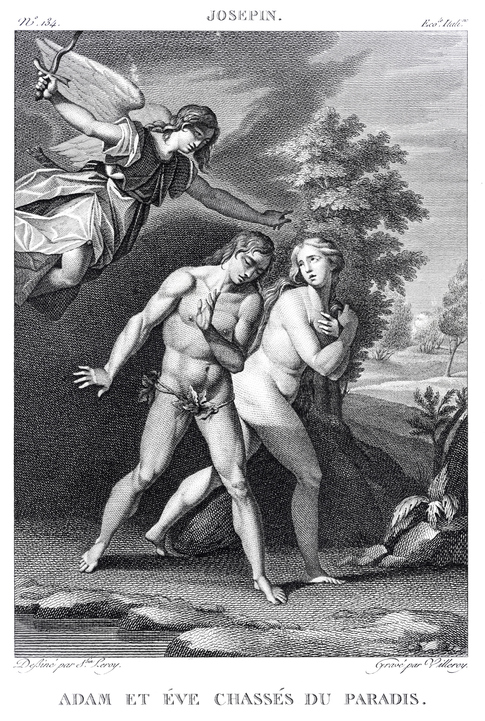
  • Adam, Noah and the Snake-king

    Reading Time: 8 minutesIn a previous article we learned that the words ‘Man’ and ‘Woman’ in the second chapter of Genesis have been translated from īš and ‘iššă. It seems possible that, in addition to Adam, Noah and the Snake-king have something to do with the Christian story of Adam and Eve. This article will explore three possible conclusions:

    The first man and woman of Genesis 2 were deities.
    These deities were Siva and Parvati, who is also Osiris and Isis.
    Humans had no part in a catastrophe called the Fall of Man. (This statement is probably too simplistic.)

    What Exactly were the First Man and Woman?

    There is evidence that īš and ‘iššă have the general meaning of ‘Lord’. Following are two examples provided by Edward Moor:

    “When they consider the divine power exerted in creating, they call the deity Brahma, in the masculine gender also; and when they view him in the light of destroyer or rather changer of forms, they give him a thousand names: of which, Siva, Isa, or Iswara, Rudra, Hara, Sambhu, Mahadeva, or Mahesa, are the most common…

    “Mahesa is maha, great, and Isa, Lord; the epithet is prefixed to many names of gods…”

    The Hindu Adam, Swayambhuva, is called ‘the first of men’, but he is clearly something more than human.

    “Swayambhuva, or the son of the self-existing, was the first Manu, and the father of mankind: his consort’s name was Satarupa. In the second Veda the Supreme Being (Brahm) is introduced in this way: ‘From me Brahma was born: he is above all; he is pitama, or the father of all men: he is Aja and Swayambhu, or self-existing.’ From him proceeded Swayambhuva, who is the first menu: they call him Adima (or the first, or Protogonus): he is the first of men; and Parama-Parusha, or the first male. His help-mate, Pracriti, is called also Satarupa: she is Adima, (the feminine gender) or the first: she is Visva-Jenni, or the mother of the world: she is Iva, or like I, the female energy of nature; or she is a form of, or descended from, I: she is Para, or the greatest: both are like Mahadeva, and his Sacti (the female energy of nature), whose names are also Isa and Isi. [mfn]Moor, Edward, F.R.S. “The Hindu Pantheon”. T. Bensley, London. 1810[/mfn]

    Siva and Parvati

    In “The Hindu Pantheon” īš and ‘iššă are more strongly associated with Siva and Parvati. And Moor associates Siva/Parvati with the Egyptian goddess Isis. Because Hinduism is fundamentally monotheistic, many deities who have their own attributes melt into each other and become one. It is also true that each of the deities has a consort, but the consorts can be reduced to one as well. The goddesses, in turn, are merely the female energy or ‘sacti’ of their lord. For this reason, the Supreme Being of any particular sect, whether it is Vishnu, Siva or Brahma, is said to be a hermaphrodite, with male and female attributes combined.   So it is not really clear in what way the mythology should be applied to human men and women.

    Original Sin

    For Christians, the doctrine of original sin is at least partly responsible for policies concerning women, but that doctrine is not a universal belief. Judaism and Islam have no such doctrine, but they have all proscribed the rights and equality of women to some degree.  This is particularly true of Islam. So there seems to be a common tendency that aligns with the conception of woman as portrayed in the story of the Fall of Man, and which is independent of the doctrine of Original Sin. It could be argued that a rationale for subjection is the main function of the story of the Fall of Man.  But on the other hand, maybe it is the attempt to say in mythological language what really happened.  We just don’t happen to understand the language.

    Creation Stories in Other Cultures

    There are similarities in the creation stories of many cultures between Noah and Adam. For example, Noah and Adam both had control over animals, as did the Chinese Shang-te, the Hindu Siva, and the Greek Hermes. Additional shared elements include the ark and the dove.

    In Chinese mythology, the Yin, or darkness, or the female principle is the ovum mundi and becomes the Earth, the ark or the Great Mother. Heaven, or Shang-te is the son of Earth, (or the ark), as he is ‘born’ from her womb. But he is also the builder of the ark, and the creator of Mother Earth. So she is his daughter. And since they are both born from the same circle, they are brother and sister. Heaven or Shang-te marries his mother or daughter or sister. In other words, their union is incestuous.

    Since Eve was created from Adam’s rib they are brother and sister, or father and daughter. This is true of the Greek Jupiter and Juno and of the Hindu gods, as well. “Brahma, the Supreme Being of Hinduism, is an androgynous conjunction of Adam and Eve, the universal parents of the human race.” [mfn]The Chinese Recorder and Missionary Journal”. Vol. 4, Rozario, Marçal & Co. Foochow, 1872. p. 217[/mfn]

    Similarities Between Adam and Noah

    It is interesting that Chinese, Hindu and Greek myths also identify the snake with both Adam and Noah. The woman seems to be connected indirectly.  Ancient legends say that in the golden age there was no distinction of sex.  According to Plato, “in the first arrangement ordained by Jupiter there were neither human politics, nor the appropriation of wives and children, but all lived in common upon the exuberant productions of the earth.” It was the hero-god, also called the snake-king, who instituted marriage.

    In Greek mythology marriage was instituted by Cecrops. Cecrops was a native of Egypt, who led a colony to Athens about 1556 B.C. He was a culture hero who introduced the worship of Zeus Hypatos, and forbade the sacrifice of living things. His marriage decree came about in this way:

    “He was arbitrator at the ‘strife’ of Athena and Poseidon. The women, who exceeded the men by one, voted for Athena, and to appease the wrath of Poseidon they were henceforth disenfranchised and their children were no longer to be called by their mother’s name. The women’s decision came as a shock to old Cecrops and he forthwith instituted patriarchal marriage.”

    All of the hero-gods of Greece were serpents.

    “Cecrops is a snake, Erichthonios (Cecrops’ son) is a snake, the old snake-king is succeeded by a new snake-king…What the myths of Cecrops and Erichthonios tell us is that, for some reason or another, each and every traditional Athenian king was regarded as being also in some sense a snake.”

    Adam, Noah and the Snake King
    Cecrops, Epilegomena & Themis, Fig. 63

    Jane Ellen Harrison thinks this came about because of the ceremonial carrying of snakes or figures of snakes. This was like the carrying of phalloi, a fertility charm. A Hermes of wood was the votive-offering of Cecrops, and it was possibly snake-shaped. [mfn]Harrison, Jane Ellen. Epilegomena & Themis. University Books, New York. 1927[/mfn]

    Shang-te

    In Chinese mythology, the dragon is the symbol of Shang-te. In this way, the Chinese gods resemble the fish-gods Vishnu and Dagon. The serpent was the symbol of the transmigrating diluvian god, who was reborn.  It was also the token of regeneration for those initiated into the mysteries.

    Shang-te also gave the first couple coats of skins and instituted marriage.  In Hinduism, Siva is depicted with a coat of skins.

    Adam, Noah and the Snake-King
    Siva and His Coat of Skins, The Hindu Pantheon

    Christian Missionaries thought these were non-Christian myths

    Demon-god, Hero-god, and snake-king are the terms used by Christian missionaries in the Chinese Recorder. In that publication, these names referred to non-Christian myths. But according to the same publication, Shang-te’s dragon is identical with the serpent in the Garden of Eden.  However, in the biblical story, it was God Yahweh who provided coats of skin and instituted patriarchal marriage.

    Patriarchal marriage is clearly implied in the following verse:

    “I will make intense your pangs in childbearing.
    In pain shall you bear children;
    Yet your urge shall be for your husband,
    And he shall be your master.” (Genesis 3:16)

    In the Anchor Bible notes on verse 16 concerning ‘pangs in childbearing’, we are told that this is a parade example of hendiadys in Hebrew. The literal rendering would read “your pangs and your childbearing,” but the idiomatic significance is “your pangs that result from your pregnancy.” [mfn]Speiser, E.A. “Genesis: The Anchor Bible”. Doubleday & Co. Inc. New York, 1986[/mfn]

    And the sentence Yahweh pronounced on the serpent becomes more interesting as well.

    God said to the serpent:

    I will plant enmity between you and the woman,
    And between your offspring and hers;
    They shall strike at your head,
    And you shall strike at their heel. (Genesis 3:15)

    It seems the serpent who became the mortal enemy of the woman and her offspring (perhaps in their human character) was the serpent-king.  Both male and female are affected.  The verse says “the woman and her offspring”.  

    In a strict comparison with the Chinese myth, the serpent-king would be God Yahweh and also his son, Adam/Noah.  (According to the Anchor Bible, the deity in the Garden of Eden was “God Yahweh” rather than “Yahweh”.  This may be the personal name of another deity.)

    Possibly, these myths refer to a political development that has adverse consequences for the woman and her offspring.

    Jesus

    In the following verses from the New Testament, Jesus seems to have claimed membership in the ranks of the demon-gods.

    “For as the lightning, that lighteneth out of the one part under heaven, shineth unto the other part under heaven; so shall also the Son of man be in his day.

    But first must he suffer many things, and be rejected of this generation.

    And as it was in the days of Noe, so shall it be also in the days of the Son of man.

    They did eat, they drank, they married wives, they were given in marriage, until the day that Noe entered into the ark, and the flood came, an destroyed them all.

    Likewise also as it was in the days of Lot; they did eat, they drank, they bought, they sold, they planted, they builded;

    But the same day that Lot went out of Sodom it rained fire and brimstone from heaven, and destroyed them all.

    Even thus shall it be in the day when the Son of man is revealed.” (Luke 17:24-30)

    Lot’s connection with Noah in this passage is explained by the fact that Lot was saved from the destruction of Sodom and Gomorrah, which he believed had destroyed the whole world. He also had incestuous relations with his daughters. Something similar may have happened between Noah and his son Ham. This is the pattern of a snake king.

    In the Chinese Recorder,

    “This Demon-god or First Man or Noah is a reappearance of Adam in his deified character…or ‘Imperial Heaven’, and also the Son of Noah as being the eldest of the triplication Fuh-he, Shin-nang, Hwang-te; or Shem, Ham, and Japhet…. ‘Noah, in every mythological system of the pagans was confounded, or rather identified with one of his three sons. Fab. Vol. I. p. 343. Vishnu (one of the triplication of Bram or Monad) appears distinct from Menu (First Man) and personates the Supreme Being: yet, single, he is certainly Noah or Menu himself: as one of a triad of gods springing from a fourth still older deity (the Monad, or elder Noah) he is a son of Noah. Ibid. vol. II. 117. Considered then as Noah, we find Jupiter (the elder Monad or Chaos) both esteemed the father of the three most ancient Cabiri (Cælus, Terra, and First Man), and himself also reckoned the first of the two primitive Cabiri (Cælus and Terra); Bacchus being associated with him as the younger. This however is a mere reduplication, for Jupiter and Bacchus are the same person. &c., i. e. the First Man.”

    This, in turn, agrees with the following etymology of īš and ‘iššă.

    “Linguistically, the name Issa (‘Isa) is the Aramaic form of the Arabic Al-‘Ays, meaning ‘the water of the male’, in reference to the masculine semen, the suffixed ‘a’ in ‘Isa being the Aramaic definite article. Related to this term is the Arabic ‘Aysh, meaning ‘life’ (as in Al ‘Ayyash). The Jesus of the ‘I am’ statements was none other than the God Jesus who was Al ‘Isa or Al ‘Ays–the ultimate source of the fertilizing ‘power’ of the male.” Al ‘Ays is ‘the God of Semen’, and Al ‘Ayyash is the ‘Life-Giving God’. [mfn]Salibi, Kamal, S. “Who was Jesus?: Conspiracy in Jerusalem. Tauris Parke Paperbacks, 2007[/mfn]

  • The Genealogy of Adam and Eve

    Reading Time: 2 minutesThe central tendency and probably the major cause of error in modern religion is the determination to separate male and female and define them as superior or inferior in relation to each other. Even today the Catholic Encyclopedia states that women are inferior to men. “The female sex is in some respects inferior to the male sex, both as regards body and soul.”

    Today, writers don’t use those terms. They might use the word ‘difference’, for example. However, the general sentiment remains the same. Christian fathers, such as Tertullian, who was born 160 AD, remain influential. Tertulian condemned all women for the part Eve played in the Garden of Eden.

    The Garden of Eden is first mentioned in the second chapter of Genesis. However, some have argued that this chapter is actually an independent creation story. In the first chapter, ‘P’ or the priestly source does not mention the Garden of Eden. He only tells us that the Elohim created the earth. The Elohim also created humans, male and female.

    The Genealogy of Adam and Eve
    Genesis 1, credit: RapidEye

    The second chapter of Genesis was written by the J source. J stands for Jehovah. This source tends to be more politically minded. He writes of the birth of gods, or of the man-god. In this version, Yahweh creates man; then he creates the woman from the man.

    This is the version that dictates the world’s social relations and organization.

    In verse 23,

    “Said the man, This one at last is bone of my bones and flesh of my flesh. She shall be called Woman for she was taken from Man.”

    Genesis 2
    Yahweh Creates Adam and Eve, Credit: gldburger

    The Anchor Bible notes that Woman and Man are translated from ‘īš and ‘iššā. E. A. Speiser says this assonance has no etymological basis in Hebrew. [mfn]Speiser, E.A. “The Anchor Bible: Genesis”. Doubleday & Company, Inc. 1986[/mfn]