
Series: The Wilderness Crucible

  • Gospel Perspectives, Old Testament Parallels and Application to a Vulnerable America: The Wilderness Crucible

    Gospel Perspectives, Old Testament Parallels and Application to a Vulnerable America: The Wilderness Crucible

    This entry is part 1 of 3 in the series The Wilderness Crucible
    Reading Time: 6 minutes

    I wrote Justice of the Rupture  after our attempt to elect Bernie Sanders to the presidency. Shortly afterward, Nina Turner, the national co-chair of Sanders’ 2020 campaign, identified the nature of our grief when she said “Progressives are in the wilderness“. Nina was raised in the church. She was talking about the wilderness that Jesus experienced after has baptism. Sadly, the entire country is here with us today. The important thing at this time is to recognize it for what it is. The wilderness crucible is not a punishment. It’s an opportunity.

    The Wilderness Crucible
    The Wilderness

    Biblical Theology and Modern Application 

    The wilderness narrative of Jesus is not merely a historical interlude but a profound spiritual, psychological, and metaphysical blueprint for navigating civilizational crisis. This article explores the structural nuances of the text across the synoptic Gospels and examines its Old Testament typologies. It will then analyze the symbolic anatomy of the three temptations and apply these insights to contemporary Americans.

    The three-fold dimension of the wilderness framework is adapted from classic synoptic gospel analysis (Matthew 4:1-11/Luke 4:1-13), utilizing Deuteronomy 6-8 as the primary textual subtext for testing national identity under deprivation.

    The American Wilderness Shift

    America is shifting from an era of radical comfort to an age of profound multi-directional volatility. When a society conditioned on radical comfort, predictable material prosperity, and geographic invulnerability faces friction from several directions at once (macroeconomic, geopolitical, and domestic hyper-polarization), it defaults to the exact pathologies tested in the wilderness. As we enter a cultural wilderness, the original temptations of Jesus are bound to repeat themselves as systemic pathologies. The biblical framework provides a precise diagnosis:

    The Bread Crisis (Economic Anxiety & Material Idolization)

    When inflation, resource scarcity, and economic volatility threaten the modern standard of living, the natural temptation is to compromise ethics for survival. This is the ‘stones to bread’ trap. Americans are tempted to believe that physical, financial security is the ultimate good, leading to frantic consumerism, hoarding, and an abandonment of neighborly solidarity. The remedy of Jesus requires recognizing that structural crises are moments to realign with baseline moral truths and spiritual realities, rather than worshiping economic metrics.

    The Temple Pinnacle (Political Radicals & The Illusion of Immunity)

    Under multi-directional threat, citizens often demand public, structural guarantees of safety, or fallback into the toxic presumption that ‘America is inherently immune’ to the laws of historical collapse. This manifests psychologically as a demand for a performative savior or a weaponized civil religion that expects God (or the State) to validate our specific group or nation without demanding our repentance. Testing God via institutional hubris replaces quiet civic duty and moral accountability.

    The Mountain Kingdoms (The Allure of Authoritarian & Machiavellian Power)

    Faced with geopolitical instability and domestic breakdown, the temptation to embrace corrupt mechanisms to achieve protective ends becomes overwhelming.  This mirrors the offer of all earthly kingdoms. Americans are increasingly tempted to look to total political control, institutional weaponization, and Machiavellian compromises to preserve their comfort. The wilderness teaches that acquiring power at the expense of our foundational values is an absolute metaphysical and structural defeat.

    The Purpose of the Desert

    The fundamental error of Israel was viewing the wilderness as an unmitigated punishment to be escaped at all costs, leading them to long for the slavery of Egypt just for its food security. Jesus demonstrated that the wilderness is actually a place of essential purgation. For modern Americans, this era of disruption is not merely an inconvenience; it is a crucible. It strips away the illusion that comfort equals safety, exposing our idols, and offering an opportunity to build an unshakeable inner resilience that does not depend on outward geopolitical or economic tranquility.

    Core Analytical Frameworks of the Desert

    As we have seen, the Modern American application of the wilderness is based on a more ancient framework. This includes the synoptic comparison (Matthew, Mark, and Luke), and the Old Testament typology.

    The Synoptic Comparison

    Each Gospel writer anchors the wilderness differently. Mark framed it as a sudden, violent cosmic boundary shift where the spirit ‘drives’ Jesus into an apocalyptic war with wild beasts and angels. Matthew positioned it as a royal, legal debate over the fulfillment of structural righteousness, culminating on a high mountain. Luke emphasizes Jesus’ perfect humanity under intense dependency on the Holy Spirit, shifting the final temptation to the pinnacle of the religious establishment in Jerusalem.

    The Old Testament Typology

    In the Old Testament portion of the analysis, the wilderness acts as a diagnostic mirror for a nation. First, the story of Jesus represents a 40-day/40-year reversal. Jesus enters the precise geographical and spiritual microcosm where the corporate ‘son’ (Israel) failed during their 40-year journey.

    In addition, this typology includes the Deuteronomy strategy. Every scriptural response Jesus makes after his temptations is from Deuteronomy 6 and 8. These verses are a sort of manual given to Israel to explain why God allowed them to be hungry.

    But the nature of the wilderness also encompasses three additional dimensions: the spiritual dimension; the psychological dimension; and the metaphysical dimension.

    Theological Analysis

    The wilderness of Jesus was a spiritual and metaphysical battleground designed to test his messianic identity and obedience.

    Historical and Psychological Analysis

    Jesus’ wilderness was an intense period of physical deprivation and preparation that mirrored Israel’s 40 years in the desert. The idea that Jesus succeeded where Israel failed is a common interpretation.[1, 2, 3, 4, 5] He also succeeded where Adam failed. But we shouldn’t forget that Jesus was a product of both Israel and Adam. Christian theology tells us he succeeded for the entire human race.

    The Spiritual Dimension

    In Christian theology, the wilderness was a direct confrontation between the divine and the demonic.[1, 6]

    Cosmic Showdown

    The Spirit affirmed Jesus as the Son of God at his baptism; immediately the Spirit led him into a spiritual crucible where Satan tested him.[1, 7]
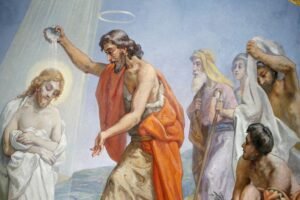
    The Baptism of Jesus (godongphoto)
    Messianic Purpose

    The temptations were spiritual tests of his mission. Would he rely on miraculous power for personal needs (turning stones into bread), seek worldly domination, or test God’s protection?[8, 9]

    The Word as Weapon

    Jesus overcame this spiritual adversity by utilizing the spiritual authority of scripture (quoting Deuteronomy), demonstrating that spiritual victory comes from reliance on the Word of God.[10]

    The Psychological Dimension

    The wilderness tested the limits of Jesus’ humanity, representing an extreme test of mental resilience, focus, and human endurance.[7, 11, 12]

    Vulnerability

    After forty days and nights without food, Jesus experienced acute physical hunger, emotional exhaustion, and severe isolation.[7, 13]

    The Human Condition

    The ultimate test of doubt, ambition, and the temptation to take the path of least resistance to achieve his goals was a psychological ordeal.[2, 8, 13, 14, 15]

    Identity and Calling

    The wilderness was a period of mental clarity where Jesus rejected human desires and embraced the psychological and emotional suffering necessary for his ultimate destiny on the cross.[2, 13]

    The Metaphysical Dimension

    In biblical tradition, the wilderness is a place outside of human society, often viewed as a metaphysical realm of chaos, desolation, and spiritual danger.[1, 16]

    Kingdom of Darkness vs. Kingdom of Light

    The encounter with Satan involves metaphysical phenomena. This encounter demonstrates an attack by the Kingdom of Darkness on the Kingdom of Light. For example, Satan transports Jesus to a high mountain to see all the kingdoms of the world, only to change his location in another moment to the pinnacle of the temple. First he tempts Jesus with power and control over the kingdoms of the world. then he tempts Jesus to demonstrate a dare-devil leap into space in order to be rescued by God. They were metaphysical phenomena, but the effects of Jesus’ capitulation would have been real. [8, 13, 17, 18]

    Transcendent Intervention

    The Gospel of Mark further emphasized the metaphysical nature of the the wilderness. In this Gospel, Mark notes that Jesus was ‘with the wild animals, and angels were ministering to him’. This verse bridges the physical world with the transcendent realm.[4, 16, 19]
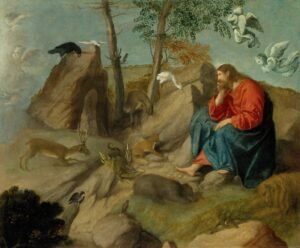
    Angels Ministered to Him


    Ultimately, the wilderness represents three things. It represents a physical location, a severe mental trial of Jesus’ human faculties, and a spiritual-metaphysical triumph over the forces of evil.[6, 20, 21, 22]

    Is the Wilderness Only a Place of Passive Meditation?

    Some might object that the course laid out in this article is too limited. We seem to be left with an important question: is true wilderness resilience simply a retreat into passive meditation? The wilderness does have something to say about physical strategy. This will be the subject of the next article.

    (In the preparation of this work, digital research assistants and language modeling tools were utilized to organize source texts, verify historical timelines, and cross-reference literary citations.)

    [1] https://www.youtube.com

    [2] https://www.new-covenant-church.com

    [3] https://feedingonchrist.org

    [4] https://learn.ligonier.org

    [5] https://bibleproject.com

    [6] https://www.youtube.com

    [7] https://medium.com

    [8] https://www.logos.com

    [9] https://www.logos.com

    [10] https://connectionpointchurch.org

    [11] https://www.wildernesstrek.org

    [12] https://lifespringschristianchurch.org

    [13] https://www.youtube.com

    [14] https://swedenborg.com

    [15] https://www.viewchurch.co

    [16] https://www.behindthegospels.com

    [17] https://www.youtube.com

    [18] https://tidings.org

    [19] https://laurenbdavis.com

    [20] https://renewcm.com

    [21] https://scripturecentral.org

    [22] https://storage2.snappages.site
     

  • The Blameless Center Line

    This entry is part 2 of 3 in the series The Wilderness Crucible
    Reading Time: 4 minutes

    The morning after a devastating political defeat, the silence can feel heavier than the loudest campaign noise. You watch the maps change, feeling a suffocating mixture of disappointment and deep, exhausting discouragement. It feels as though a massive, impersonal machine has rolled over everything you value. You did the work, you held the line—and the system failed you anyway.

    If you are standing in that quiet, anxious modern wilderness today, I want to take you out of our current media echo chamber and place you onto a marshy moor in Scotland on April 16, 1746.

    Because centuries ago, a community was driven into that exact same wilderness. They were called Clan Chattan.

    Culloden

    Clan Chattan stood at the dead center of the Jacobite front line at the Battle of Culloden. Surrounding them was an era in violent, terrifying transition. The old world they knew—built on localized kinship, sacred oaths of personal loyalty, and historical legitimacy—was being systematically whittled away. First, their ancient kingship had been feudalized; then, great monarchs handed land titles to Norman warlords who turned clansmen into rent-paying tenants.

    By 1746, the financial systems of the early Enlightenment had completely rigged the game. Bankrolled by central banking power, global trade networks, and industrial logistics, the British fiscal-military state faced the clans. From a structural and economic standpoint, the old way of life, or rather the Stuart vision for the future of Scotland, never stood a chance. The wilderness of a new global epoch had enveloped them.

    The Specter of Betrayal

    Worse than the external military threat was the internal rot of the desert. Many neighboring clan chiefs had already succumbed to the ultimate wilderness temptation—the Machiavellian compromise. They collaborated with the new regime, took government commissions, or stayed home to secure their private wealth while their culture burned. They chose comfort and survival over fidelity.

    But Clan Chattan was different. In a wilderness defined by betrayal, they chose absolute, unyielding faithfulness to one another.

    The chief of the Mackintoshes (the leaders of the Chattan confederation) held a government commission and refused to let his clan participate in the rising of 1745. Yet, in an astonishing act of defiance, his wife, Lady Anne Farquharson-MacKintosh, raised the men of the clan for the cause anyway. She refused to let a compromised leader dictate her clan’s honor.

    The Highlanders were obligated to fight by their oath to their clan leader, to Prince Charles Edward Stuart, their rightful king, and to their clan. Of course, there were conflicts of interest between the clans and the Stuarts. The clans were fighting for their lands and for the legal succession of Charles Edward Stuart, while the Stuarts were fighting for a divine king. However, they all fought a common enemy. The enemy was the British global financial system.

    The Highland Charge

    Immediately after the order to charge the clans were paralyzed under devastating government artillery fire. It was the men of Clan Chattan, standing at the center, who broke forward first into the grapeshot. They could bear the passivity no longer. They charged the lines with staggering physical courage, fighting not because the mathematical odds favored them, but because they refused to betray their identity and each other. And they were systematically mowed down by the more sophisticated weaponry of the British army.

    The Blameless Center Line
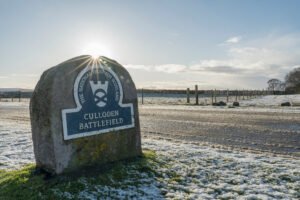
    Culloden (Editorial Credit: ROBIN MACGREGOR / Shutterstock.com)

    The Ultimate Meaning of Culloden

    From an analytical, geopolitical standpoint, Culloden was a total defeat. The old clan system was broken. But from a metaphysical standpoint, Clan Chattan achieved an absolute victory over the wilderness. They survived the spiritual test of the desert by refusing to let outer chaos dictate their inner honor.

    But it seems to me this is true of Clan Chattan’s entire history. Since the time of warlords and feudal kings they fought to defend their own lands. They were not trying to increase their own wealth. Fighting for their land was a matter of survival. This was also true at Culloden. They fought to honor their obligations to their clan and their king.

    In a time of conflicting motives, Clan Chattan was blameless. Today, history does not honor the compromised chiefs who stayed home to count their silver. We honor the blameless center line.

    Rethinking One’s Orientation in a Globalized World

    When the macro-systems of your world disappoint you, your duty changes. It shifts away from trying to fix a massive, rigged global machine, and moves toward horizontal fidelity—protecting, loving, and standing uncompromised alongside your people.

    If the wilderness is here, stop looking to the mountaintops for a political savior or a miraculous rescue. Look to your left and to your right. Double down on your localized values. Fast from the constant consumption of anxiety, audit your life with radical realism, and build deep, unshakeable commitments to your immediate community.

    When the systems fail, hold the center line. Protect your own clan.

    Long live the clan!


    For the Historical Analysis see: The socio-economic evolution of the Scottish clan system from kin-based societies to feudal tenure, and its ultimate clash with the British fiscal-military state, is documented in The Highland Clans by Alistair Moffat and Culloden: Scotland’s Last Battle and the Forging of the British Empire by Trevor Royle.

    For Clan Chattan Specifics:  The role of Lady Anne Farquharson-MacKintosh (“Colonel Anne”) and Clan Chattan’s position at the center of the Jacobite line is detailed in the historical archives of the National Trust for Scotland and the Battle of Culloden Visitor Centre records.

  • When the Paper Architecture Fails the Wilderness: The American Paradox

    This entry is part 3 of 3 in the series The Wilderness Crucible
    Reading Time: 4 minutes

    There is a distinct spiritual vertigo that comes when a society realizes its foundations are fracturing. As we look out at a landscape shifting under multi-directional threats—hyper-polarization, macroeconomic instability, and geopolitical chaos—the world suddenly feels like a barren, trackless wilderness.

    On paper, America rejected the idealism of French philosopher Jean-Jacques Rousseau. Rousseau believed a state could force its citizens to conform to a singular, collective “General Will.” Instead, the American Founders built a mechanical fortress designed to prevent tyranny. They fractured power into three competing branches, built a maze of checks and balances, and anchored the entire experiment in John Locke’s vision of “negative liberty”—a system where the government’s primary duty is to protect individual rights and stay out of private lives.

    Yet, very early in our history, the ink on the Constitution was met with a brutal reality check. When confronted with the raw pressures of expansion, economic ambition, and a literal territorial wilderness, the republic proved it could talk like Madison but act like an autocrat.


    Table of Contents


    The Weaponization of the “General Will”

    By the 1820s, the sovereign Creek (Muscogee) Nation sat on highly coveted, fertile land in Georgia. The Creek National Council had enacted a strict law: anyone who signed away tribal lands to the United States without the collective consent of the nation would face the death penalty.

    • The Compromised Leader: Chief William McIntosh, a wealthy leader and slaveholder, chose the “Mountain Kingdoms” trap of personal survival.
    • The Illegal Treaty: In 1825, McIntosh and a small, unauthorized faction signed the Treaty of Indian Springs, illegally ceding millions of acres of Creek land.
    • The Systemic Betrayal: The U.S. government knew McIntosh did not speak for the Creek Nation. Yet, the American executive branch eagerly accepted his single signature as the voice of the entire tribe.

    This was Rousseau’s dangerous philosophy weaponized in real time. The American state bypassed actual law and institutional contracts by manufacturing a hand-picked proxy to represent a false “General Will” of the people. McIntosh was executed by his own people for this betrayal, but the legal wedge had already been driven into the stone wall.

    When the Courts Fail to Hold the Line

    The true systemic collapse occurred a few years later under President Andrew Jackson. When the state of Georgia attempted to strip neighboring Cherokee and Creek sovereignty, the issue went to the United States Supreme Court.

    In the landmark case Worcester v. Georgia, Chief Justice John Marshall ruled clearly and unequivocally in favor of indigenous sovereignty. The American paper architecture had worked exactly as designed: the judicial branch checked the unconstitutional tyranny of the majority.

    But a system of checks and balances only works if those in power respect the boundaries. President Jackson famously ignored the ruling, allegedly stating:

    “John Marshall has made his decision; now let him enforce it.”

    When the executive branch refused to enforce the law of the land, the American republic officially pivoted to authoritarianism. The forced, state-sponsored migrations that followed—the Trail of Tears—were not caused by a lack of laws. They occurred because a populace and a government chose to smash their own institutional checks to get immediate results.

    A Warning for Our Modern Digital Wilderness

    Let us be entirely clear: our modern wilderness cannot be conquered on a physical battlefield. Today, our systemic challenges exist in the digital cloud, in global tax havens, and in impersonal macroeconomic shifts. Taking up physical arms in an era of bureaucratic decay would be a civic disaster, not a victory.

    If we look to history, the ultimate warning is found in the quiet, structural decay of reality rather than romantic battlefield charges:

    • The Lesson of Constantinople: In 1453, the last Byzantine emperor fought with breathtaking physical courage on the breaches. But his bravery came too late.
    • The Internal Rot: The civilization had spent decades hollowing itself out through internal polarization, institutional neglect, and an arrogant belief that its ancient walls made it inherently immune to history.
    • Our Modern Temptation: When we face modern multi-directional crises, the slow, grinding mechanisms of American gridlock become exhausting. We are tempted by Rousseau’s ghost to crave a political savior who will smash through boundaries and ignore the courts to restore our comfort.

    If we allow our internal institutions, our local courts, and our constitutional boundaries to rot because we are frustrated by the slow grind of the system, no amount of late-stage, frantic courage can save us. The battle for the republic is won or lost in how we maintain the integrity of the law today, long before the walls are fully breached.

    Standing at the Breach

    During the chaos of Culloden, the government forces managed to breach a crucial stone wall on the Southern flank of the battlefield. This allowed the government cavalry to charge through the gap and threaten to completely roll up and annihilate the retreating Jacobite lines. Major Gillies “Mor” Macbean was the senior major in Lady Anne’s Clan Chattan regiment. Seeing this catastrophic breach, he stationed himself directly inside the breach of that stone wall.

    He did not stand there because he possessed a mathematical strategy to reverse the global rise of the British fiscal state. Gillies Macbean stood there because it was his post. He held the gap single-handedly against an entire advancing column, buying time for his retreating comrades with his life.

    The lesson of the wilderness is that when the great structures fail, your macro-influence ends, but your local duty begins.

    The Test of Our Character

    When the wilderness presses in, the test of our character is not how fiercely we can demand a king to break the rules for us. The test is whether we have the courage to stand shoulder-to-shoulder defending the slow, painful integrity of the law—even when it doesn’t give us the immediate victory we want.

    The honorable reputation outlives the world. We stand shoulder-to-shoulder at the stone wall.


    Sources & Further Reading

    • Political Philosophy: Federalist No. 51 (James Madison) & The Social Contract (Jean-Jacques Rousseau, 1762).
    • The Treaty of Indian Springs: The Muscogee (Creek) Nation: A History by Michael D. Green.
    • Constitutional Crisis: Worcester v. Georgia (1832) & Andrew Jackson and his Indian Wars by Robert V. Remini.
    • Culloden History: Major Gillies Macbean’s stand is in the archive of the National Trust for Scotland and commemorated at McBain of McBain.