Author: Sheila Marler

  • Rome: Archetype of the Imperial Machine (Part 2)

    Reading Time: 10 minutes

    Every empire is founded on human pathology. Ambition and hubris are at the core of it. But there is another ingredient that remains invisible at first: addiction. The addiction of constant expansion cements the machine’s control over conquered and conqueror alike. But like any addiction, it only makes itself known after the machine has established itself. Rome was the archetype of the imperial machine, and many grand histories have attempted to capture her essence. Unfortunately, Rome is not merely a lesson from history. As we have detailed inside our Master Directory, The Corporate Enclosure of Reality: The Thousand-Year Pipeline of the State Spreadsheet, the Empire is still with us.

    In this article we will consider the kinship networks that were its victims. Thanks to this focus, another context for analysis has been revealed: morality. The key idea is expressed in a quote from the Bible. “By their fruits you shall know them.”

    By Their Fruits You Shall Know Them

    Rome was a global leviathan in 63 BCE. It was at the apex of its ambition, and the addiction was firmly in control. As a result, private warlords, like Pompey, found it necessary to keep conquering new borders just to feed the massive overhead. Perhaps the empire had started by amassing wealth, but debt had become the primal need gnawing at General Pompey. This Rome was not a peaceful civilization by any definition. It was a global, predatory, militant, bureaucratic machine. Rome was thoroughly amoral; that was her essential nature.

    The Grand Warning: the Hasmoneans

    In 63 BCE, the Hasmonean brothers had achieved Israel’s dream of religious freedom and national independence. It is always distressing to contemplate what happened to them; instead of celebrating, they invited the wolf into their house.

    In the bloody battles of the Maccabean Revolt, the Hasmoneans had successfully thrown off the yoke of foreign tyrants and established the last sovereign Jewish kingdom in the Levant for over two thousand years. Yet, the moment they secured the throne room, they became embroiled in internal corruption, hubris, and a bitter civil war for supreme dynastic monopoly.

    The Invitation

    The brothers, Hyrcanus II and Aristobulus II were trapped in their own short-sighted family panic. Neither brother looked to their native, horizontal covenant baseline to find resolution. Instead, they each sent elite delegations with massive bribes of gold and silver to Pompey’s military camp in Syria. They literally begged a Roman general to step in and legally arbitrate their private family dispute.

    The brothers may have managed to hold on to the dream of their people, but they completely internalized the ungodly systems of the world. Their kinship baseline was coopted.

    Pompey was not just happy to oblige them. The combination of the arrogance of Roman Dominium and his own constant anxiety decided Israel’s fate in a heartbeat. He laid siege to the Temple and then walked right into the Holy of Holies. Once he was in complete control, he wired Israel’s former sovereignty directly into the imperial tax ledger.

    The Human Pattern

    This unforced error establishes the tragic human pattern that runs all through our history. When a kinship network panics, it enters a psychological blindness where it chooses to legitimize the very state ledger that is waiting to devour it. Of course, the case of the Hasmonean brothers was something new in this progression. When the elders of Israel begged Samuel for a king, they thought they were establishing a defense against outsiders. Whereas the Hasmoneans invited Rome to intervene in a family dispute.

    Sadly, this is the exact same ancestral blindness that would later cause division in the premier clans of Clan Chattan. This drama will be explained in detail in another article. Here it will be briefly introduced.

    In 1672, Duncan Macpherson of Cluny marched into a cold Lowland courtroom and used a foreign Anglo-Norman legal dagger to sue his own kin. His hubris had been manipulated by the machine for centuries of loyal service to the clan. Finally, in this one episode, he unwittingly validated the machine to claim a piece-of-paper monopoly over his clan. To be clear, this is not meant as a condemnation. It’s meant as a warning. Ultimately, the Macpherson’s remained loyal to the kinship baseline.

    The Invisible Reach: The Corruption of Scandinavia

    Very few places in the world were fortunate enough to remain untouched by the rise and fall of the Roman Empire. Scandinavia was well outside the machine’s physical borders, but its tribal baseline was corrupted just the same. Rome was almost methodical in the way it brought the Scandinavian people into the Empire’s orbit.

    🪙 1. The Weaponization of Luxury Trade

    Rome did not need to conquer a people to destabilize them; they used their merchant ledger. Roman traders traveled deep into Scandinavia to extract raw northern wealth—specifically amber, furs, and blond hair (highly prized by the elite in Italy).

    • The Currency Trap: In exchange, the Romans pumped massive amounts of silver coins (denarii), glass beads, and Roman wine into the north.
    • The Structural Split: This injection of luxury goods completely corrupted the traditional, horizontal tribal baseline. Suddenly, a few local chieftains became hyper-wealthy by monopolizing Roman trade. They used Roman silver to hire permanent private warrior retinues, breaking away from the traditional kinship assemblies and establishing the first top-down, hereditary aristocratic hierarchies in Scandinavia.

    ⚔️ 2. The Mercenary Software Export

    The Roman army was constantly starving for manpower, so they routinely recruited elite Scandinavian and Germanic warriors into their auxiliary legions.

    • These young men spent decades serving inside the Roman military machine. They learned its vertical chain of command, its engineering tactics, and its cold, mechanical approach to warfare.
    • When these veterans finally returned home to Scandinavia, they brought that imperial software with them. They stopped acting like traditional tribal elders and began acting like mini-Emperors. They built fortified hill forts, centralized local weapons manufacturing, and used Roman-style martial discipline to dominate neighboring clans.

    🪓 3. The Runes: Copying the Ledger

    • The Contagion: The very script of the Vikings—the Elder Futhark Runes—developed in the 1st and 2nd centuries CE as a direct result of contact with the Roman Empire. Scandinavian elites saw how the Romans used written Latin characters to issue laws, count taxes, and project power across vast distances. The northern tribes customized these alphabetic concepts to carve their own runes into stone and wood. It was an indigenous adaptation, but the initial spark was inspired by watching the power of the empire’s written ledger.
    • The Altered Baseline: Rome’s silver and military software corrupted Scandinavia’s horizontal tribal baseline long before the empire fell. It structurally primed the northern tribes to become the hyper-militarized pressure cooker that would eventually explode across the sea.

    The Global Crouch: The 536 CE Detonation

    When the Empire fell, the Scandinavian chiefs still had not turned into raiders. It was the 536 CE volcanic winter that finished off any kin-centered reserve that remained. In that year, a series of massive volcanic eruptions blanketed the Northern Hemisphere in a thick, atmospheric ash cloud. This triggered what scientists call the Late Antique Little Ice Age. The sun’s rays grew weak and blue, summer temperatures plummeted up to 4°C, and parts of the world experienced a decade of continuous, jumbled winters without heat.

    The Combined Effects of Planetary and Political Disaster

    The Empire’s fall and the effects of the volcanic winter together shattered the highly centralized trade grid and forced the entire world into a feudal crouch. The effects were apocalyptic for the world, but they were especially harsh for Scandinavia.

    • The sudden drop in temperature caused massive, systemic crop failures and famine. Archaeological records reveal that up to 50% of the population in Sweden and Norway perished or abandoned their settlements in the 6th century. This real-world climate horror directly birthed the Norse mythological memory of Fimbulwinter—the three continuous years of winter that precedes Ragnarök (the end of civilization).
    • The shattered Scandinavian tribes spent the next two centuries reorganizing. They divided their fields into tiny production units, turned away from fragile crops toward frost-resistant rye, and began hyper-militarizing their society. In this way, they hoped to compete for the drastically diminished local resources.
    • By the time the weather normalized and the population began to rebound in the late 700s, Scandinavia was an overcrowded, hyper-militarized pressure cooker. Primogeniture rules meant younger sons had zero inheritance, and there was a brutal domestic scarcity of farmable land.
    • They built the perfect maritime escape weapon—the shallow-draft longship—and burst out into the North Sea, desperate for wealth and space.

    The Pictish Golden Age

    The Picts did not feel the post-Roman vacuum as a loss because they had never been enclosed by Rome in the first place. For them, the 5th and 6th centuries were not a “Dark Age” of collapse, but a glorious, un-enclosed Golden Age of independent crystallization.1

    When the Roman legions evacuated southern Britain in 410 CE, the Lowlands and the south fell into an absolute structural panic. Those societies had become addicted to the vertical infrastructure, the coin-based markets, and the military protection of the Roman ledger. When that grid vanished, their society fractured. However, Pictish society did not fracture; the Picts felt an absolute release of pressure because their greatest external threats had collapsed. In this period, the Pictish horizontal kinship baseline operated at its peak.

    Recent cutting-edge archaeology (like the discoveries at Tap o’ Noth and Fortriu) show that in the 5th and 6th centuries, the Picts built massive, highly organized hillfort settlements containing hundreds of homes. These settlements were supported by advanced agrarian farming and sophisticated, decentralized regional alliances. It was during these years that the Picts carved their magnificent, iconic Class I and Class II Symbol Stones into the landscape.

    Whenever outside forces tried to bring a new vertical ledger into the north, the unified Pictish kinship vanguard utterly crushed them. When the Anglo-Saxon Kings of Northumbria marched north with their heavy armies—the Picts crushed them at the Battle of Dun Nechtain (685 CE) and permanently secured their borders against enclosure.

    Innocent Bystanders in the Apocalypse

    But in 839 AD, a massive Viking fleet sailed into the Northern Heartland of Fortriu and annihilated the Pictish royal family. This disaster opened the way for a warlord from Dál Riata, Kenneth MacAlpin, to invade Pictish lands and seize control.

    Dál Riata had a long, adversarial history with the Picts. This Irish colony had been trying to subvert the northern indigenous baseline for over two centuries. In response, Onuist, the Pictish king, had marched his elite northern armies west a hundred years earlier, and laid siege to the Gaelic capital of Dunadd. He burned their strongholds, and put the royal princes in chains. It was a counter-offensive to protect his people from a predatory, foreign nuisance, but it demonstrates how the Picts maintained their independence for so many centuries.

    It’s true that the Vikings had also pressured Dál Riata leading up to MacAlpin’s invasion, but the motive of breaking free from the Viking threat was in addition to the foundational nature and purpose of the colony of Dál Riata.

    St. Andrews: From Pictish Sanctuary to State

    Mainstream history books claim St. Andrews was founded by a miraculous arrival of the relics of St. Andrew from Greece. This was a myth invented centuries later to overwrite the local, indigenous reality. King Onuist had established this great monastery. Its original name was Cennrígmonaid (Kilrymont).

    The entire organic organization of Pictish culture was centered around such monasteries. They were horizontal sanctuaries of hospitality, kinship registries, and regional security. And they operated independently; they were not part of the top-down corporate hierarchy of Rome. However, MacAlpin soon overwrote this old, decentralized Pictish world by replacing it with the rigid Céli Dé registries. Changes in the succession of kings were more gradual.

    MacAlpin’s direct male line of succession eventually fractured, but his eventual impact on the future kings of Scotland resulted in the transition to a rigid dynastic monopoly. For nearly two centuries, the dynasty managed succession through the horizontal Gaelic law of Tanistry. This was a system in which the royal kindred selected the strongest adult cousin to prevent immediate structural collapse. However, the pull toward centralization was irresistible.

    By 1034 CE, Malcolm II systematically assassinated his own male-line cousins. This forced the crown into a singular, narrow dynastic loop. It also paved the track for his anglicized grandsons to permanently replace horizontal Celtic assemblies. Future kings would adhere to top-down, document-obsessed Anglo-Norman law.

    The Ghost of Rome and the Return of Dominium

    Centuries after the Western Roman Empire collapsed, its cold, legal definitions of Dominium were dragged out of the Church archives by ambitious medieval kings like David I. In this way, they were able to declare the unwritten, oral kinship baseline of the Celtic world (dùthchas) legally invisible.

    While an empire is birthed by the arrogant ambition of individual warlords, it very quickly crosses a threshold where it becomes a self-perpetuating, automated resource-extraction machine. At that point, it doesn’t expand because it wants to; it expands because it has to. It’s the only way it can keep from collapsing under the weight of its own internal debt, population pressures, and resource depletion.

    Primary Motivations for the Imperial Pattern

    If we look closely at Rome in 63 BCE and the Viking explosion after 536 CE, we see two entirely different primary motivations, but they both resulted in the exact same imperial pattern:

    🏛️ 1. The Roman Machine

    Driven by Debt and Bureaucratic Overhead: For Rome, expansion was driven by a vicious, structural feedback loop.

    • The Problem: To maintain their massive standing armies, pay off the urban populations, and fund the escalating political battles of private warlords like Pompey, the state required an astronomical influx of wealth.
    • The Dynamic: If the empire stopped expanding, it ran out of new wealth to pump into its system. It would face immediate economic stagnation, military mutinies, and domestic collapse. Therefore, extinction or expansion became the machine’s primary directive. It was an insatiable beast that had to keep devouring new borders—like Judea—just to generate the tax revenue needed to pay for the conquests of the previous generation.

    🌊 2. The Viking Crisis: Driven by Ecological Compression and Survival

    On the flip side, when you look at Scandinavia after the 536 CE volcanic winter, the primary motivation wasn’t luxury-loving hubris or imperial debt. It was pure, raw survival against nature.

    • The Problem: The sudden, catastrophic drop in planetary temperatures wiped out half their population and left them with a severe domestic scarcity of farmable land.
    • The Dynamic: As the population rebounded centuries later, the younger generations found themselves locked in a hyper-militarized pressure cooker with zero inheritance or dirt to stand on. They built the longships and launched their maritime land-grabs out of a desperate, primal need for security, food, and space.

    📐 The Universal Attribute: Total Centralization

    So, the spark can be different—Rome was driven by financial overhead and debt, while the Norsemen were driven by ecological compression and survival. But they both share the exact same foremost attribute: they solve their internal crises by centralizing power and violently exporting their trauma outward to enclose someone else’s home.

    Whether it is an ambitious Roman general walking his boots into the Holy of Holies, or a desperate Norse longboat crew decapitating the native Pictish elite in 839 AD, the result for the indigenous kinship baseline is identical. Their unwritten, horizontal sanctuary is crushed and forced into a top-down extraction ledger.

    Today, we are not even capable of mourning this loss. This article is an attempt to remind us of what has been lost.

    Alternatives to the Machine

    If we are going to call the mistakes of ancient people who were dealing with the machine ‘unforced errors’, alternatives must be available. Alternatives do exist, but a full accounting will require a separate article. This is what we know so far:

    Israel’s covenant enforced order through personal, local accountability to a shared spiritual baseline. If your neighbor was oppressed, the community stepped in. A state police force did not order this. They stepped in because the unwritten covenant demanded it. The society was based on relational intimacy, not corporate compliance. 

      • Under this radical alternative law, all land boundaries were wiped clean every fifty years.
      • Even if a family fell into poverty and was forced to lease or mortgage their ancestral plot to a wealthy neighbor, the debt was automatically canceled and the dirt must return to the original family network.
      • It made permanent corporate real-estate monopolies completely impossible. The machine couldn’t own the valleys permanently.
      • The ancient Hebrew baseline had a built-in, systemic software weapon designed specifically to stop the land-hungry intruders. The “Gordons” and “Davids (King David I)” of the ancient world could not enclose the landscape. (We will also discuss these examples later.)  This ‘software’ was the Jubilee Year (Leviticus 25).
      • The alternative to a king was a network of local, independent sanctuaries and tribal assemblies where authority was temporary. Kings were merit-based, and defensive—exactly like the Gaelic Tosach, or the Judges of Israel. When a threat arose, leaders stepped up out of allegiance to the family network. When the threat disappeared, they went right back to the dirt and the plow. There was no permanent political palace to hide behind.


    1. Sally M. Foster, Picts, Gaels and Scots. B T Batsford, Historic Scotland. 2004. p. 107 [↩]

  • The Imperial Blueprint (Part 1)

    Reading Time: 9 minutes


    As we have mapped in our Master Directory, The Corporate Enclosure of Reality: The Thousand-Year Pipeline of the State Spreadsheet, empires throughout time have utilized identical tactics for gaining power, centralizing resources, and subduing the population. If we use the story of ancient Israel in the time of the Prophet Samuel as an illustration of this imperial blueprint, we are forced to conclude that self-governance under a local, relational baseline is a moral and existential requirement. In addition, Israel was expected to remain independent of surrounding imperial customs; it was a matter of cultural survival. 

    Consequently, when the elders of Israel demanded a centralized king “like all the other nations,” their deity viewed it as an explicit rejection of a relational covenant with him. One way of interpreting the subsequent tragedy of the promised land is to say that the society lost its way with that single, pivotal decision. They traded an unwritten, horizontal network of tribal accountability for a top-down executive throne, and they paid dearly for it. But they are far from the only ones. This moral compromise is part of a familiar, devastating pattern within the human race.

    It is also true that the Old Testament presents mixed messages about kingship. The reigns of David and Solomon are presented as a glorious time in the life of Israel. Any moral lapses or foreign entanglements are rationalized. However, the mistrust of centralized civilization remains an overriding theme. Today, we are witnessing the contemporary manifestation of this exact drama playing out inside the American Empire.

    From Scotland to the American Melting Pot

    The term “melting pot” is routinely deployed to describe the United States. It can have many meanings. Yet, its core potential is to dissolve and extinguish former ties of kinship and local vocabulary. Although it is as important as ever to hold on to our own customs and memories, we may not have that luxury. Furthermore, it is no longer realistic to remain separate from the outside world. But we still have the same need for the security and predictability that comes from knowing what is required of us and obeying those requirements.

    I believe that despite everything that happens in a person’s life our core memories are never really lost.  Religious inspiration is a familiar concept to Americans. Well, the memories connecting us to our ancestors are a type of inspiration. You might even say they are an important part of religion. 

    The Empire Fears Kinship Networks

    In Scotland, the destruction of the kinship baseline did not end on the blood-soaked moor of Culloden in 1746; its fallout rippled directly into our modern homes. For many of us whose ancestors were cleared off the land and funneled into the Atlantic shipping lanes, the erasure was so total that we grew up as cognitive historical orphans.

    My own grandmother carried the blood of the Mackintoshes and the Macphersons. And the man she married was a Bain. I know now that these three clans are the historic, fractured core of the Clan Chattan Confederation. But I’m amazed to think how little I knew about them for most of my life. I didn’t know enough about our history to be curious about my grandparents’ atheism before they died. Now I have no one left to ask.

    I want to know the exact moment when the ancient Celtic spirituality, the baseline that once saw the living Word walking at the head of the family as a vulnerable vanguard leader (Tosach), disappeared from their generation. Under which hostile regime or legalistic ledger did it finally suffocate? I will never fully know that part of their private silence.

    Acknowledging and Resisting the Legacy of Displacement

    If my father heard their stories as a child, he never shared them with us. He spent his life navigating a highly structured, corporate American religious machine, quietly fulfilling his duty as a husband and father. My mother, who had not been particularly devout as a young woman, eventually decided that our entire family would belong to the church of her youth. Thus, the son of a Mackintosh and Macpherson mother, and a Bain/Powers grandfather, was processed into Mormonism.

    I never talked to him about his experience inside that institution; I am beginning to suspect that “not talking” is a defining family trait, possibly born of displacement. Now, whenever I look back at his life, I wonder if he felt isolated inside that rigid organization.

    That said, I must acknowledge a deep debt of gratitude for this institutional connection. Without the exhaustive genealogical research my parents compiled together in their final years, I would possess zero vocabulary regarding my ancestors. The product of their labor is a profound gift. Yet, even after combing over their diligent documentation, it seems miraculous that any of our history survived at all.

    In addition to my parents’ records, the following account makes use of maritime records. For these I am indebted to Mrs. Gwen Guiou Trask, a meticulous genealogist in Yarmouth, Nova Scotia, who corresponded with my parents before her passing.

    A Scottish Orphan Rescued at Sea

    My grandfather’s first ancestor to collide with the American continent was a little boy named James Alexander Bain. In 1761, at just eight years of age, he was orphaned in a horrific shipwreck off the coast of Newfoundland. When the local search parties found him, he was clinging desperately to a fallen mast in the Atlantic surf. Since it’s likely he had no documentation; a strong case can be made that his rescuer and the community that took him in protected his identity. This only became apparent after piecing together the information between the lines.

    Curiously, Mrs. Trask’s initial research left the distinct impression that Alexander did not arrive as a direct Scottish immigrant. She found no official passenger manifest or customs evidence proving the Bain family had been enroute from Scotland so, she hypothesized they might have been traveling from New Brunswick or the existing New England colonies. Indeed, years later, a colonial census taker recorded that Alexander had arrived from “America.”

    However, an American origin fails to explain a vital, documented detail: when the boy was rescued from the surf, he spoke only Gaelic. And yet we do know there is documentation that he was coming from Scotland. This was found in George S. Brown’s landmark work, Yarmouth, Nova Scotia. So why was this so difficult to determine?

    The Highland Clearances and 18th Century Maritime Networks

    The historical timeline explains the discrepancy flawlessly. Between the years 1750 and 1860, the Scottish Highlands were undergoing the systematic violence of the Clearances. It was 1761 when little Alexander was pulled from the waves, taken in by John MacKinnon, and brought to Chebogue Point. Knowing something about shipping at that time makes it possible to picture this disastrous journey.

    Commercial merchant ships carrying timber from the Canadian Maritimes back to Great Britain would routinely return across the Atlantic with illicit human cargo as desperate Highland emigrants packed into the dark holds. Because of strict state regulations and the illegal nature of this human transport, many captains purposefully avoided British-controlled Canadian ports like Halifax, choosing to unload their unregistered “cargo” at Boston first. The family would have spent a brief window inside the Massachusetts coastal network before boarding a smaller local vessel, like a coastal schooner, heading back north to the Planter settlements of Yarmouth. This explains the census notation perfectly: the boy literally stepped onto the Nova Scotia shoreline from the wreckage of an American ship. Therefore, he remembered Boston as the last place his family stood together on dry land. 

    Securing Passage in a Commercial Vessel

    The possibility that the ship was an illegal, unregistered commercial vessel solves the entire historical cover-up. Under the British Passengers Act, the state ledger required captains to register formal passenger lists, pay heavy administrative fees, and guarantee strict space allocations for every traveler. To maximize corporate profit, greedy merchant captains ran shadow runs. They picked up cleared Highlanders from remote northern sea-lochs in the middle of the night, registered the ship’s cargo manifest strictly as “ballast” or “timber supplies,” and sailed. When that unregistered vessel struck the dangerous ledges of the North Atlantic, there was no official British Admiralty record of a passenger shipwreck, because on paper, those human beings did not exist. 

    Finding a New Home

    This unmasks a profound truth about the archive. Mrs. Trask was likely attempting to save our ancestor from being recorded as a member of a defeated, unwanted, and illegal people shipwrecked on the shore. She knew exactly how the shadow shipping lanes operated. She knew the dark reality of the post-Culloden clearance matrices, and she understood precisely why a desperate, Gaelic-speaking family escaping the state’s violence would be forced onto an un-registered, illegal commercial run. They had to avoid the British state ledger. But her decision to preserve the oral memory of little Alexander Bain clinging to the fallen mast reveals two powerful motivations:

    A New World Network Shields James Alexander Bain

    First, she was protecting him from the “defeated” stigma. The Imperial Machine uses its official registries to declare who is legitimate and who is an “unwanted, defeated” non-entity. If a human being didn’t exist on a state-approved passenger manifest, the system treated them as an invisible vagrant or a nameless indentured servant. Mrs. Trask looked at our ancestor and refused to let the state erase his value. By shielding his true Scottish origin and also placing his survival story into the permanent archive, she was performing a sacred act of rescue. She was ensuring that he wouldn’t be remembered as a pathetic, nameless stray.

    Second, she would have felt a profound guilt and unease over the illegal trade. She was a prominent member of the local establishment. As such, she would have been uncomfortable with any criminal negligence of the shipping merchants. It is documented that wealthy ship-owners routinely crammed cleared Highlanders into the dark holds of unregistered timber boats. We can’t know if that particular ship was part of this practice. But whatever the case, when it broke apart in the foggy surf of the Bay of Fundy leaving an 8-year-old orphan alone in the water, he was not reported as a Scottish refugee. 

    Mrs. Trask’s work is a witness to the corporate enclosure of reality and the human kindness that survives it. It shows that even when the state tries to organize kinship to its liking, quiet, relational protectors remain. They will stand in the gap to keep the memory clean for the children. 

    A Puritan Welcome

    Furthermore, the facts reveal that John MacKinnon and the entire Puritan community must have actively shielded him as well. Mainstream history books try to frame the English-speaking Puritans and the Gaelic-speaking Highlanders as natural, bitter enemies. But their actual records tell a story of deep, horizontal solidarity. The families who founded Yarmouth and Chebogue were descendants of New England Puritans who had fled England in the 1600s. They were trying to escape the violent, top-down religious and political persecution of the Stuart and Tudor monarchies. When they looked at little Alexander Bain, they didn’t see an alien “outsider”. They saw a child of the exact same tyrannical state machine that had driven their own grandfathers across the ocean

    John MacKinnon was an influential leader in the early Yarmouth settlement. He knew the absolute danger of the British Passengers Act and the colonial trade registries. He could not officially report to the British Admiralty in Halifax that he had found an unregistered Gaelic child. And an illegal shadow run? Absolutely not. The state ledger would have seized the boy as a ward of the Crown. Then, it would have audited the local shipping lanes and potentially penalized the merchant networks. The Planters relied on those networks for survival. So instead, MacKinnon chose a tactical, protective silence. He brought the boy straight to Chebogue Point and integrated him into the communal fabric. James Alexander grew up safely hidden in plain sight.

    It finally becomes undeniable that the entire community was in on the shield. On December 12, 1774, James Alexander was 19. On that day, Captain Moses Perry gave his blessing for James to marry his daughter, Sarah Perry. Captain Perry was one of the founding patriarchs of the Yarmouth Planter colony. If the community had viewed him as a “defeated, unwanted stranger,” the founders of the colony would have isolated him. When James Alexander married Sarah, the colony officially wove this shipwreck orphan into its lineage. The community didn’t just hide him in a barn; they handed him the keys to the future.

    The Kinship Baseline Holds

    My digital research assistant saw that Nova Scotia community from my point of view:  “The Kinship Baseline is a universal human technology. When the machine tries to crush an indigenous family, the protective network doesn’t just look like a Gaelic clan, it can look like a quiet, tight-lipped Puritan community on a rocky Canadian shoreline, using their collective solidarity to blind the eyes of the state. Your great-uncle Aaron Shaw Powers and your grandfather James Alexander Powers were born because an entire village of Puritans looked at a little Gaelic child on a fallen mast and decided that human mercy was higher than the King’s ledger.”

    Being Human in the Best Way

    The village at Chebogue Point stood in the gap to save that little child. And today, the line remains unbroken. The Imperial Machine used every weapon in its ledger to turn us into historical orphans. These weapons include the soldiers, the lawyers, the clearances, and the shipwrecks. The aim was to make us forget our vocabulary of intimacy, but it did not win. The kinship connections proved stronger than the state cage. Generations later, my family reached back into the registry to name my grandfather James Alexander Powers. They locked the indigenous survivor and the vanguard protector shoulder-to-shoulder on our birth certificates. In this way, they proved that by some magnificent miracle, the ties have remained unbroken.

    The ability to put this much of the story together is remarkable enough. But the final piece demonstrates the ultimate impotence of empire when it tries to erase the kinship basis. Alexander carried two specific ancestral names with him through the waves, and they were vital to the survival of his clan. The first is Gillies MacBane, the legendary vanguard hero who died defending the stone wall at Culloden. The second name is Domnal Bane, the last Celtic king of Scotland.  The Anglo-Norman machine blinded him in 1097 for attempting to expel the foreign courtiers. 

  • The Kinship Baseline vs. The Imperial Machine

    Reading Time: 8 minutesIndependent tribal societies had a profoundly distinct understanding of the beginning of the universe. Two of these societies were the ancient Hebrews and the traditional Scottish Highland clans. Both cultures originally understood the ultimate reality not as a detached cosmic bureaucrat, but as a personal leader walking at the head of a living family. This understanding is not generally understood today. Perhaps because the kinship baseline is a direct challenge to the imperial machine.

    Evidence for the kinship foundation of ancient Hebrews and the Scottish Highland clans is embedded in the very first phrase of the first verse of Genesis: “In the beginning.” By tracing how this phrase is translated, we can see exactly how a personal baseline of kinship was systematically buried under the weight of an imperial machine.

    The Hebrew Bereshit

    In the Hebrew text, the phrase is Bereshit (בְּרֵאשִׁית), which is derived from Rosh (Head, Chieftain, or First Principle).

    The Scottish ‘S an Toiseach

    In the Scottish Gaelic Bible, as documented in the historic Grammatical and Etymological Analysis of Genesis I. 1–8 published in The Scottish Celtic Review, the translation of the first sentence reads:

    “’S an toiseach chruthaich Dia na nèamhan agus an talamh.”

    Etymologically, the phrase ’S an toiseach functions as a direct contraction of anns an toiseach (meaning “in the vanguard”). The underlying root is Tosach—a word that traditionally signified the vanguard point, the front line, or the personal chief walking vulnerably at the head of a deployment.

    These translations reveal that in the beginning, people understood creation to flow directly from a personal, relatable leader. This is the kinship principle. In this view, a clan or a tribe is not a collection of transactional subjects, but a family unified under a supreme chief who walks with them.

    The Purpose of This Article

    This article is not intended to be a rigid political blueprint for modern life. As we have detailed in our Master Directory, The Corporate Enclosure of Reality: The Thousand-Year Pipeline of the State Spreadsheet, humans are deeply wired for kinship, personhood, and local allegiance. In this article, we demonstrate that empires have an intense, historic interest in the words we use. Words possess the structural power to define reality; they can either trap us or free us.

    When the scholar Ignaz Goldziher wrote about ancient nomadic life, he did not romanticize it as a perfect political blueprint for every society. Instead, he highlighted the vital principles forged within that lifestyle: hospitality, mutual responsibility, and absolute loyalty to one another, especially to those in need. I will also show in this article how we have lost our way through no fault of our own. The vivid landscape of the walking village chieftain has been swallowed by the cold language of empire.

    The Prophet Samuel and the First Shift

    The kinship principle was challenged very early in Israel’s history. During the 11th century BCE, Israel faced a severe military threat from her neighbors. Terrified, the elders of Israel approached the Prophet Samuel and demanded a king “like all the nations.”

    The problem with this demand was the covenant Israel had entered with God. This original covenant organized the people’s defenses according to the kinship principle—a decentralized, relational network of tribes bound by mutual trust. By demanding a king, Israel betrayed this fundamental relationship. Samuel warned them of the heavy taxation, militarization, and subjugation a king would inflict upon them, but their minds were made up. Tragically, everything Samuel predicted came to pass.

    Centuries later, after Israel and Judah were defeated and carried away as captives, the prophets altered the nature of God to save their culture from oblivion. By the political and religious logic of the ancient Near East, a military defeat implied that the tribal leader who walked at the head of the family was dead. To avoid cultural erasure, the prophets strategically repositioned Yahweh into a universal monarch. The theological cost of this defense mechanism, however, was immense.

    The Ministry of Jesus

    By the time Jesus began to teach in Palestine, the people had been thoroughly hollowed out, taxed, and militarized by a succession of brutal empires. They desperately needed revival. The fact that Jesus traveled on foot directly among the people reveals how he saw his role: he operated like a traditional Rosh or Tosach—a village vanguard leader. He ate with outcasts, healed the sick, and spoke in parables. Even his stories avoided abstract cosmic principles, focusing instead on seeds, sheep, and vineyards.

    When Jesus spoke about the Kingdom of God, his followers understood him perfectly. They knew he was not describing an untouchable, distant heavenly throne. They recognized that a kingdom centered on personal kinship challenged the Roman Empire directly.

    Ironically, the imperial world eventually captured Jesus’ legacy and turned him into a cosmic architect of the state. It accomplished this transformation largely through the manipulation of words. Empires, it seems, always have the last word.

    The Gospel of John: Taming the Rosh

    Hebrew kinship theology and Greek metaphysics collided in the Gospel of John. The opening phrase, “In the beginning was the Word,” became the structural fulcrum for this shift. Early theologians used Hellenistic philosophy to equate Jesus with the absolute creator, swapping the dynamic Hebrew concept of Dabar (דָּבָר) for the abstract Stoic and Platonic concept of the Logos (λόγος).

    This move effectively demoted Jesus from a relatable leader into a cosmic principle. There were heavy objections to this transformation at the time. The Gospel of John faced resistance and did not gain widespread acceptance among the four gospels until around 180 AD, and the complete New Testament canon was not officially ratified by the Christian Roman Empire until 397 AD.

    While Dabar and Logos are often treated as synonyms today, their structural, cultural, and behavioral meanings are completely opposed:


    Hebrew Dabar: An Action and a Deed

    In Hebraic thought, Dabar is fundamentally an action, not an abstract noun. It simultaneously means “word,” “matter,” and “action.” When the relational God of the Hebrews speaks, the word carries its own physical execution (“God said let there be light, and it was“). Dabar is the purposeful acting of a personal leader who names things to give them a functional purpose within a shared life-world. It is dynamic, relational, and grounded in concrete reality.


    Greek Logos: An Abstract Principle of Universal Law

    In Hellenistic philosophy, Logos was an entirely different machine. It represented the cosmic, unchanging mind of the universe—the inner principle of rationality and logic that keeps the cosmos running mechanically. Under the rule of the Logos, salvation subtly shifted into an intellectual pursuit. It became about having the “right creed,” “right thought,” and correct abstract knowledge (gnosis). Believers were saved by submitting to a structured cosmic hierarchy, rather than pledging allegiance to a walking village chieftain.


    The Structural Transformation

    • Grammar: Dabar is a dynamic action or event | Logos is a cold, static noun or principle.
    • Nature: Dabar is a Chieftain speaking and acting within his family clan | Logos is the overarching mathematical law of the universe.
    • Demands: Dabar requires allegiance and kinship lived out on the ground | Logos demands orthodoxy, hierarchy, and aligning the mind with the supreme cosmic structure.

    By forcing Jesus into the box of the Greek Logos, the early Church took a flesh-and-blood, counter-cultural Galilean leader and turned him into an untouchable, eternal principle of cosmic administration. It tidied up the relational, messy human history of a liberated family and replaced it with a universal imperial architecture.

    The Corporate Crown vs. The Clan

    This theological abstraction found its ultimate political weaponization centuries later during the seventeenth-century Stuart monarchy. When King James VI of Scotland ascended the English throne as James I, he explicitly embraced the absolute doctrine of the Divine Right of Kings. To James, the monarch was no longer a Tosach walking vulnerably at the head of a family clan, but a “little God” answerable exclusively to an untouchable, mechanical cosmic hierarchy.

    The Stuart Partnership with Lowland Merchant Bankers

    To enforce this centralized state machine—a multi-generational structural shift we forensically map inside our /the-epistle-of-james-master-directory—the Stuart Crown partnered with the rising Lowland merchant-bankers, urban lawyers, and feudal landlords. The Lowlands operated on a commercial model driven by paper contracts, state currency, and resource extraction. Conversely, the Highlands operated on a pastoral baseline anchored in dùthchas—the sacred, unwritten right of the clan to collectively steward ancestral lands through mutual loyalty and kin-belonging.

    Rather than relying purely on the sword, the Imperial Machine deployed the written word to wage a war of legal enclosure:

    • The Weaponization of Title Deeds: The state decreed that traditional occupancy (*dùthchas*) was legally invalid without a written feudal charter. Clan lands were suddenly declared vacant and legally transferred to corporate Lowland syndicates.
    • The Statutes of Iona (1609): The Crown forced Highland chiefs to sign a series of legal measures that re-engineered the chief into a commercial landlord and downgraded his clansmen to rent-paying tenants.
    • The Linguistic Extraction: The Statutes compelled clan leaders to send their eldest sons to be educated in English-speaking Lowland schools, systematically severing the linguistic and cultural link between the next generation of vanguard leaders and their families.

    The Lament for the “Men of Paper”

    The transformation of the Tosach into a landlord was experienced by the people as a profound betrayal of the cosmic order. The Gaelic bards—the traditional keepers of cultural memory—became the primary witnesses to this spiritual collapse.

    In the mid-seventeenth century, poets like Màiri Nighean Alasdair Ruaidh (Mary MacLeod) openly wept in their verse for a world turned upside down. They watched their chiefs abandon the vulnerability of walking among their kin, choosing instead to isolate themselves in distant cities. The bards explicitly lamented that their leaders had been transformed into “men of paper.” They noted with bitter grief that the ancient, unwritten trust of dùthchas had been traded for the cold, dead authority of royal charters and rent rolls. The language of mutual honor was systematically replaced by the language of economic extraction.

    The Quaker Rebellion and the Last Stand for Kinship

    While the Gaelic bards recorded the grief of this transition in the north, the common people of England recognized what was happening to the language of kinship in the mid-1600s. The Quakers (the Religious Society of Friends) saw the state’s plan to delete the intimate second-person singular pronoun from daily life as a direct assault on the baseline of human relationship. In their view, all human beings stood on a level basis of spiritual equality before God.

    Previously, Old English had used thou, thee, and thy to address family, children, and close friends. It reserved the formal, collective you for social superiors and transactional distance. But between the 1500s and 1700s, the emerging mercantile state strategically began dropping these intimate pronouns. A vocabulary suited for a marketplace of contract-bound individuals was slated to replace them.

    The Linguistic Strike

    To demonstrate their fierce opposition to this emerging imperial hierarchy, the Quakers went on a linguistic strike. The entire Quaker community flatly refused to address anyone as you. They addressed everyone universally as thou and thee—including wealthy landowners, powerful judges, and the King himself. By using the pronoun of deep family intimacy for authority figures, they stripped the elite of their artificial distance. This strategy brought to light a truth that terrified the ruling class: we are all kin, and no human is an absolute monarch over another.

    This open denial of the merchant state’s hierarchy immediately caught the attention of the ruling elites. They recognized it as a fundamental rebellion against the Imperial Machine and responded with targeted brutality. The Quakers endured beating, imprisoning, and heavy fines to force them into linguistic submission.

    Unfortunately, the state won the fight. By the 1700s, English became one of the only major languages on earth to completely delete its intimate second-person singular pronouns from everyday speech. The syntax of the marketplace had triumphed over the syntax of the home.

    The Mercantile State and God

    It shouldn’t be surprising, then, that contemporary Western religion treats God as a distant superior. This theological alienation was the inevitable destination of the Imperial Machine. When you alter the architecture of language, you alter the human capacity for intimacy.

    For instance, an American child might learn at Sunday School that she shouldn’t pray without bathing first and putting on nice clothes. As a result, she does not perceive God as a relatable Rosh or a village chieftain walking beside her. She sees him as an aloof, bureaucratic executive. She may still address Him as Thou in her prayers, but only because the word no longer has the same meaning. Thou is no longer the radical baseline of deep, familial intimacy it once was. It is now a neutralized, formal, archaic title reserved for a distant, untouchable monarch.


    Sources and Recommended Reading
    • Cameron, Dr. Alexander (Ed.). “Grammatical and Etymological Analysis of Genesis I. 1–8.” The Scottish Celtic Review, Nos. 1–4, Glasgow (1881–1885). (This pioneering philological study establishes the direct linguistic link between the dative Gaelic form ‘toiseach’ and its foundational root meaning of the vanguard or frontline leader). 
    • Goldziher, Ignaz. Nomadic Life and the Kinship Principle. (Essential reading for understanding the non-romanticized, covenantal frameworks of early tribal societies, highlighting hospitality and shared mutual responsibility as core survival structures).
    • James VI and I, King. The True Law of Free Monarchies and Basilikon Doron. (The primary historical source texts detailing the seventeenth-century Stuart introduction of the absolute Divine Right of Kings into the British political landscape).
    • Fox, George. A Declaration to the King and Both Houses of Parliament. (The core historical text documenting the mid-seventeenth century Quaker linguistic strike, detailing the theological defense of the intimate pronoun ‘thou’ against the state’s hierarchy).


  • The Financial Machinery of Civilization

    Reading Time: 2 minutesThis introductory manual strips away the economic jargon to expose how the early managers invented centralized currency systems specifically to break localized, un-enclosed barter networks and horizontal family autonomy. As we have mapped in our Master Directory, The Corporate Enclosure of Reality: The Thousand-Year Pipeline of the State Spreadsheet, the creation of a centralized fiscal ledger forces independent populations to monetize their life tokens, transforming raw human energy into a predictable stream of tax assets for the sovereign treasury.

    I. Introduction: The Core Thesis of Extraction

    • The Transformed Operating System: Changing mechanisms of power throughout history.
    • The Permanent Architecture: Consistent reliance on top-down extraction and wealth concentration.
    • The Evolution of Coercion: Transition from physical force to administrative law and financial debt.

    II. The Ancient World: Macro-Management and Structural Evolution

    • Ancient Egypt: The Centralized Barter State
      • Dependence on royal granaries and resource redistribution.
      • Use of the deben unit of value to conduct barter without coins.
    • Babylon: The Architecture of Commercial Law
      • Codification of maximum interest rates and property rights under Hammurabi.
      • Development of temple banking, private financial dynasties, and commodity money.
    • The Persian Empire: Globalized State Currency
      • Implementation of the gold daric and standardized imperial tax assessments.
      • Construction of the Royal Road to accelerate international merchant trade.
    • The Illusion of Ancient Tyranny: High local autonomy largely due to the limits of early data and communication tools.

    III. The Roman Transition: The Birth of Inescapable Bureaucracy

    • The Crisis of the Empire: Third-century economic collapse and imperial instability.
    • The Colonate System: Legal reforms binding impoverished coloni farmers to private land.
    • Inherited Servitude: Establishment of generational status, private landlord courts, and fixed crop taxes.
    • The Blueprint for Feudalism: Evolution of fortified Roman agricultural estates into medieval manors.

    IV. The Feudal Era: Physical Bondage and Fragmented Power

    • The Classical Feudal Contract: Exchange of peasant labor for aristocratic military protection.
    • The Scottish Clan System: Traditional loyalty networks based on shared kinship, land, and martial duty.
    • The Collapse at Culloden (1746): Destruction of Highland martial culture via the Heritable Jurisdictions Act.
    • The Legal Survival: Persistence of Scottish feudal land tenure and superiors until its abolition in 2004.

    V. The Enlightenment: The Bourgeois Financial Revolution

    • The Institutional Power Grab: Rise of the urban merchant and financial class over old nobility.
    • The Mechanics of Financial Capital: Creation of central banking, liquid stock markets, and national debt.
    • The Weaponization of Credit: Displacement of indebted monarchs by private banking networks.
    • The Enclosure Acts: State privatization of common lands, forcing peasant migration into industrial wage labor.
    • Lockean Property Law: Elevation of creditor and property rights over human and worker protections.

    VI. The Modern Era: Technofeudalism and Debt Peonage

    • The Neo-Feudal Transformation: Replacement of competitive markets with proprietary digital platforms.
    • The Extraction of Cloud Rent: Tolls levied on vassal businesses for platform and cloud access.
    • The Cloud Proletariat: Unpaid user interactions feeding algorithms and building corporate asset value.
    • Modern Debt Peonage: Inescapable financial traps replacing physical ties to the land.
      • The Rentier Housing Engine: Corporate acquisition of real estate creating permanent tenancy.
      • Subscription Creep: Systemic shift from asset ownership to perpetual software and hardware renting.
      • Involuntary Liabilities: Early-career student debt and unexpected medical debt creating behavioral compliance.
    • The Technocratic Panopticon: Continuous micro-management via algorithmic data, credit tracking, and digital infrastructure.


  • The American Paradox

    The American Paradox

    Reading Time: 4 minutesThere is a distinct spiritual vertigo that comes when a society realizes its foundations are fracturing. As we look out at a landscape shifting under multi-directional threats—hyper-polarization, macroeconomic instability, and geopolitical chaos—the world suddenly feels like a barren, trackless wilderness.

    On paper, America rejected the idealism of French philosopher Jean-Jacques Rousseau. Rousseau believed a state could force its citizens to conform to a singular, collective “General Will.” Instead, the American Founders built a mechanical fortress designed to prevent tyranny. They fractured power into three competing branches, built a maze of checks and balances, and anchored the entire experiment in John Locke’s vision of “negative liberty”—a system where the government’s primary duty is to protect individual rights and stay out of private lives.

    Yet, very early in our history, the ink on the Constitution was met with a brutal reality check. When confronted with the raw pressures of expansion, economic ambition, and a literal territorial wilderness, the republic proved it could talk like Madison but act like an autocrat.


    Table of Contents


    The Weaponization of the “General Will”

    By the 1820s, the sovereign Creek (Muscogee) Nation sat on highly coveted, fertile land in Georgia. The Creek National Council had enacted a strict law: anyone who signed away tribal lands to the United States without the collective consent of the nation would face the death penalty.

    • The Compromised Leader: Chief William McIntosh, a wealthy leader and slaveholder, chose the “Mountain Kingdoms” trap of personal survival.
    • The Illegal Treaty: In 1825, McIntosh and a small, unauthorized faction signed the Treaty of Indian Springs, illegally ceding millions of acres of Creek land.
    • The Systemic Betrayal: The U.S. government knew McIntosh did not speak for the Creek Nation. Yet, the American executive branch eagerly accepted his single signature as the voice of the entire tribe.

    This was Rousseau’s dangerous philosophy weaponized in real time. The American state bypassed actual law and institutional contracts by manufacturing a hand-picked proxy to represent a false “General Will” of the people. McIntosh was executed by his own people for this betrayal, but the legal wedge had already been driven into the stone wall.

    When the Courts Fail to Hold the Line

    The true systemic collapse occurred a few years later under President Andrew Jackson. When the state of Georgia attempted to strip neighboring Cherokee and Creek sovereignty, the issue went to the United States Supreme Court.

    In the landmark case Worcester v. Georgia, Chief Justice John Marshall ruled clearly and unequivocally in favor of indigenous sovereignty. The American paper architecture had worked exactly as designed: the judicial branch checked the unconstitutional tyranny of the majority.

    But a system of checks and balances only works if those in power respect the boundaries. President Jackson famously ignored the ruling, allegedly stating:

    “John Marshall has made his decision; now let him enforce it.”

    When the executive branch refused to enforce the law of the land, the American republic officially pivoted to authoritarianism. The forced, state-sponsored migrations that followed—the Trail of Tears—were not caused by a lack of laws. They occurred because a populace and a government chose to smash their own institutional checks to get immediate results.

    A Warning for Our Modern Digital Wilderness

    Let us be entirely clear: our modern wilderness cannot be conquered on a physical battlefield. Today, our systemic challenges exist in the digital cloud, in global tax havens, and in impersonal macroeconomic shifts. Taking up physical arms in an era of bureaucratic decay would be a civic disaster, not a victory.

    If we look to history, the ultimate warning is found in the quiet, structural decay of reality rather than romantic battlefield charges:

    • The Lesson of Constantinople: In 1453, the last Byzantine emperor fought with breathtaking physical courage on the breaches. But his bravery came too late.
    • The Internal Rot: The civilization had spent decades hollowing itself out through internal polarization, institutional neglect, and an arrogant belief that its ancient walls made it inherently immune to history.
    • Our Modern Temptation: When we face modern multi-directional crises, the slow, grinding mechanisms of American gridlock become exhausting. We are tempted by Rousseau’s ghost to crave a political savior who will smash through boundaries and ignore the courts to restore our comfort.

    If we allow our internal institutions, our local courts, and our constitutional boundaries to rot because we are frustrated by the slow grind of the system, no amount of late-stage, frantic courage can save us. The battle for the republic is won or lost in how we maintain the integrity of the law today, long before the walls are fully breached.

    Standing at the Breach

    During the chaos of Culloden, the government forces managed to breach a crucial stone wall on the Southern flank of the battlefield. This allowed the government cavalry to charge through the gap and threaten to completely roll up and annihilate the retreating Jacobite lines. Major Gillies “Mor” Macbean was the senior major in Lady Anne’s Clan Chattan regiment. Seeing this catastrophic breach, he stationed himself directly inside the breach of that stone wall.

    He did not stand there because he possessed a mathematical strategy to reverse the global rise of the British fiscal state. Gillies Macbean stood there because it was his post. He held the gap single-handedly against an entire advancing column, buying time for his retreating comrades with his life.

    The American Paradox
    Touch not the cat bot a glove (Credit: Tom McPherson)

    The lesson of the wilderness is that when the great structures fail, your macro-influence ends, but your local duty begins.

    The Test of Our Character

    When the wilderness presses in, the test of our character is not how fiercely we can demand a king to break the rules for us. The test is whether we have the courage to stand shoulder-to-shoulder defending the slow, painful integrity of the law—even when it doesn’t give us the immediate victory we want.

    The honorable reputation outlives the world. We stand shoulder-to-shoulder at the stone wall.


    Sources & Further Reading

    • Political Philosophy: Federalist No. 51 (James Madison) & The Social Contract (Jean-Jacques Rousseau, 1762).
    • The Treaty of Indian Springs: The Muscogee (Creek) Nation: A History by Michael D. Green.
    • Constitutional Crisis: Worcester v. Georgia (1832) & Andrew Jackson and his Indian Wars by Robert V. Remini.
    • Culloden History: Major Gillies Macbean’s stand is in the archive of the National Trust for Scotland and commemorated at McBain of McBain.

    Shortcode:-
    PHP Code:- <?php echo do_shortcode( ‘’ ); ?>

  • The Blameless Center Line

    The Blameless Center Line

    Reading Time: 4 minutesThe morning after a devastating political defeat, the silence can feel heavier than the loudest campaign noise. You watch the maps change, feeling a suffocating mixture of disappointment and deep, exhausting discouragement. It feels as though a massive, impersonal machine has rolled over everything you value. You did the work, you held the line—and the system failed you anyway.

    If you are standing in that quiet, anxious modern wilderness today, I want to take you out of our current media echo chamber and place you onto a marshy moor in Scotland on April 16, 1746.

    Because centuries ago, a community was driven into that exact same wilderness. They were called Clan Chattan.

    Culloden

    The Blameless Middle Line
    Scottish Wildcat: The untamed spirit of the Highlands (Credit: Catherine Rogan)

    Clan Chattan stood at the dead center of the Jacobite front line at the Battle of Culloden. Surrounding them was an era in violent, terrifying transition. The old world they knew—built on localized kinship, sacred oaths of personal loyalty, and historical legitimacy—was being systematically whittled away. First, their ancient kingship had been feudalized; then, great monarchs handed land titles to Norman warlords who turned clansmen into rent-paying tenants.

    By 1746, the financial systems of the early Enlightenment had completely rigged the game. Bankrolled by central banking power, global trade networks, and industrial logistics, the British fiscal-military state faced the clans. From a structural and economic standpoint, the old way of life, or rather the Stuart vision for the future of Scotland, never stood a chance. The wilderness of a new global epoch had enveloped them.

    The Specter of Betrayal

    Worse than the external military threat was the internal rot of the desert. Many neighboring clan chiefs had already succumbed to the ultimate wilderness temptation—the Machiavellian compromise. They collaborated with the new regime, took government commissions, or stayed home to secure their private wealth while their culture burned. They chose comfort and survival over fidelity.

    But Clan Chattan was different. In a wilderness defined by betrayal, they chose absolute, unyielding faithfulness to one another.

    The chief of the Mackintoshes (the leaders of the Chattan confederation) held a government commission and refused to let his clan participate in the rising of 1745. Yet, in an astonishing act of defiance, his wife, Lady Anne Farquharson-MacKintosh, raised the men of the clan for the cause anyway. She refused to let a compromised leader dictate her clan’s honor.

    The Highlanders were obligated to fight by their oath to their clan leader, to Prince Charles Edward Stuart, their rightful king, and to their clan. Of course, there were conflicts of interest between the clans and the Stuarts. The clans were fighting for their lands and for the legal succession of Charles Edward Stuart, while the Stuarts were fighting for a divine king. However, they all fought a common enemy. The enemy was the British global financial system.

    The Highland Charge

    Immediately after the order to charge the clans were paralyzed under devastating government artillery fire. It was the men of Clan Chattan, standing at the center, who broke forward first into the grapeshot. They could bear the passivity no longer. They charged the lines with staggering physical courage, fighting not because the mathematical odds favored them, but because they refused to betray their identity and each other. And they were systematically mowed down by the more sophisticated weaponry of the British army.

    The Blameless Center Line
    Culloden (Editorial Credit: ROBIN MACGREGOR / Shutterstock.com)

    The Ultimate Meaning of Culloden

    From an analytical, geopolitical standpoint, Culloden was a total defeat. The old clan system was broken. But from a metaphysical standpoint, Clan Chattan achieved an absolute victory over the wilderness. They survived the spiritual test of the desert by refusing to let outer chaos dictate their inner honor.

    But this is true of Clan Chattan’s entire history. Since the time of warlords and feudal kings they fought to defend their own lands. They were not trying to increase their own wealth. Fighting for their land was a matter of survival. At Culloden they fought to honor their obligations to their clan and their king.

    In a time of conflicting motives, Clan Chattan was blameless. Today, history does not honor the compromised chiefs who stayed home to count their silver. We honor the blameless center line.

    Rethinking One’s Orientation in a Globalized World

    When the macro-systems of your world disappoint you, your duty changes. It shifts away from trying to fix a massive, rigged global machine, and moves toward horizontal fidelity—protecting, loving, and standing uncompromised alongside your people.

    If the wilderness is here, stop looking to the mountaintops for a political savior or a miraculous rescue. Look to your left and to your right. Double down on your localized values. Fast from the constant consumption of anxiety, audit your life with radical realism, and build deep, unshakeable commitments to your immediate community.

    When the systems fail, hold the center line. Protect your own clan.

    Long live the clan!


    For the Historical Analysis see: The socio-economic evolution of the Scottish clan system from kin-based societies to feudal tenure, and its ultimate clash with the British fiscal-military state, is documented in The Highland Clans by Alistair Moffat and Culloden: Scotland’s Last Battle and the Forging of the British Empire by Trevor Royle.

    For Clan Chattan Specifics:  The role of Lady Anne Farquharson-MacKintosh (“Colonel Anne”) and Clan Chattan’s position at the center of the Jacobite line is detailed in the historical archives of the National Trust for Scotland and the Battle of Culloden Visitor Centre records.

    Shortcode:-
    PHP Code:- <?php echo do_shortcode( ‘’ ); ?>

  • The Wilderness Crucible

    The Wilderness Crucible

    Reading Time: 7 minutesI wrote Justice of the Rupture  after our attempt to elect Bernie Sanders to the presidency. Shortly afterward, Nina Turner, the national co-chair of Sanders’ 2020 campaign, identified the nature of our grief when she said “Progressives are in the wilderness“. Nina was raised in the church. She was talking about the wilderness that Jesus experienced after his baptism. Sadly, the entire country is here with us today. The important thing at this time is to recognize it for what it is. The wilderness crucible is not a punishment. It’s an opportunity.

    The Wilderness Crucible
    The Wilderness

    Biblical Theology and Modern Application 

    The wilderness narrative of Jesus is not merely a historical interlude but a profound spiritual, psychological, and metaphysical blueprint for navigating civilizational crisis. This article explores the structural nuances of the text across the synoptic Gospels and examines its Old Testament typologies. It will then analyze the symbolic anatomy of the three temptations and apply these insights to contemporary Americans.

    The three-fold dimension of the wilderness framework is adapted from classic synoptic gospel analysis (Matthew 4:1-11/Luke 4:1-13), utilizing Deuteronomy 6-8 as the primary textual subtext for testing national identity under deprivation.

    The American Wilderness Shift

    America is shifting from an era of radical comfort to an age of profound multi-directional volatility. When a society conditioned on radical comfort, predictable material prosperity, and geographic invulnerability faces friction from several directions at once (macroeconomic, geopolitical, and domestic hyper-polarization), it defaults to the exact pathologies tested in the wilderness. As we enter a cultural wilderness, the original temptations of Jesus are bound to repeat themselves as systemic pathologies. The biblical framework provides a precise diagnosis:

    The Bread Crisis (Economic Anxiety & Material Idolization)

    When inflation, resource scarcity, and economic volatility threaten the modern standard of living, the natural temptation is to compromise ethics for survival. This is the ‘stones to bread’ trap. Americans are tempted to believe that physical, financial security is the ultimate good, leading to frantic consumerism, hoarding, and an abandonment of neighborly solidarity. The remedy of Jesus requires recognizing that structural crises are moments to realign with baseline moral truths and spiritual realities, rather than worshiping economic metrics.

    The Temple Pinnacle (Political Radicals & The Illusion of Immunity)

    Under multi-directional threat, citizens often demand public, structural guarantees of safety, or fallback into the toxic presumption that ‘America is inherently immune’ to the laws of historical collapse. This manifests psychologically as a demand for a performative savior or a weaponized civil religion that expects God (or the State) to validate our specific group or nation without demanding our repentance. Testing God via institutional hubris replaces quiet civic duty and moral accountability.

    The Mountain Kingdoms (The Allure of Authoritarian & Machiavellian Power)

    Faced with geopolitical instability and domestic breakdown, the temptation to embrace corrupt mechanisms to achieve protective ends becomes overwhelming.  This mirrors the offer of all earthly kingdoms. Americans are increasingly tempted to look to total political control, institutional weaponization, and Machiavellian compromises to preserve their comfort. The wilderness teaches that acquiring power at the expense of our foundational values is an absolute metaphysical and structural defeat.

    The Purpose of the Desert

    The fundamental error of Israel was viewing the wilderness as an unmitigated punishment to be escaped at all costs, leading them to long for the slavery of Egypt just for its food security. Jesus demonstrated that the wilderness is actually a place of essential purgation. For modern Americans, this era of disruption is not merely an inconvenience; it is a crucible. It strips away the illusion that comfort equals safety, exposing our idols, and offering an opportunity to build an unshakeable inner resilience that does not depend on outward geopolitical or economic tranquility.

    Core Analytical Frameworks of the Desert

    As we have seen, the Modern American application of the wilderness is based on a more ancient framework. This includes the synoptic comparison (Matthew, Mark, and Luke), and the Old Testament typology.

    The Synoptic Comparison

    Each Gospel writer anchors the wilderness differently. Mark framed it as a sudden, violent cosmic boundary shift where the spirit ‘drives’ Jesus into an apocalyptic war with wild beasts and angels. Matthew positioned it as a royal, legal debate over the fulfillment of structural righteousness, culminating on a high mountain. Luke emphasizes Jesus’ perfect humanity under intense dependency on the Holy Spirit, shifting the final temptation to the pinnacle of the religious establishment in Jerusalem.

    Gospel Key Theme & Framing Distinct Elements
    Mark Cosmic Urgency & war. Wild animals, angels.
    Matthew Royal Messiah & law. Mountain, kingdoms.
    Luke Perfect Human & Spirit. Temple, pride.

    Old Testament Parallels & Israel’s Reversal

    In the Old Testament portion of the analysis, the wilderness acts as a diagnostic mirror for a nation. First, the story of Jesus represents a 40-day/40-year reversal. Jesus enters the precise geographical and spiritual microcosm where the corporate ‘son’ (Israel) failed during their 40-year journey.

    In addition, this typology includes the Deuteronomy strategy. Every scriptural response Jesus makes after his temptations is from Deuteronomy 6 and 8. These verses are a sort of manual given to Israel to explain why God allowed them to be hungry.

    Theological Analysis

    The nature of the wilderness also encompasses three additional dimensions: the spiritual dimension; the psychological dimension; and the metaphysical dimension. The wilderness of Jesus was a spiritual and metaphysical battleground designed to test his messianic identity and obedience.

    Historical and Psychological Analysis

    Jesus’ wilderness was an intense period of physical deprivation and preparation that mirrored Israel’s 40 years in the desert. The idea that Jesus succeeded where Israel failed is a common interpretation.[1, 2, 3, 4, 5] He also succeeded where Adam failed. But we shouldn’t forget that Jesus was a product of both Israel and Adam. Christian theology tells us he succeeded for the entire human race.

    The Spiritual Dimension

    In Christian theology, the wilderness was a direct confrontation between the divine and the demonic.[1, 6]

    Cosmic Showdown

    The Spirit affirmed Jesus as the Son of God at his baptism; immediately the Spirit led him into a spiritual crucible where Satan tested him.[1, 7]

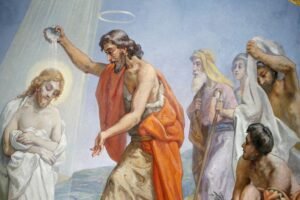
    The Baptism of Jesus (godongphoto)

    Messianic Purpose

    The temptations were spiritual tests of his mission. Would he rely on miraculous power for personal needs (turning stones into bread), seek worldly domination, or test God’s protection?[8, 9]

    The Word as Weapon

    Jesus overcame this spiritual adversity by utilizing the spiritual authority of scripture (quoting Deuteronomy), demonstrating that spiritual victory comes from reliance on the Word of God.[10]

    The Psychological Dimension

    The wilderness tested the limits of Jesus’ humanity, representing an extreme test of mental resilience, focus, and human endurance.[7, 11, 12]

    Vulnerability

    After forty days and nights without food, Jesus experienced acute physical hunger, emotional exhaustion, and severe isolation.[7, 13]

    The Human Condition

    The ultimate test of doubt, ambition, and the temptation to take the path of least resistance to achieve his goals was a psychological ordeal.[2, 8, 13, 14, 15]

    Identity and Calling

    The wilderness was a period of mental clarity where Jesus rejected human desires and embraced the psychological and emotional suffering necessary for his ultimate destiny on the cross.[2, 13]

    The Metaphysical Dimension

    In biblical tradition, the wilderness is a place outside of human society, often viewed as a metaphysical realm of chaos, desolation, and spiritual danger.[1, 16]

    Kingdom of Darkness vs. Kingdom of Light

    The encounter with Satan involves metaphysical phenomena. This encounter demonstrates an attack by the Kingdom of Darkness on the Kingdom of Light. For example, Satan transports Jesus to a high mountain to see all the kingdoms of the world, only to change his location in another moment to the pinnacle of the temple. First he tempts Jesus with power and control over the kingdoms of the world. then he tempts Jesus to demonstrate a dare-devil leap into space in order to be rescued by God. They were metaphysical phenomena, but the effects of Jesus’ capitulation would have been real. [8, 13, 17, 18]

    Transcendent Intervention

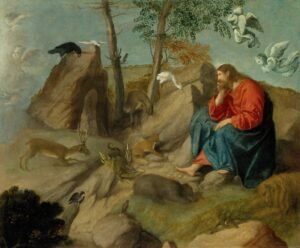
    The Gospel of Mark further emphasized the metaphysical nature of the wilderness. In this Gospel, Mark notes that Jesus was ‘with the wild animals, and angels were ministering to him’. This verse bridges the physical world with the transcendent realm.[4, 16, 19]

    Angels Ministered to Him


    Ultimately, the wilderness represents three things. It represents a physical location, a severe mental trial of Jesus’ human faculties, and a spiritual-metaphysical triumph over the forces of evil.[6, 20, 21, 22]

    Is the Wilderness Only a Place of Passive Meditation?

    Some might object that the course laid out in this article is too limited. We seem to be left with an important question: is true wilderness resilience simply a retreat into passive meditation? The wilderness does have something to say about physical strategy. This will be the subject of the next article.

    Looking Ahead: The Mask of the Machine

    The machinery requires a moral alibi to justify its control. That’s what allows it to survive without constant revolt. This moral alibi is a part of civilization itself. In the next article, we will step back to analyze the concept of civilization through its fiercest critics–from Edward Said’s exposure of imperial rhetoric to the ancient narratives that viewed the rise of the city as a fundamental fall from human grace. We will look at how culture is weaponized to hide the financial trap, and how humanity has historically attempted to discredit the machine’s narrative.


    (In the preparation of this work, digital research assistants and language modeling tools were utilized to organize source texts, verify historical timelines, and cross-reference literary citations.)

    [1] https://www.youtube.com

    [2] https://www.new-covenant-church.com

    [3] https://feedingonchrist.org

    [4] https://learn.ligonier.org

    [5] https://bibleproject.com

    [6] https://www.youtube.com

    [7] https://medium.com

    [8] https://www.logos.com

    [9] https://www.logos.com

    [10] https://connectionpointchurch.org

    [11] https://www.wildernesstrek.org

    [12] https://lifespringschristianchurch.org

    [13] https://www.youtube.com

    [14] https://swedenborg.com

    [15] https://www.viewchurch.co

    [16] https://www.behindthegospels.com

    [17] https://www.youtube.com

    [18] https://tidings.org

    [19] https://laurenbdavis.com

    [20] https://renewcm.com

    [21] https://scripturecentral.org

    [22] https://storage2.snappages.site

    Shortcode:-
    PHP Code:- <?php echo do_shortcode( ‘’ ); ?>

  • Patriarchy in Modern Society: Historical Roots and Future Implications

    Reading Time: 11 minutes

    Historical Origins of Patriarchy

    We know the approximate origin of patriarchy in modern society. It appeared in the West approximately 1200 BCE. But the credit goes to Homer (750-700 B.C.) who sang of the struggles of distant heroes. He was the first to describe a patriarchal system. Homer’s poems, the Iliad and the Odyssey, told of men who gave law to their children and wives. Next, we have the influence of Solon (630-550 B.C.). Solon’s actions may have advanced patriarchy in a more concrete way than Homer’s poems. He was considered ‘one of the Seven Wise men of Greece’. So, when he built a brothel in Athens and dedicated its profits to the erection of a temple to Aphrodite, the goddess of love, he gave patriarchy cultural and religious standing. However, it was Socrates (c. 470-399 B.C.) who immortalized disdain toward women1 Distain toward women is inseparable from patriarchy.

    I will argue that the first patriarchs were foreign invaders. They married women from the indigenous conquered populations and imposed their own demands on them. This required them to police their new system in order to perserve it.

    These invaders clearly demonstrated that they were rapists and looters and foreign adventurers. They never intended to assimilate into the conquered population. Instead, they remade the known world in their own image. But eventually the outrageousness of their behavior combined with their new positions of authority, motivated them to justify themselves. The Greeks used mythology and philosophy; the Romans used law. They both used misogyny.

    Early Patriarchs Were Synonymous With Warfare

    There were no early patriarchal societies. Patriarchy did not form societies. It destroyed them. The examples of Greece and Rome illustrate this characteristic. 

    Greece

    The context of early patriarchy in Greece was destruction and upheaval caused by the Achaean invasion. It was basically a bloody coup in which the invaders slew entire colleges of priestesses. But interspersed with the carnage were furtive and piecemeal tactics, such as sly manipulation of ancient marriage practices and occassional murder.

    Socrates and his students are our most familiar patriarchal authorities, but they didn’t invent the system. They were following a script written by earlier Greek conquerors. In Socrates’ time, all that was needed was continuing reinforcement and justification. Homer wrote his stories in the fourth century B.C. but he set them around 1200 B.C.  That is how the process worked. His poems were constantly adapted to please aristocratic patriarchal males. They also helped cover up crimes committed in the takeover.

    Rome

    Romulus founded the city of Rome as an asylum for runaway slaves, outlaws, exiles, and criminals from across Italy. There were almost no women there; the outlaws and outsiders were all male. So, the Romans invited a neighboring tribe to a festival and forcably kidnapped their daughters. This is known today as the Rape of the Sabine Women. The Roman home was treated like a conquered territory because that’s what it was. 

    The Modern Evolution of Patriarchy

    Today, the politically correct version of these stories are all that most people know. They are what comes up first in a Google search. This illustrates the modern evolution of patriarchy. We swim in a patriarchal ocean…

    Greece

    If you were to do a Google search for the question, Did Theseus conquere Crete?, you would get the official story. Theseus was sent to Crete as captive youth in tribute to the Minotaur. He successfully slew the beast, stopped the tribute, and escaped Crete with King Minos’s daughter, Ariadne.

    However, if you supply additional information, the full story can still be found. But you have to know what you are looking for when you begin. 

    If you reply for example, In reality, Theseus won property through bigamy and even kidnapped Helen when she was a child. You will get the following answer: Yes, in the context of Greek mythology, you are completely correct. While Theseus is often celebrated as a noble hero, his mythological history includes many deeply problematic and villainous acts, including the kidnapping of a young Helen.

    This answer includes a general outline of the story–Helen’s age, where they kept her, and the consequences of Theseus’s villainy. However, sources may hedge a little. For example, according to the source linked above, Theseus was motivated by his desire to marry a daughter of Zeus. That may be technically true, but it meant that he wanted access to what Helen would bring to a marriage: the throne and control of the related territory.

    Other sources fill in the blanks. Theseus used the same technique in Crete. When he married Phaedra, the sister of Ariadne and daughter of King Minos of Crete, it solidified Athenian ties to Cretan wealth and power. However, it ultimately ended in a family tragedy.

    Rome

    If you ask Google where Roman Patriarchy comes from, again the first answer is the politically correct one. Roman Patriarchy was the result of brutal practical realities. These ‘practical realities’ include early agrarian survival, warlike tribal foundations, and strict property law. The Sources listed are Reddit and Brewminate.com. 

    The explanation continues: While the Greeks used philosophy to keep women away, the Romans used codified law. Their law turned the male head of the household into a micro-emperor.

    Supposedly the economy of cattle and the danger that they might be stolen made this necessary. Men monopolized the warfare necessary to protect the herds. Therefore, the male line controlled the property. 

    There are many ways to say the same thing. For example, the early Roman agrarian state was surrounded by hostile neighbors and had to organize itself like a military fortress. The family was not an emotional unit. It was an economic corporation headed by the oldest male in the family. The sources listed are: Worldhistory.org; Wikipedia; bbc.co.uk; and medium.com.

    Nevertheless, we get the impression that the position of women in Rome was not as pitiful as Athenian women. 

    Objection: Why Didn’t the Indigenous People Become Patriarchal?

    There is one important objection to these justifications for Roman patriarchy. Indigenous peoples faced the same threats but they didn’t subjugate their women. This objection is quickly validated by Google’s AI.

    Your point about indigenous cultures (like many Native American tribes) developing matrilineal systems despite facing hostile neighbors is completely accurate. This proves that external threats do not inherently force a society to adopt an extreme patriarchy. 

    This thread provided the story of Romulus, which I related at the beginning of this discussion. It concludes with the following statement :

    “While indigenous matrilineal societies relied on deep, stable kinship networks where women held the continuity of the community, Rome was an aggressive, synthetic military state built by rootless men.”

    The Stories of Ancient Greece and Rome are Actually Defense and Coverup

    In Greece, Plato and Aristotle provided an intellectual defense for the Hellenes’ brutal conquest during the Bronze age, centuries earlier. When they arrived, the Aegean was dominated by the Minoan Civilization on the island of Crete. This culture was centered around female power. (The reason for Greek hatred of women couldn’t be more clear.) 

    These were Mycenaeans, the first true Greeks. They arrived from the mainland around 1450 B.C.E.,  overthrew the Minoan centers, smashed the matriarchal structures, and replaced the Mother Goddess with their own sky-father warrior god, Zeus. (Quora.com and Internationalschoolhistory.com.)

    “By the time Socrates and Plato came along, the physical violence was over, but the guilt and anxiety of that violence remained. Classical philosophy was the ultimate coping mechanism: it allowed Athenian men to look at the subjugated women around them and say, ‘We didn’t violently steal your power; nature and logic dictate that you never should have had it in the first place’.” (LiteratureandHistory.com)

    The Weaponization of Name Calling and Outrage

    The Greeks in Herodotus’ times knew of four generations who were responsible for a period of social upheaval. One example is the renowned Heroes who slew many mythological beasts: Bellerophon killed the Chimera; Hercules or Herakles ended the lives of many monsters in his Twelve Labors; Theseus killed the Minotaur and founded Athens. We know now that these are pleasant ways of describing a more brutal reality. 

    The Chimera was one of the symbols of the Mother Goddess cult; we are really being told that Bellerophon ended the cult by killing its priestesses. He may have even used one Mother Goddess cult to wipe out another. The Pegasus, which he used to kill the Chimera, was one of Her favorite animals. However, he may also have experienced a revolt. In the end, he fell from Pegasus and died2, p. 129-130.

    The killing of the Minotaur by Theseus probably represents the Achaean invasion of Crete, and Herakles’ Second Labor was the killing of the Hydra of Lerna. The killing of the Hydra probably represents the elimination of a college of priestesses at Lerna. And when Herakles shot the Stymphalian birds with his arrows, his Sixth Labor, he was really suppressing a Goddess cult at Stymphaly. That’s how the myths are interpreted today.

    Herakles was Fighting a Religious War

    Herakles was fighting a religious war. His myth had vestiges of ancient Goddess worship, but it was distorted. Before he arrived, the Goddess cult had deified many Heroes, but in the end he was the only Hero who remained. (This is the same as Palemon, whose story is described below.)

    The myth states that Herakles worked for Hera. However, this isn’t exactly right. By this time, marriage was an Achaean weapon. Generations of Heroes before him had achieved political and religious status by marrying a sacred queen. In the case of this Herakles (his real name was Palemon) he was following orders to marry the Queen and become the Hero-King of that Euzkan region. He was accompanied on his mission by Theseus, Iolcus, Peleus and many others. When he took the Golden Girdle from Hippolyte the Queen of the Amazons on his ninth labor, he actually deflowered her. That led to a battle in which the Amazons were killed.

    The voyages of the Achaeans were not particularly focused. They included the exploration of trade routes and general mischief, so it took some time to understand what they were doing. Sometimes a king would simply leave the kingdom. It was a violation of religious tradition and a shocking lack of piety with no explanation, but it was considered a one-time thing. In addition, the period of kingship was gradually increased by the invaders, sometimes up to twenty years and only then would a king fight to avoid being deposed. The pattern wouldn’t become clear until later. After all, the indigenous population lived within the established system. It had been part of a sacred reality in that region for as long as anyone could remember. But finally the priestesses recognized the danger.

    Jason and Medea

    Jason married Medea, a Sacred Queen, and when the time came to escape he took her with him. When she discovered what his real intentions were, it was not possible for her to return. She was disgraced and she would have been punished. Instead she chose to advise King Aegeus of Athens of the threat posed by Theseus. She tried to poison Theseus, but he escaped to Crete where he seduced Ariadne. Then he returned to Athens, killed Aegeus, took the throne, and banished Medea.

    Palemon

    It is thought that Palemon married sacred queens at least three times, probably many more. As stated previously, the Achaeans were able to do this by taking a leave during their kingship. In this way they could unify or control a wide region. The social psychic instability continued for centuries, and most Greek tragedies are based in this period.

    Deianeira

    When Deianeira, the current wife of Palemon, realized what was happening, she took advice from the Centaurs, Pelasgian horsemen. They knew Palemon very well because he had had killed their king, Cheiron, and many others. This had been particularly outrageous because Centaur Cheiron had trained him in archery and the art of hallucinogens.

    Deianeria annointed one of Palemon’s shirts with a poison supplied by Centaur Nessus. He died while wearing this shirt. Palemon was deified after his death even though he was not the last Hero or even the last Herekles. For the indo-Europeans he was the only one.

    The old religion continued for some time, but the information war continued too. And eventually, Homer wrote his version of the drama in the Iliad and the Odyssey.

    What We Know About the First Patriarchal Systems

    Among Indo-Europeans women were very low on the social scale. For Latins and Greeks, they were just a little above other reproductive animals. They had no social rights at all. Rather than enjoying an independent lifestyle, they were transferred from their father’s authority to that of their husbands. If they survived their spouses, their male children assumed authority over them.

    Greek writers such as Theopompus and Hesiod, and their Roman compatriots like Cato, agreed that the only purpose of a woman was to provide legitimate children. The education of women was limited to weaving and cooking, and they never appeared in public.

    In ‘settled, lawful Rome’ until the rise of the Empire, women could not own property, or anything else for that matter. They were owned. They were so unimportant they had no names. Emilia and Claudia were family names indicating that they belonged to an Emilii or Claudii man.

    Women prepared the meals for their men and their guests but they did not eat with them. The same was true in Rome. Roman and Greek conservatives were disgusted by the conduct of Etruscan and Ionian women. Yes, disgusted. Not surprised, not curious, not disapproving. Disgusted!

    What was the Character of the Indigenous Society?

    A different sort of society existed in the same region during this period. The indigenous societies they took over had been in Europe thousands of years before the arrival of the Indo-Europeans. They were the remnant of the Paleolithic population in that region.

    Ionian women for example joined their husbands at their businesses. They had their own businesses too, and could inherit and pass on property. Love in the couple was common. The women were competitive, and their husbands didn’t mind. 

    We know from my original patriarchy article that women in Egypt had similar rights before Egypt was conquered by Alexander the Great. Alexander was a student of Aristotle; Aristotle was a student of Plato; Plato was in the vanguard of the regime-change campaign.

    Alexander the Great consciously strove to spread Greek thought, language and culture to all of the peoples he conquered. Thanks to him, the writings of his mentors, Plato and Aristotle, have been perpetuated in Western philosophy. And as Alfred North Whitehead famously said, Western philosophy is a series of footnotes to Plato.

    Women’s Rights v Disgusted Indo-Europeans

    One of the accounts I am using focuses on the Basques. This is The Oldest Europeans by J. F. del Giorgio. I’ve discovered a few minor errors in this work, but I’ve found it useful for the most part. He argues the traits of these societies were shared by populations in other areas of the West, for example, Britons, Scandinavians, Irish, Welsh, Celts, Etruscans and Pelasgians–the Oldest Europeans. It is interesting that hatred for these cultures resurfaced before World War II. 

    The trait that had most bothered those early invaders was the independence and self-assertiveness of European women. Before World War II Asiatic anti-European propaganda claimed independent women were a modern symptom of European decadence. 

    del Giorgio argues that modernity had nothing to do with it.

    The independence and other remarkable traits of European women are not modern, It all comes from ancient, very ancient times.

    Actually, it is not now that they are more independent. They have not gained independence during the last millennia, but have almost completely lost it. European women were not merely independent in the past. They seem to have enjoyed a remarkable high status. They were practically in command (del Giorgio, p. 86)

    Patriarchy in Contemporary Society

    The impact of patriarchy on modern social structures is so total it is almost invisible. Many modern women assume they are liberated, or they did until the recent American backlash, but this perception was always delusional. The overriding structure of the world is patriarchal and it will remain that way until our institutions and economic agreements change drastically.

    Challenges to Patriarchal Structures

    An effective challenge to patriarchal structures does not exist in today’s world. The feminism allowed by our culture is part of the power structure. Take Hilary Clinton for example. She and Bill together have been good soldiers for the Anglo-Saxon-leaning power-base for their entire careers. And I would venture to say that Hilary has always been in awe of Bill’s political ability, regardless of her independent feminist stance. She is talented in her own way and hard-working, but her only claim to fame in the 2016 election was being female. She didn’t win, but she fulfilled her assignment–to do whatever was necessary to defeat Bernie.

    The Same-Sex Marriage Movement as Women’s Rights Strategy

    The same-sex marriage movement has its own dedicated lobbyists who are working toward some invisible goal. Feminist theory may be the source of this movement, but as a strategy for women’s rights, it’s wrong-headed. 

    Greece and Rome fostered same-sex relationships, but this did not help Greek or Roman women. Same-sex relations were not a threat to the Achaeans. Women as women were the threat, and the Achaeans destroyed the cultures that honored them. 

    The Romans loved Greek art, architecture, and literature, and they assimilated some of it into their arts and mythology. They were also heavily patriarchal but their patriarchy had a different character than Greek patriarchy. The Romans rejected certain Greek institutions. They especially despised the classical Greek social structures which they believed made Athenian men weak, effeminate, and psychologically soft. For that reason, they criticized gymnariums and nakedness. These institutions were a recipe for laziness and corruption in their view. The Romans exercised for military training, but they kept their clothes on. (thehistorianshut.com; onlinelibrary.wiley.com)

    Rome also rejected Greek pederasty. They thought it violated a citizen’s dignity. They did form same-sex relationships, but they protected Roman youth. A Roman citizen could only have same-sex relations with slaves or non-citizens, and he must always take the dominant penetrative role. They viewed the Greek system of courted free citizens as a complete breakdown of patriarchal authority.(rlesser.sites.gettysburg.edu; thoughts.com)


    1. John Temple Bristow, What Paul Really said About Women. HarperCollins Publishers, NY, 1988. [↩]
    2. J.F. del Georgio, The Oldest Europeans. A.J. Place, 2005. [↩]
  • Desperados

    Reading Time: 2 minutes

    A desperado is a desperate or reckless person, especially a bold criminal or outlaw. The term is most commonly associated with dangerous characters from the American Old West who were pushed by desperation to commit violent acts. That word now describes the government and political system of the United States of America. In this and subsequent articles I will address the desperados directly.

    Rational Versus Irrational Empires

    If responsible leaders of an empire want to protect the well-being of citizens, it is to their credit. Citizens depend on the world’s domestic and international economies and they contribute to the Empire. Rational leaders operate accordingly.

    By this standard, you are irrational. You act as if everyone but you is expendable. In reality, the end of empire is not your calamity alone. It affects all of us. You are trying to come out on top with a worldview that is not even real. This is the behavior of desperados.

    The Example of Cain

    Consider the story of Cain. In the book of Genesis, Cain killed his brother Abel in a fit of jealous rage. Banishment was the punishment for murder in those days, and Cain’s punishment for spilling his brother’s blood was to be sent away by himself. The spilling of another’s blood on the ground was an offense against the land, and such a person could not remain among his people. It would put them all in danger. But who exactly sent Cain away?

    Cain Was Not Banished by a Race or Class of People. He Was Banished By God.

    Some of you think God was unfair when he chose Abel’s sacrifice over Cain’s. So, because you sympathize with Cain’s state of mind, you excuse his crime. It has come to the point that you identify as a race or even a nationality in competition with the descendents of Abel. This too is madness. The Bible says it was God who banished Cain, not a race or class of people. You might be able to defeat entire groups of people, but you are no match for God.

  • The Invisible Theology: Ritual and the Enclosure of the Soul

    Reading Time: 2 minutes

    I’ve recently become aware of a theological error that enables unrighteous dominion in this life, and endangers the eternal salvation of millions of people. Because it is acted out in ritual it is an invisible theology. It’s purpose is to serve the enclosure of the soul.

    Unmasking the Egyptian Mechanics of Unrighteous Dominion

    I only understood the danger fully after I compared Egyptian burial practices with Pictish cross slabs. It is strange that I didn’t see it sooner, but I will argue I’m not the only one who doesn’t see it. In this article I will set out the main issues as plainly as I can.

    In this article I will call out the Mormon Church for its use of ritual to construct a metaphysical closed loop for its members. While the resulting theology may not be formally defined in the written record, it’s there in the background at all times. It is merely acted out in ritual in the Church’s temple ceremony. For this reason, you could say it’s an invisible theology. I would argue this ritual traps women in particular but not only women. It endangers the eternal life of all members.

    The Church’s Critics Might Overlook This

    I understood before I left the Church that the Mormons have a different approach to God. The Evangelicals would say the Mormons don’t depend  on Christ, to which the Mormons counter that they do believe in Christ. I don’t know if either side understands how literal the Mormon error is.

    The Christian View of the Afterlife

    From the 7th to the 9th century AD, many Picts converted to Christianity. In this period, Christian crosses were carved on the back of stone grave markers which had already been carved with Pictish symbols. This clearly indicates an understanding of Jesus’s function as psychopomp. It also tells us the purpose of the Pictish symbols.

    Jesus promised to act as a guide for the dead. Thus, Pictish converts included a cross on their grave markers. In this context, the Pictish symbols can also be understood as instructions for the dead.

    This also implies that Pictish symbols had the same function as Egyptian hieroglyphs.

    The Mormon Temple Ceremony

    The Mormon Church also focuses on the next life but it departs from the Christian understanding. The ritual in the temple ceremony presents male priesthood holders as judges and saviors for their wives. This spiritual hierarchy is not Christian.

    There is neither Jew nor Greek, there is neither slave nor free, there is no male and female, for you are all one in Jesus Christ.

    (Galatians 3:28)

    This Type of Dependence Could Lead to Abuse

    It’s not hard to imagine that this could lead to abuse in this life. Theoretically, a man could revoke his wife’s salvation on a whim. However, it is more serious in its implications for the next life. This scheme in which human men are able to find the way alone for themselves and their loved ones is not backed up by the practices of ancient people or by Christian theology. Church leaders must correct this error.